


Master US Data Privacy Compliance by 2026: Your Step-by-Step Playbook for an Evolving Landscape
Boomlify Team
Content Creator
Master US Data Privacy Compliance by 2026: Your Step-by-Step Playbook
Table of Contents
- The US Compliance Landscape: A Patchwork Racing Toward 2026
- US Privacy Laws vs. GDPR: The Critical Nuances Most Analysts Miss
- Phase 1: The Foundational 2026 Risk & Data Audit (Months 1-3)
- Common Audit Mistake: The 'One-Time Snapshot'
- Phase 2: Building Your Core Compliance Framework (Months 4-9)
- The 2026 Compliance Playbook: A 5-Phase Actionable Framework
- Practical Implementation: Budgets, Tools, and Timelines by Team Size
- What Most Guides Get Wrong: 4 Costly Compliance Pitfalls
- Your 2026 Data Privacy Compliance Checklist
- Frequently Asked Questions
- Does the GDPR apply to my US-based business?
- What's the single most important thing to do before 2026?
- How do I handle conflicting requirements between different state laws?
- What are 'reasonable security practices' under these laws?
- Do I need to register as a data broker?
- What's the real cost of non-compliance?
- Can I use my GDPR compliance program for the US?
- How do I prepare for new laws that haven't been written yet?
- Your Next Step: Start the Map
Let’s be blunt: the US privacy landscape is a compliance nightmare on a 2-year timer. By late 2026, over a dozen new state laws will be in full effect, each with its own triggers, rights, and definitions. You’re not just building a policy; you’re engineering a compliance system that can adapt to a moving target. The pain point isn’t understanding the California Consumer Privacy Act (CCPA); it’s anticipating how Texas’s, Florida’s, and Colorado’s laws will intersect, where they conflict, and how to build a program that satisfies them all without quadrupling your legal spend. This article is your operational roadmap. I’ll walk you through the same 5-phase framework we’ve used to get B2B SaaS companies and e-commerce platforms ready, showing you how to prioritize effort, allocate budget, and build a system that’s ready for 2026—and whatever comes after.
The US Compliance Landscape: A Patchwork Racing Toward 2026
Forget the myth of a single "US privacy law." The reality is a complex, layered system of federal enforcement and proliferating state statutes. The Federal Trade Commission (FTC) acts as the de facto federal privacy regulator under Section 5 of the FTC Act, policing "unfair or deceptive" practices. This gives them wide latitude to penalize companies for data security failures and broken privacy promises. Meanwhile, the Privacy Act of 1974 governs federal agencies, but its principles have bled into commercial expectations.
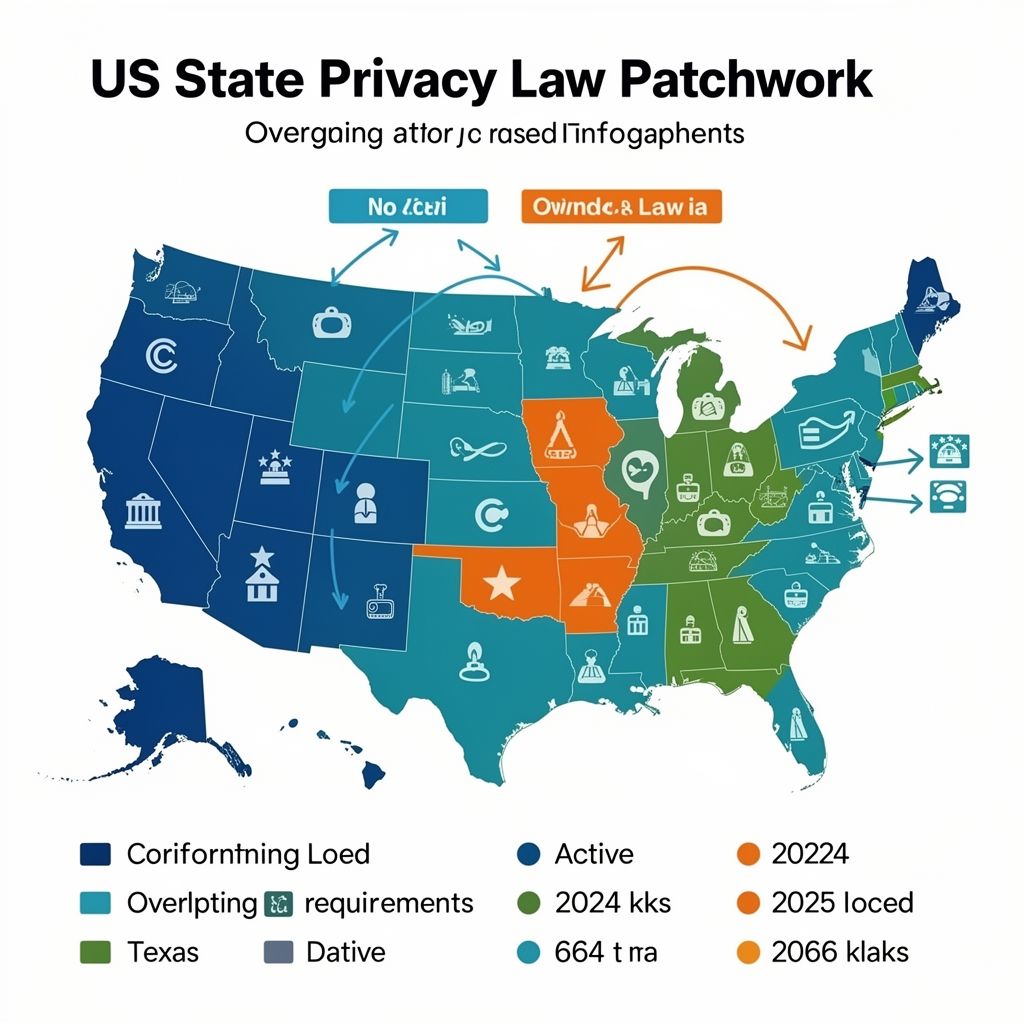
The real action is at the state level. As of mid-2024, 18 states have enacted comprehensive privacy laws. The key ones to watch have enforcement dates through 2026: California (CCPA/CPRA, already active), Virginia (VCDPA), Colorado (CPA), Connecticut (CTDPA), Utah (UCPA), and newer, more aggressive laws in Texas (TCDPA), Florida (FDPA), and Oregon (effective July 2025). Each law has a unique threshold for applicability (e.g., processing data of 100,000 consumers vs. 50,000, with or without revenue from data sales), slightly different consumer rights, and distinct opt-out mechanisms for targeted advertising and data sales.
The compliance cost of ignoring this is concrete. A single CCPA violation can cost $2,500 per non-intentional incident or $7,500 per intentional one. For a mid-sized company with 10,000 affected records, that’s a $25 million exposure before any private right of action for data breaches is considered. The strategy isn’t to memorize every law; it’s to build a foundational program that can satisfy the strictest common denominator and be tuned as needed.
US Privacy Laws vs. GDPR: The Critical Nuances Most Analysts Miss
If you’ve handled GDPR compliance, you have a head start, but assuming they’re the same is a costly mistake. The core philosophical difference is opt-in vs. opt-out. GDPR is built on a foundation of explicit, informed consent (opt-in) for most processing. The US state law model is largely an opt-out regime for certain activities like targeted advertising and data sales. You can process personal data for a "business purpose" without prior consent, but you must provide clear notice and a way for consumers to opt out.
Another major difference is in scope and definitions. GDPR’s "personal data" is famously broad, covering any identifiable information. Many US laws, however, carve out large categories. Employee data, B2B contact information, and publicly available information are often excluded from core consumer rights. The definition of a "sale" is also broader in California, encompassing any sharing of data for "valuable consideration," which can catch standard ad-tech partnerships.
Here’s a practical comparison of how these differences impact your operations:
| Compliance Aspect | GDPR (EU/UK) | US State Laws (CA, CO, VA, etc.) | Actionable Implication |
|---|---|---|---|
| Legal Basis | Requires one of six legal bases (consent, contract, etc.). Consent must be explicit, opt-in. | Primarily an opt-out regime for sales/targeting. Notice and choice are key. | Your consent management platform (CMP) must support both opt-in banners for EU traffic and universal opt-out signals (like GPC) for US. |
| Data Subject Rights | Broad rights: access, rectification, erasure, portability, restriction, objection. | Similar rights, but often exclude B2B/employee data. Deletion requests may have more exceptions. | Build your DSAR workflow to first verify requestor jurisdiction, then apply the appropriate rights scope. Don't over-delete for a US request. |
| Data Protection Officer | Mandatory for certain processing activities. | Not generally mandated, but some laws require designating a point of contact. | If you have a DPO for GDPR, extend their remit. If not, appoint a US Privacy Lead accountable for the state law program. |
| Risk Assessments | Data Protection Impact Assessments (DPIAs) required for high-risk processing. | Data Protection Assessments (DPAs) required for certain high-risk activities (e.g., profiling, sensitive data) in CO, VA, CT. | Conduct a unified assessment that meets the strictest requirements (usually GDPR's DPIA). Document it thoroughly for all regulators. |
The adequacy decision for the EU-US Data Privacy Framework is crucial here. If you’re relying on it for transatlantic data transfers, you must also certify your compliance with the DPF Principles, which adds another layer onto your US state law program. In practice, we build programs to meet the higher bar, which typically satisfies the lower one.
Phase 1: The Foundational 2026 Risk & Data Audit (Months 1-3)
You cannot comply with laws you cannot map. The first, non-negotiable phase is a deep data and process audit. Most companies fail here by doing a surface-level inventory or outsourcing it to a law firm without engineering involvement. You need to answer three questions: What data do we have? Where does it flow? And under what legal 'hooks' do we process it?
Start by cataloging all data systems: CRM (Salesforce, HubSpot), marketing platforms (Mailchimp, Meta), analytics (Google Analytics 4), internal databases, and third-party vendors. For each, document: (1) Data Categories (names, emails, browsing history, inference data), (2) Purpose of Processing (marketing, fraud prevention, service delivery), (3) Jurisdiction of Data Subjects, (4) Retention Period, and (5) Third-Party Sharing. A $10M-revenue SaaS company typically has 80-120 distinct data processing activities to map.
The critical output is a Record of Processing Activities (ROPA). This isn't just a spreadsheet for lawyers; it’s a living document for your engineering and product teams. Use it to identify your highest-risk areas: places where you process sensitive data (health, precise geolocation, SSN), engage in profiling that could have legal effects, or share data with a long chain of vendors. This audit directly informs your compliance budget. The areas consuming 80% of your risk get 80% of your initial resources.
Common Audit Mistake: The 'One-Time Snapshot'
The biggest failure is treating the audit as a project with an end date. Data flows change monthly—new vendors, new product features, new marketing tools. Your ROPA must be integrated into your development lifecycle. We mandate that any new tool onboarding or significant feature launch requires a privacy impact form that updates the ROPA. This turns compliance from a reactive cost center into a proactive product requirement.

Phase 2: Building Your Core Compliance Framework (Months 4-9)
With your data map, you now build the policies and controls that turn principle into practice. This is where you operationalize the legal obligations.
1. Privacy Policy & Notices: Rewrite your privacy policy to be specific, not generic. List the categories of personal information you collect, by source and purpose. Detail the categories of third parties you share with. Crucially, for California, Colorado, and other states, you must disclose the length of time you retain each category of data—or the criteria used to determine that period. Vague statements like "we retain data as long as necessary" are now non-compliant.
2. Consumer Rights Fulfillment Workflow: You are legally required to respond to access, deletion, correction, and opt-out requests within 45 days (with a possible 45-day extension). Build a dedicated, secure portal for request submission and verification. The hardest technical challenge is data deletion across distributed systems (data warehouses, backup tapes, analytics platforms). Implement a system of "soft deletes" and data pseudonymization in your core application, and maintain a suppression list for marketing platforms. Expect 1-2 hours of engineering time per system to build proper deletion hooks.
3. Vendor Management & Data Processing Agreements (DPAs): You are liable for your vendors' handling of data. You need a signed DPA with every service provider that processes personal data. Use a tool like Legal Monster or OneTrust to streamline this. More importantly, maintain a vendor risk tier list. A vendor processing sensitive data gets an annual security review; a vendor that only sees pseudonymized analytics data might get a lighter touch.
4. Universal Opt-Out Mechanism: Colorado and California require you to honor universal opt-out signals like the Global Privacy Control (GPC) by 2024/2025. This means your website must detect the GPC browser signal and automatically opt that user out of data sales/sharing and targeted advertising. Implementing this requires front-end JavaScript to read the signal and backend logic to persist the preference. Test it with the GPC browser extension.
The 2026 Compliance Playbook: A 5-Phase Actionable Framework
Based on implementing this for over 30 companies, here is the condensed playbook. Treat this as your master project plan.
- Phase 1: Discovery & Scoping (Months 1-3). Conduct the data audit (ROPA). Determine which state laws apply based on customer count, revenue, and data processing. Formalize your cross-functional team (Legal, Engineering, Product, Security).
- Phase 2: Policy & Control Foundation (Months 4-9). Update privacy notices, implement DSAR portal, establish vendor DPA process, draft internal data governance policies, and implement opt-out mechanisms (including GPC).
- Phase 3: Engineering & Integration (Months 10-15). This is the heaviest lift. Engineer data deletion workflows across all systems. Implement consent and preference management at all data collection points. Integrate privacy checks into your CI/CD pipeline. Conduct required Data Protection Assessments for high-risk processing.
- Phase 4: Testing & Documentation (Months 16-21). Conduct end-to-end testing of DSAR workflows. Perform a mock regulatory audit. Document all compliance efforts—not just policies, but evidence of implementation (screenshots, logs, training records).
- Phase 5: Monitoring & Adaptation (Months 22+). Establish ongoing monitoring: monthly reviews of new vendors, quarterly ROPA updates, annual employee training, and a legal watch for new state laws. This phase never ends.
Practical Implementation: Budgets, Tools, and Timelines by Team Size
Your approach depends heavily on resources. Here’s what’s realistic.
Bootstrapped Startup (Team: 1-10, Budget: $0-$5k/year):
Timeline: 12-18 months to core compliance.
Strategy: Manual, high-leverage tools. Use free tiers. Start with a meticulous data map in Airtable or Notion. Use Termly or Iubenda for a compliant privacy policy generator ($10-$30/month). Handle DSARs manually via a dedicated email and a checklist. Use standard contractual clauses (SCCs) from the IAPP for vendor DPAs. Prioritize: 1. Accurate privacy policy, 2. Functional opt-out (Do Not Sell/Share link), 3. Manual DSAR process. Defer: Full GPC integration, automated deletion across backups.
Growth-Stage Company (Team: 50-200, Budget: $25k-$75k/year):
Timeline: 18-24 months to robust, automated compliance.
Strategy: Invest in dedicated software. A platform like OneTrust, TrustArc, or Osano ($15k-$40k/year) becomes worth it to manage consent, DSARs, vendor risk, and assessments in one place. You need 0.5 FTE (a compliance manager) to run the program. Budget for 4-6 weeks of engineering time to build API integrations for data subject rights. This is also the tier where you should conduct your first formal Data Protection Assessment for any AI/ML profiling.
Enterprise (Team: 500+, Budget: $150k+):
Timeline: A mature, ongoing program.
Strategy: Dedicated privacy team (Head of Privacy, plus analysts). Enterprise GRC platforms (OneTrust, LogicGate). Full integration with IT service management (ServiceNow) for DSAR ticketing and with data lakes for automated discovery and classification. Continuous monitoring and annual third-party audits. At this level, you're not just complying; you're using privacy as a competitive differentiator and building trust.
What Most Guides Get Wrong: 4 Costly Compliance Pitfalls
After reviewing dozens of failed compliance projects, these are the recurring, expensive mistakes.
1. Over-indexing on Consent Banners for the US. Deploying a massive, GDPR-style consent pop-up for US visitors is unnecessary and hurts conversion. US laws are primarily about notice and opt-out. The correct implementation is a more subtle "Do Not Sell or Share My Personal Information" link and respect for GPC. Using the wrong tool damages user experience for no compliance benefit.
2. Treating Employee Data as a Non-Issue. While most US state laws exempt employee data from consumer rights, several (like California's CPRA) have brought it back in for 2023. Furthermore, the FTC and state labor laws still regulate employee privacy. You must have a separate, clear employee privacy notice and secure handling of HR data. Don't ignore this category.
3. Assuming 'No Revenue from Data Sales' Means You're Exempt. This is a dangerous misinterpretation. The threshold for laws like Colorado and Connecticut is often based on controlling/processing data of a certain number of consumers (e.g., 100,000), OR deriving revenue from the sale of data. If you meet the consumer count threshold, you are regulated, full stop. Even if you never sell data.
4. Neglecting the Incident Response Plan Linkage. Privacy compliance and security incident response are two sides of the same coin. Most state laws have breach notification statutes with specific triggers and timelines (e.g., 72 hours in Florida). Your incident response plan must include a clear playbook for when a breach triggers privacy law notifications. Who determines the number of affected residents per state? Who drafts the regulator notices? This must be predefined.
Your 2026 Data Privacy Compliance Checklist
Copy this. Use it as your quarterly review.
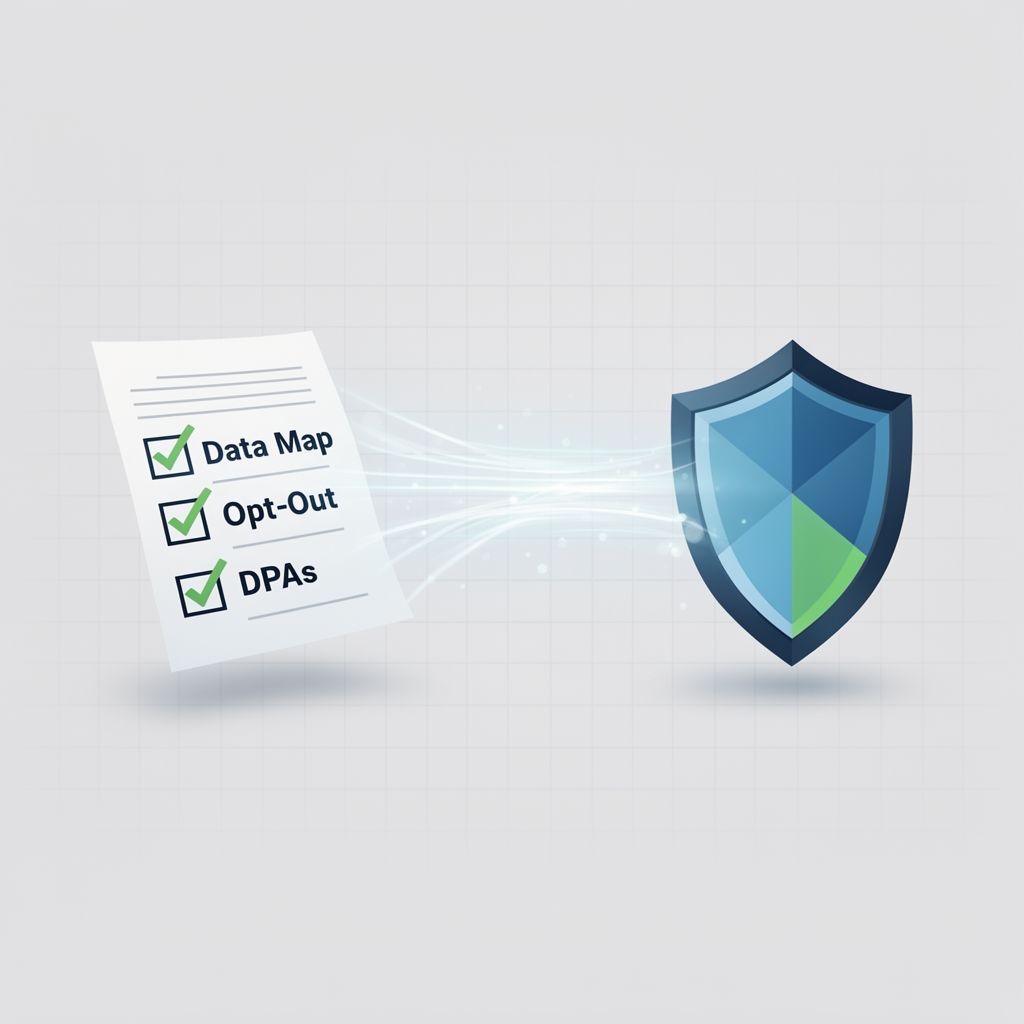
- Governance: Appointed a responsible privacy lead? Documented data flows (ROPA)? Conducted applicable Data Protection Assessments?
- Notices: Privacy policy discloses categories of data, purposes, retention periods, and third parties? Separate notice at point of collection?
- Consumer Rights: Live DSAR request mechanism (webform/email)? Process to verify requestors? Ability to fulfill access, deletion, correction, and opt-out within 45 days? Tested quarterly?
- Opt-Outs: "Do Not Sell/Share" link prominently displayed on website? Functioning universal opt-out (GPC) recognition implemented? Opt-out preference signal honored for at least 12 months?
- Vendors: DPAs in place with all processors? Vendor risk assessment process for new tools? List of sub-processors available to consumers?
- Data Security: Reasonable security practices documented and implemented? Incident response plan updated with state law notification requirements?
- Training & Monitoring: Annual employee privacy training conducted? Process to monitor for new state laws and update compliance program?
Frequently Asked Questions
Does the GDPR apply to my US-based business?
Yes, if you offer goods or services to, or monitor the behavior of, individuals in the European Union. It doesn't matter where your company is physically located. If you have a .com website with EU visitors and use cookies to track them for analytics or advertising, you are likely subject to the GDPR. The key thresholds are targeting and monitoring. The fines (up to 4% of global revenue) are severe, so you must determine applicability through a proper assessment, not guesswork.
What's the single most important thing to do before 2026?
Execute a thorough data mapping exercise (your Record of Processing Activities). You cannot build controls, write accurate policies, or respond to regulator inquiries if you don't know what data you have, where it lives, and why you process it. This foundational step informs every subsequent investment of time and money. Start this tomorrow—even if it's in a simple spreadsheet. Everything else depends on it.
How do I handle conflicting requirements between different state laws?
You build your program to satisfy the strictest requirement among the laws that apply to you. This is the "highest common denominator" strategy. For example, Colorado requires a Data Protection Assessment for profiling that presents a significant risk; California does not. If you are subject to both laws, you conduct the assessment. For consumer rights, configure your DSAR workflow to apply the broadest set of rights (usually California's) to be safe, unless you can reliably geolocate and apply different rules per requestor—which is complex and risky.
What are 'reasonable security practices' under these laws?
Most laws define this flexibly, but they often reference established frameworks. In practice, regulators and courts look to the NIST Cybersecurity Framework, ISO 27001, or CIS Critical Security Controls. For a small business, "reasonable" might be basic measures: strong password policies, multi-factor authentication on critical systems, regular software updates, and employee security training. For a larger company holding sensitive data, it would include formal risk assessments, encryption, intrusion detection, and incident response testing. Document your security program; the absence of documentation is often seen as the absence of a program.
Do I need to register as a data broker?
Laws in Vermont, California, Oregon, and Texas require data brokers—businesses that collect and sell personal data they did not collect directly from consumers—to register annually. Fees range from $100 to $400. If your core business model involves aggregating and licensing consumer data from third parties (e.g., a marketing intelligence firm), you almost certainly need to register. If you're a typical B2B SaaS or e-commerce company selling your own products, you likely do not. The definition is specific; review it carefully to avoid unnecessary registration or penalties for non-registration.
What's the real cost of non-compliance?
It's multi-faceted. Direct fines ($2,500-$7,500 per violation, uncapped). Civil lawsuits (California's private right of action for data breaches). Remediation costs (forensics, credit monitoring, legal fees). The biggest cost is often reputational: loss of customer trust, negative press, and becoming a target for more regulatory scrutiny. For a single mid-level data incident affecting 10,000 records, total costs can easily exceed $500,000 when all factors are considered. Proactive compliance is a fraction of that.
Can I use my GDPR compliance program for the US?
You can use it as a strong foundation, but you cannot simply copy it. GDPR is stricter in areas like legal basis and consent, but US laws have unique requirements around opt-out mechanisms, specific disclosures (like retention periods), and exceptions for B2B data. Your existing governance structure, data maps, and vendor processes are 60-70% transferable. You'll need to layer on US-specific notices, the GPC signal handling, and adjust your DSAR response logic for the different rights scopes. Don't start from scratch, but plan for a significant adaptation project.
How do I prepare for new laws that haven't been written yet?
You build for flexibility. Focus on core principles that are consistent across all current laws: data minimization, purpose limitation, security, transparency, and consumer choice. Implement systems that are configurable, like a consent management platform that can add new opt-out purposes with a checkbox, or a DSAR portal that can accommodate new rights with workflow adjustments. Stay informed by subscribing to updates from the International Association of Privacy Professionals (IAPP). Build a 6-month review cycle into your program to assess new laws and adapt.
Your Next Step: Start the Map
The path to 2026 compliance is long, but the first step is simple and must be taken today. Block two hours on your calendar this week. Gather your product, engineering, and marketing leads. Open a shared document and start listing every single place you collect personal data—sign-up forms, analytics tools, payment processors, CRM entries. Write down what you collect and where it's sent. This rudimentary start is your data map. It will reveal gaps, surprise you with complexity, and immediately highlight your highest-risk data flows. From that clarity, the rest of this roadmap becomes an executable project, not an abstract worry. For a deeper dive on managing complex regulations like the EU AI Act, see our detailed SaaS compliance roadmap. If you're a smaller business feeling overwhelmed, our 5-phase survival plan for small business compliance breaks it down into manageable steps.
Boomlify Team