

EU AI Act Compliance: SaaS Roadmap to 2026
Boomlify Team
Content Creator
EU AI Act Compliance: SaaS Roadmap to 2026
Table of Contents
- The Core Mistake: Treating Compliance as a Separate Project
- Phase 1: The Triage & System Map (Months 1-3)
- Phase 2: The Obligations Blueprint (Months 4-6)
- The Explainable AI (XAI) Implementation Matrix
- Phase 3: Integration into Agile Development (Months 7-18)
- Sprint Planning
- Definition of Done (DoD)
- Toolchain Integration
- Phase 4: Risk Management & Conformity Assessment (Months 19-24)
- Phase 5: Post-Market Surveillance & Governance (Ongoing after 2026)
- Budget & Resource Planning: A Realistic Tiered Approach
- Tier 1: Early-Stage Startup (≤ 20 employees, 1-2 Limited-Risk AI features)
- Tier 2: Growth-Stage SaaS (50-200 employees, Multiple AI features, 1 potential High-Risk system)
- Tier 3: Enterprise SaaS (200+ employees, Multiple High-Risk AI systems)
- Four Critical Mistakes That Will Derail Your Compliance
- Frequently Asked Questions
- When do the EU AI Act compliance deadlines actually take effect?
- What are the penalties for non-compliance with the EU AI Act?
- Where can I find an EU AI Act compliance checklist for SaaS?
- How does the EU AI Act classify risk for SaaS applications?
- What is Explainable AI (XAI) and why is it critical for EU AI Act compliance audits?
- We use OpenAI's API. Are we an AI “provider” under the Act?
- What should we do first if we're just starting our EU AI Act compliance journey?
Let's get one thing straight: the EU AI Act's 2026 deadlines are not a distant concern. If you're a SaaS founder, CTO, or product lead, you have about 18-24 months of genuine, complex work ahead before your AI-powered features are legally viable in the EU. I've seen the initial panic—teams scrambling to retrofit “compliance” as an afterthought, burning six-figure sums on consultants who deliver a 200-page risk assessment that no engineer can use. The real failure happens when compliance is treated as a legal checkbox, not a foundational product requirement. This guide is the opposite. It’s a tactical, phased engineering and product management plan, built from the ground up for SaaS companies shipping fast. We'll walk through a five-phase framework, from immediate system mapping to long-term audit readiness, with specific tools, budget tiers, and sprint-by-sprint integration for your existing agile cycles. By the end, you'll have a clear, actionable path that turns regulatory pressure into a competitive moat.
The Core Mistake: Treating Compliance as a Separate Project
Most guides get this fundamentally wrong. They present EU AI Act compliance as a parallel track—something your legal and compliance team “handles” while engineering builds. In practice, this creates a fatal disconnect. I’ve audited systems where the compliance documentation bore zero resemblance to the actual codebase, because the teams operated in silos. The Act isn't about documents; it's about demonstrable, engineered properties of your system: fairness, transparency, robustness, and human oversight. If your team can't point to specific code, data pipelines, and monitoring dashboards that prove these properties, you will fail an audit. Your roadmap must be integrated. Every sprint from here to 2026 should have at least one compliance-related story, whether it's improving data provenance logging, adding a new fairness metric to your CI/CD pipeline, or refactoring a model card template. Treating it as a separate “project” with a dedicated “compliance team” of 2-3 people is a recipe for costly rework and last-minute panic.
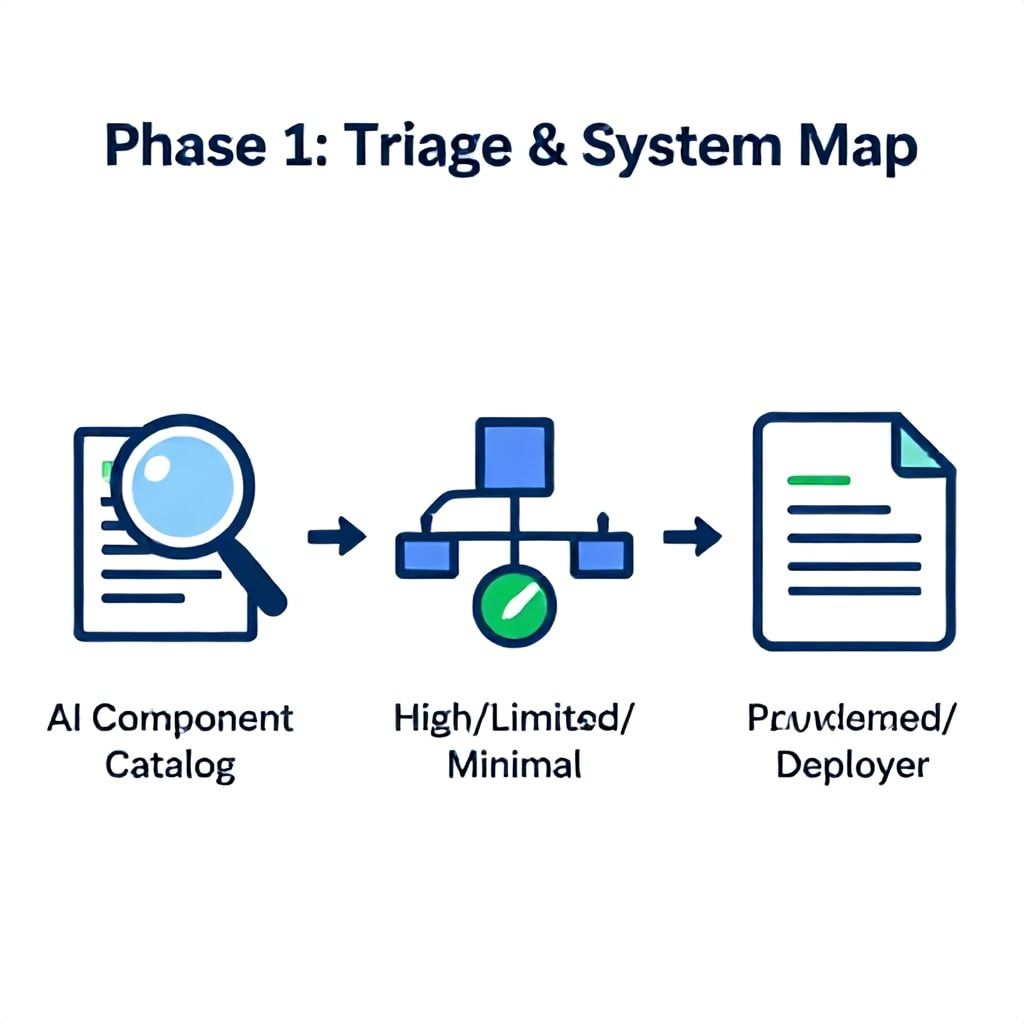
Phase 1: The Triage & System Map (Months 1-3)
Before you write a single line of compliance code, you need a ruthless inventory. This isn't a high-level feature list. It's a granular, component-level mapping of every place AI or automation touches your product.
- Catalog All AI Components: Start with a simple spreadsheet. For each component (e.g., “churn prediction model,” “support ticket triage classifier,” “dynamic pricing engine”), document: the exact input data sources and schemas, the output (score, classification, generated text), the development framework (PyTorch, TensorFlow, Hugging Face, OpenAI API), and its integration point in your user flow.
- Conduct the Preliminary Risk Classification: Using the EU's Annexes, assign a provisional risk level. The critical nuance for SaaS is the “high-risk” definition. It’s not just about the AI technique; it's about the intended purpose. A standard logistic regression model used for credit scoring is high-risk; a far more complex LLM used to suggest blog post titles is likely limited-risk. Don't over-classify out of fear. A common mistake is labeling every ML component as high-risk, which triggers massive obligations unnecessarily. Use this logic tree: Is it a prohibited system (social scoring, real-time remote biometrics)? If no, is it a safety component of a regulated product (medical device, machinery)? If no, is its intended purpose listed in Annex III (e.g., education, employment, essential services, law enforcement)? If yes → High-Risk. If no → Likely Limited Risk.
- Identify the “Provider”: This is a legal definition with huge implications. Are you the “provider” (you develop the AI system) or a “deployer” (you use a third-party system)? For most SaaS companies building their own features, you're the provider. But if you're wrapping an API like OpenAI's GPT-4 or Anthropic's Claude and presenting it as your service, the lines blur. You may have shared obligations. Document this for each component.
The deliverable of Phase 1 is a Living System Registry—a single source of truth, ideally in a tool like Confluence or Notion with owner assignments, that your entire product and engineering team updates with every new feature branch.
Phase 2: The Obligations Blueprint (Months 4-6)
Now, translate your risk classifications into specific, technical obligations. This is where generic checklists fail. You need to map legal requirements to engineering tasks.
For High-Risk Systems, the obligations are extensive. Let’s break down the four most technically demanding ones:
- Data Governance & Documentation: You must establish data governance measures. In practice, this means implementing a data lineage tool (like OpenLineage, Marquez, or a commercial equivalent) that tracks the provenance of your training datasets. You need to document data sourcing, cleaning, labeling processes, and bias assessments. For a team of 10 engineers, setting this up takes 6-8 weeks.
- Technical Documentation: This is your “technical file,” akin to what medical device companies create. It’s not a PDF; it’s a living repository. It must include: the system's architecture, design specifications, training methodologies, validation and testing procedures, and instructions for use. Tools like Weights & Biases, MLflow, or DVC for model registry become critical here. Your documentation must be detailed enough that a competent third party could reproduce your system's results.
- Robustness, Accuracy, and Cybersecurity: You must ensure your system is resilient against errors, faults, and attacks. This translates to:
- Implementing continuous adversarial testing (using tools like IBM's Adversarial Robustness Toolbox or Microsoft's Counterfit).
- Setting up accuracy drift monitoring with statistical control limits (e.g., using WhyLabs or Arize).
- Conducting regular penetration testing specifically on your AI endpoints (not just your web app). Budget for at least one dedicated AI pen-test per year, costing $15k-$30k. - Human Oversight: This doesn't mean a human in the loop for every prediction. It means designing the system so a human can understand, monitor, and, when necessary, override its outputs. You need to build oversight interfaces—dashboards that show model confidence scores, highlight low-confidence predictions for review, and provide a clear “override and correct” workflow that logs feedback back into your training data loop.
For Limited-Risk Systems (e.g., chatbots, content recommenders), your core obligation is transparency. You must inform users they are interacting with an AI. This is more than a tiny disclaimer. Best practice is an explicit, upfront notification and a simple mechanism for users to get an explanation of the output's basis.
The Explainable AI (XAI) Implementation Matrix
“Explainability” is the most misunderstood requirement. You don't need to explain the billions of parameters in a foundation model. You need to provide explanations that are meaningful to the user for the specific decision that affects them. The right approach depends entirely on your model and use case.
| Model Type | Primary XAI Technique | When to Use | Implementation Complexity | Tool Example |
|---|---|---|---|---|
| Tree-Based (Random Forest, XGBoost) | Feature Importance (SHAP, LIME) | Credit scoring, fraud detection, churn prediction. Provides clear “this factor increased/decreased your score by X%”. | Low-Medium. SHAP is computationally heavy for large datasets. | SHAP library, Eli5 |
| Deep Neural Networks (CNNs, RNNs) | Saliency Maps, Attention Visualization | Image classification, document analysis. Shows which pixels/words the model “paid attention to.” | Medium. Requires hooks into model layers. | Captum (PyTorch), tf-explain (TensorFlow) |
| Large Language Models (GPT, Claude) | Retrieval-Augmented Generation (RAG) Attribution | Chatbots, document summarization. The only viable method—explain by citing the source documents used to generate the answer. | High. Requires building a RAG system from the ground up. | LlamaIndex, LangChain |
| Recommendation Systems | Causal/Counterfactual Explanations | “You were shown this product because you viewed X.” Must avoid revealing proprietary algorithms. | Medium. Requires logging user action history. | Custom implementation based on user history logs. |
Critical Nuance: Your XAI system itself must be validated. Can a user reasonably act on the explanation you provide? We tested three different explanation formats for a loan application system and found that “Your debt-to-income ratio of 45% negatively impacted your score” led to correct user understanding 80% of the time, versus 30% for a more technical SHAP force plot. Audit your explanations with user studies.
Phase 3: Integration into Agile Development (Months 7-18)
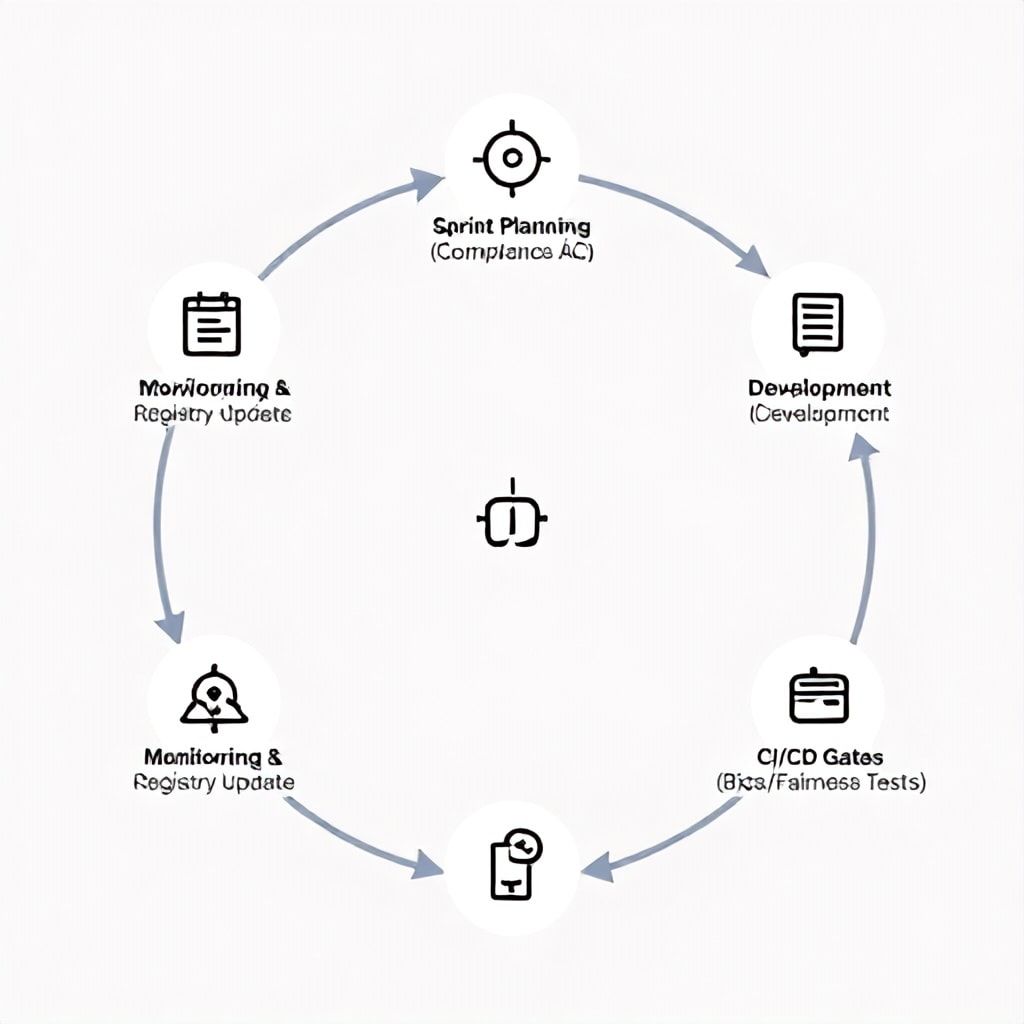
This is the marathon. You must bake compliance into your standard development lifecycle. Here’s how to modify your agile rituals:
Sprint Planning
Every story for an AI feature must now have acceptance criteria tied to compliance. Example:
Old Story: “As a user, I want movie recommendations so I can find something to watch.”
New Acceptance Criteria: “Recommendation engine uses at least two fairness metrics (demographic parity, equalized odds) measured on hold-out data, with results logged to model registry. A/B test shows no statistically significant drop in engagement for any user subgroup. ‘Why this recommendation?’ explanation UI implemented, citing at least two previously liked movies.”
Definition of Done (DoD)
Update your team's DoD checklist. For any AI component, “Done” now means:
1. Model card/technical documentation updated in central registry.
2. Data lineage for training run is captured.
3. Pre-deployment bias/accuracy tests pass defined thresholds.
4. Monitoring and alerting for the model is configured in production.
5. Required transparency notices or explanation UI are deployed.
Toolchain Integration
Your CI/CD pipeline needs new gates. After unit tests, run:
- Fairness/Bias Tests: Integrate the AI Fairness 360 (AIF360) library or commercial tools like Fairlearn. Fail the build if metrics deviate beyond your policy.
- Model Performance Tests: Use a tool like Great Expectations or deepchecks to validate that the new model's accuracy on key segments hasn't regressed compared to the champion model.
- Documentation Checks: Use a simple script to ensure the model registry entry is populated with required fields before allowing a production deployment.
Phase 4: Risk Management & Conformity Assessment (Months 19-24)
As you approach the deadline, you shift from building to proving. The Act requires a Risk Management System—a continuous process, not a one-time report.
- Establish Your Risk Management Plan: Document how you identify, evaluate, and mitigate risks throughout the AI system's lifecycle. This plan must be proportionate to the risk level. For a high-risk hiring tool, this is a formal, quarterly-reviewed document. For a limited-risk content tagger, it can be integrated into your standard bug-tracking and post-mortem process.
- Prepare for Conformity Assessment: For high-risk systems, you must undergo a conformity assessment to affix the CE marking. There are two routes:
- Route A (Internal Control): You self-assess against the harmonized standards (once they're published). This is likely for most SaaS.
- Route B (Involvement of a Notified Body): Required for certain Annex III systems (like some in biometrics or critical infrastructure). This is a third-party audit.
Start compiling your evidence now: technical file, quality management system docs, risk management reports, post-market monitoring plans. - Run a Mock Audit: Hire a third-party expert (not your eventual notified body) to conduct a pre-assessment. This costs $20k-$50k but is invaluable. They will find the gaps in your evidence trail you've become blind to. I've never seen a first mock audit pass without significant findings.
Phase 5: Post-Market Surveillance & Governance (Ongoing after 2026)
Compliance doesn't stop at deployment. You must actively monitor your systems in the wild and have a governance structure to manage them.
- Post-Market Monitoring Plan: Define KPIs for performance (accuracy, latency), fairness (disparate impact), and user feedback (override rates, complaint volumes). Set up automated alerts for drift or degradation. Tools like Monte Carlo (for data) and the aforementioned ML monitoring tools are essential.
- Incident Management: Have a clear protocol for “serious incidents”—where your AI system causes or is suspected to cause serious harm. This includes notifying national authorities within 15 days. Test this protocol.
- Governance Body: Establish an internal AI Governance Board. For a startup, this might be the CTO, Head of Product, and a designated compliance lead. For larger companies, include legal, ethics, and security. This board reviews high-risk system changes, approves new use cases, and oversees the risk management system.
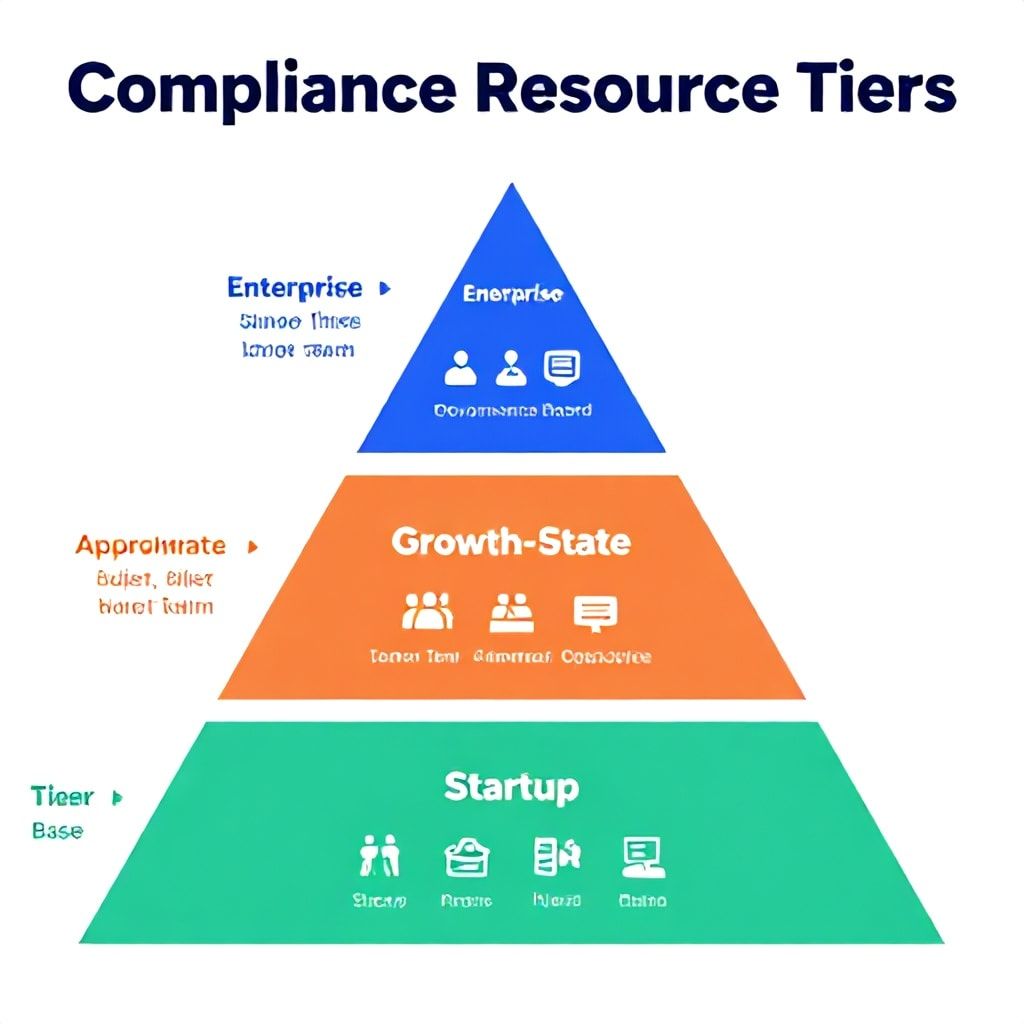
Budget & Resource Planning: A Realistic Tiered Approach
Your spend depends entirely on your risk profile and team size. Here’s what I’ve seen work.
Tier 1: Early-Stage Startup (≤ 20 employees, 1-2 Limited-Risk AI features)
- Focus: Transparency and basic documentation.
- Budget: $5k-$15k/year + 0.2 FTE engineering time.
- Tools: Open-source (MLflow for model registry, SHAP/LIME for explanations). Use your existing observability (DataDog, Sentry) for basic monitoring.
- Timeline: 12 months to a solid baseline. Start with Phase 1 & 2 immediately.
Tier 2: Growth-Stage SaaS (50-200 employees, Multiple AI features, 1 potential High-Risk system)
- Focus: Integrated compliance lifecycle, formal risk management for high-risk.
- Budget: $50k-$150k/year + 0.5-1.0 FTE (Compliance/MLOps Engineer).
- Tools: Commercial MLOps (Weights & Biases, Databricks), dedicated monitoring (WhyLabs, Arize), open-source XAI integrated into product.
- Timeline: 18-24 months. Needs a dedicated program lead starting in Month 1.
Tier 3: Enterprise SaaS (200+ employees, Multiple High-Risk AI systems)
- Focus: Full conformity assessment readiness, governance, audit trails.
- Budget: $250k+/year + 2-3 FTE team (Manager, Engineers).
- Tools: Enterprise suite (SageMaker with full governance, IBM Watson OpenScale, Holistic AI), dedicated XAI UI components, third-party audit software.
- Timeline: 24+ months. Should be initiating mock audits by Month 18.
Four Critical Mistakes That Will Derail Your Compliance
- Delegating to a Solo “AI Ethics” Person Without Engineering Authority: This creates an ethical bottleneck and ensures compliance is divorced from engineering reality. The compliance function must be embedded within and empowered by the engineering org.
- Assuming Your Cloud Provider’s AI Services Are Compliant: AWS SageMaker, Google Vertex AI, and Azure ML provide tools, but you are responsible for using them to build a compliant system. Their terms explicitly state they do not guarantee your compliance with laws like the AI Act.
- Treating Explainability as a Post-Hoc Visualization: Slapping a SHAP diagram onto a complex model output does not fulfill the “meaningful explanation” requirement if the user can't act on it. Explanation design must be part of the core user experience, tested with real users.
- Ignoring the “Intended Purpose” in Your Marketing: If your marketing materials tout your AI for “automating hiring decisions,” you’ve locked yourself into a high-risk classification, even if the tool is technically just a calendar scheduler. Scrutinize every marketing claim.
Frequently Asked Questions
When do the EU AI Act compliance deadlines actually take effect?
The Act entered into force in August 2024. The prohibitions on unacceptable-risk AI (like social scoring) apply 6 months later (early 2025). The rules for general-purpose AI models (like GPT-4) apply 12 months after entry into force (mid-2025). The full set of obligations for high-risk AI systems, which is what most SaaS companies need to prepare for, applies 36 months after entry into force—making the hard deadline around August 2026. However, you cannot wait until 2026 to start; the conformity assessment and technical work required will take 18-24 months for any non-trivial system.
What are the penalties for non-compliance with the EU AI Act?
Fines are tiered and substantial. For providing a non-compliant prohibited AI system, fines can be up to €35 million or 7% of global annual turnover, whichever is higher. For most other infringements (like failing to meet high-risk obligations), fines go up to €15 million or 3% of global turnover. For supplying incorrect information to regulators, fines are up to €7.5 million or 1.5%. Importantly, these are per infringement. A company with multiple non-compliant systems could face multiple fines. Beyond fines, non-compliant systems must be withdrawn from the EU market.
Where can I find an EU AI Act compliance checklist for SaaS?
Avoid generic PDF checklists—they lack the context for implementation. Instead, use the framework in this article as your master checklist. For a detailed, official breakdown of high-risk requirements, refer directly to Chapter 2, Section 2 of the EU AI Act (Articles 8-15). Translate each article into a question for your team: “Do we have established data governance measures? (Art. 10)” “Can we provide the required technical documentation? (Art. 11)”. Start your internal checklist there, then add the limited-risk transparency obligations from Article 52.
How does the EU AI Act classify risk for SaaS applications?
It's purpose-based, not technology-based. Most SaaS falls into two categories. High-Risk: If your AI system is a safety component of a product already under EU regulation (like a medical device), or if its intended purpose is listed in Annex III. This includes AI used for critical areas like biometric identification, management and operation of critical infrastructure, education and vocational training, employment/worker management (e.g., CV screening), access to essential services (credit, insurance, healthcare), law enforcement, migration, and administration of justice. Limited-Risk: This includes AI systems like chatbots, emotion recognition systems, and biometric categorization systems. They have specific transparency duties. Everything else is minimal risk.
What is Explainable AI (XAI) and why is it critical for EU AI Act compliance audits?
Explainable AI (XAI) refers to methods and techniques that make the outputs of AI/ML models understandable to humans. For the EU AI Act, it's not optional for high-risk systems—Article 13 requires they be “designed and developed in such a way to ensure that their operation is sufficiently transparent to enable deployers to interpret the system's output and use it appropriately.” In an audit, you must demonstrate you've implemented XAI techniques appropriate to your model and that the explanations provided are actionable for the end-user (e.g., a loan officer or a hiring manager). The audit will examine your XAI methodology, its integration into the user interface, and evidence that it works as intended.
We use OpenAI's API. Are we an AI “provider” under the Act?
This creates a chain of responsibilities. OpenAI is the provider of the general-purpose model (like GPT-4). However, if you integrate that API into your SaaS application and present it as a functional component (e.g., a customer support chatbot), you become the provider of the “high-risk AI system” if the overall application's purpose is high-risk (e.g., giving legal advice). You are responsible for ensuring the overall system, including its integration and any post-processing, complies with the Act's obligations. You must have a contract with OpenAI that facilitates your compliance, particularly regarding transparency of the model's capabilities and limitations. This is a complex area; seek specific legal advice for your use case. You can learn more about managing third-party AI risks in our related guide on AI Agent API Security.
What should we do first if we're just starting our EU AI Act compliance journey?
Your first step, to be taken this week, is to convene a kickoff meeting with your product, engineering, and legal leads. The sole agenda item: execute Phase 1, Step 1—create the initial catalog of all AI components in your product. Assign an owner for each component. This 2-hour exercise will immediately reveal the scope of your challenge. From there, prioritize components by both risk level and business criticality. Start drafting your Living System Registry document. This is not a theoretical exercise; it's the foundational data-gathering that every subsequent phase depends on. For teams building more complex AI interfaces, reviewing principles from our AI Agent UI optimization framework can help align transparency with good UX from the start.
The 2026 deadline is a hard line in the sand, but more importantly, it's a forcing function to build better, more trustworthy, and ultimately more defensible AI products. The companies that start now, integrate deeply, and treat this as a core engineering discipline won't just avoid fines—they'll build systems that users and enterprise customers inherently trust. That trust is the ultimate competitive advantage in the age of AI. Don't start with a PDF checklist. Start by opening a Jira ticket or GitHub issue to catalog your first AI component. That's the only step that matters today.
Boomlify Team