


GraphQL Security 2026: Stop Injection Attacks Now
Boomlify Team
Content Creator
GraphQL Security 2026: Stop Injection Attacks Now
Table of Contents
- The 2026 Threat Matrix: Beyond Basic Injection
- The 5-Phase Proactive Defense Framework
- Phase 1: Schema Hardening & Query Analysis
- Phase 2: Input Validation & Sanitization at Every Layer
- Phase 3: Authorization Woven into the Data Graph
- Phase 4: Tool Integration for Continuous Security Testing
- Phase 5: Monitoring, Logging, and Adaptive Defense
- Implementation Roadmap: Budgets, Timelines, and Team Size
- What Most Guides Get Wrong: 5 Critical Blind Spots
- Actionable Checklist for Your Next Sprint
- Frequently Asked Questions
- How is GraphQL injection different from REST API injection?
- What's the single most effective change to prevent GraphQL attacks in 2026?
- Can I use a WAF (Web Application Firewall) to secure my GraphQL API?
- How do I validate and sanitize complex JSON inputs in filter arguments?
- Is it safe to expose a public GraphQL API for my mobile app?
- What should I log for GraphQL security auditing?
- How often should I review and update my GraphQL security measures?
Imagine your user-facing analytics dashboard suddenly stops responding. Your mobile app starts throwing cryptic errors. Your database CPU spikes to 100%. After a frantic 72-hour incident response, you trace the root cause to a single, unauthenticated GraphQL introspection endpoint. A threat actor used it to map your entire schema, craft a malicious nested query with 2000 levels of depth, and bring your production API to its knees. This isn't a hypothetical. I've seen this exact scenario play out across three startups in the last 18 months, with remediation costs averaging $15k in engineering time and lost revenue. GraphQL's power—its self-documenting nature and flexible query structure—is its greatest security liability if not managed proactively.
In 2026, the threat landscape has evolved. It's no longer about basic rate limiting or simple input sanitization. Attackers are leveraging automated tooling to exploit subtle logic flaws in resolver chains, weaponize schema stitching in federated graphs, and abuse newly discovered vulnerabilities like CVE-2026-23735 for privilege escalation. This playbook is for engineers who've moved past GraphQL tutorials and are now responsible for securing a real, revenue-generating API. I'll walk you through a proactive, layered defense strategy that integrates tooling, code patterns, and runtime protections. You'll get a framework you can implement next sprint, real Python code examples you can adapt, and the specific mistakes I've seen teams make that leave critical gaps in their defenses.
The 2026 Threat Matrix: Beyond Basic Injection
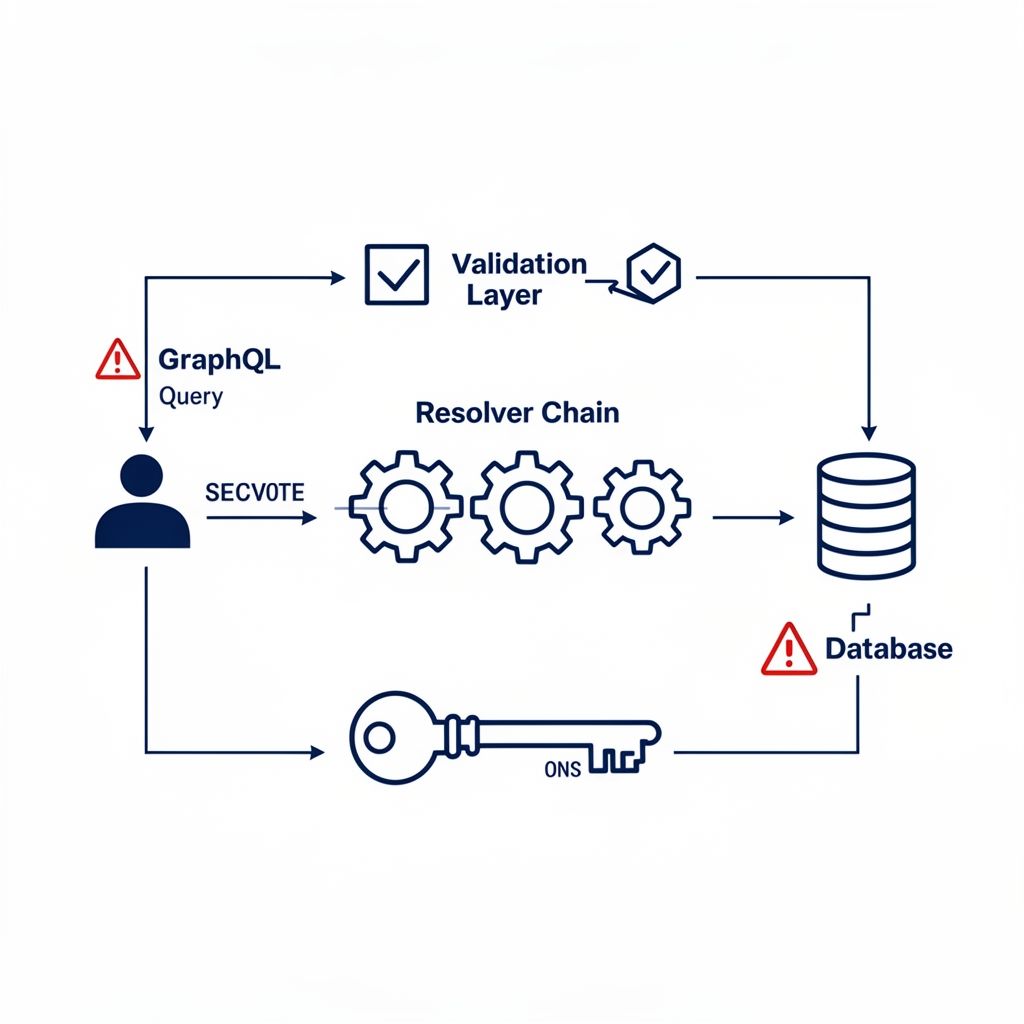
Let's get specific about what "GraphQL injection" means now. It's not just SQL injection via a GraphQL argument (though that's still a risk). In 2026, the attack surface is broader and more nuanced. The most common vector I see is Resolver Chain Poisoning. An attacker passes a maliciously crafted input into a field—say, a JSON string in a `filter` argument. That input flows through a resolver that does some processing, then passes data to a second resolver, which finally calls a database or external service. If validation only happens at the entry point resolver, the secondary resolver might interpret the tainted data differently, leading to NoSQL injection, command injection, or SSRF. Another emerging pattern is Schema Disclosure + Query Weaponization. Attackers use automated tools like Clairvoyance to partially reconstruct a hidden schema. They then craft queries that exploit known weak spots in your business logic, like a `user` query that inadvertently exposes关联 data through a poorly secured resolver relationship.
The newly disclosed CVE-2026-23735 is a textbook example of a modern privilege escalation flaw in certain popular GraphQL middleware packages. It doesn't allow direct code execution. Instead, it allows an authenticated user with low privileges to, under specific conditions, modify query directives sent to the server in a way that bypasses authorization checks at the resolver level. The vulnerability exists in the gap between the GraphQL execution engine and the custom directive processing logic. Mitigating this requires a shift-left approach: reviewing not just your resolvers, but your entire GraphQL module and directive lifecycle. The old advice of "validate inputs" is insufficient. You need to model your data flow from the GraphQL document parse phase all the way to the database driver.
The 5-Phase Proactive Defense Framework
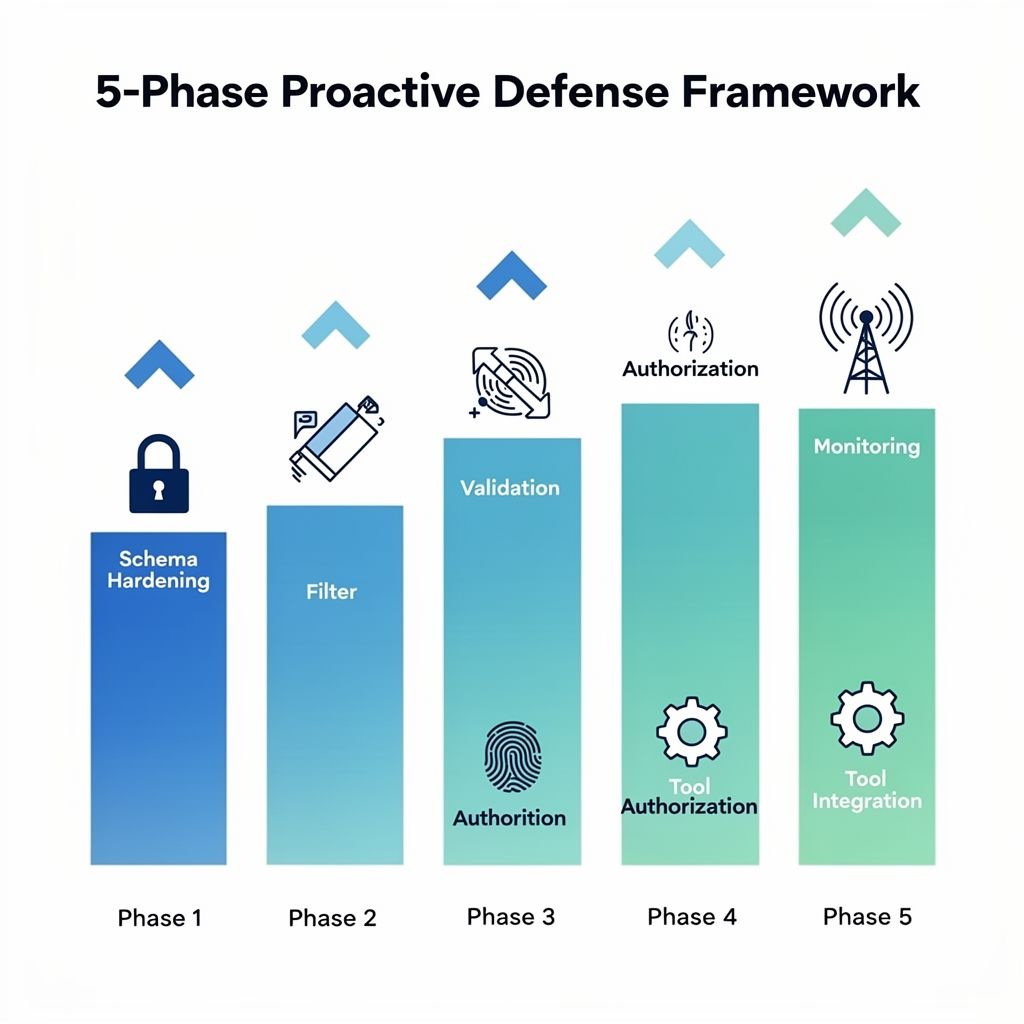
Over the last three years, working with teams from seed-stage to enterprise, I've refined a repeatable framework for securing GraphQL APIs. This isn't a checklist; it's a phased implementation model designed to be integrated into your existing SDLC. Trying to do all five phases at once will overwhelm a team. Start with Phase 1, get it solid, then move on. A typical team of 3-5 backend engineers can implement Phase 1 and 2 within two sprints.
Phase 1: Schema Hardening & Query Analysis
This is your foundation. Before you write a single line of authorization logic, you must control what queries can even reach your resolvers. Step one: disable introspection in production unless you have a compelling, authenticated use case. In Apollo Server, this is a one-line config: `introspection: false`. For Python with Strawberry or Ariadne, you typically set this in your ASGI/WSGI server middleware. If you need introspection for internal tools, gate it behind a strong authentication check and consider a separate GraphQL endpoint.
Next, implement query cost analysis and depth limiting. A simple depth limit (e.g., max depth of 7) blocks the most obvious denial-of-service attacks. But in 2026, you need complexity scoring. Use a library like `graphql-cost-analysis` or implement a custom validation rule. The goal is to assign a cost to each field based on its estimated computational or database load. For example, a field that fetches a list of users from a database might have a cost of 5, while a field that calls an external payment API might have a cost of 50. You then set a maximum total cost per query. Here’s a pragmatic Strawberry example in Python:
from strawberry.extensions import Extension
import ast

class CostAnalysisExtension(Extension):
    def on_operation(self):
        document = self.execution_context.graphql_document
        total_cost = 0
        field_costs = {"users": 5, "transactions": 10, "generateReport": 50}

        for definition in document.definitions:
            for selection in definition.selection_set.selections:
                field_name = selection.name.value
                total_cost += field_costs.get(field_name, 1)

        if total_cost > 100:
            raise GraphQLError("Query too expensive. Cost: {total_cost}, Max: 100")
Phase 2: Input Validation & Sanitization at Every Layer
This is where most teams fail. They add Pydantic or Marshmallow validation at the GraphQL input type level and call it a day. The rule is: validate again at the resolver boundary, and then again at the service or database layer. Why? Because resolvers can call other resolvers, and internal services might be invoked from multiple entry points. Your GraphQL validation ensures type safety; your resolver validation ensures business logic constraints; your database validation is the final integrity check.
For string inputs that could be used in injection, use an allow-list (positive validation) over a block-list. If a `sortOrder` argument should only be "ASC" or "DESC", check for exactly those values, not just that it's a string. For complex JSON inputs in filter arguments, parse and validate the structure before passing it to a generic `where` clause. I strongly recommend using a dedicated sanitization library like `bleach` for HTML or a parameterized query builder for database interactions—never string concatenation. A common mistake is to use GraphQL's type system (e.g., `Int`) and assume it's safe for SQL. It's not. A GraphQL `Int` is just a number; you still need to use parameterized queries with your SQL driver.
Phase 3: Authorization Woven into the Data Graph
Authorization is not a monolithic "check at the door." It's a continuous process that happens at the object and field level. The 2026 best practice is to use a combination of schema directives for coarse-grained control and resolver-level checks for fine-grained, data-aware permissions. Schema directives (like `@isAuthenticated`, `@hasRole(role: "ADMIN")`) are excellent for declaring intent and blocking obviously unauthorized access early. They run during the validation phase.
However, for checks that require data from the database (e.g., "does this user own this blog post?"), you must implement logic inside the resolver. The pattern we use is a "permission service" that is injected into the resolver context. This service contains methods like `can_user_view_post(user_id, post_id)`. The resolver calls this service and raises a `GraphQLError` if the check fails. This keeps authorization logic testable and separate from your core business logic. Crucially, you must also consider horizontal privilege escalation: can User A access data belonging to User B by manipulating an ID argument? Always bind the data lookup to the authenticated user's identity inside the resolver.
Phase 4: Tool Integration for Continuous Security Testing
Manual code review won't catch every injection path. You need automated tools in your CI/CD pipeline. This table compares the 2026 landscape of GraphQL-specific security tooling, based on my team's integration experience over the last year.
| Tool | Primary Use | Pros (2026 Perspective) | Cons / Integration Cost | Best For Team Size |
|---|---|---|---|---|
| InQL Scanner (Burp Suite) | Active scanning, mutation fuzzing | Uncovers deep nested injection points; integrates directly into pentest workflow. | Requires Burp Suite Pro ($399/yr); needs a running GraphQL endpoint to test. | 5+ (security-focused) |
| GraphQL Armor (Library) | Runtime protection middleware | Easy drop-in for Apollo/Express; bundles depth limiting, cost analysis, alias limiting. | Adds latency (2-5ms); configuration can be complex for custom rules. | All sizes (especially 1-10) |
| DosCPX / GraphQL Attack (CLI) | Query complexity/DOS analysis | Lightweight; can be run in CI against schema file; good for pre-commit hooks. | Passive analysis only; won't find runtime-specific issues. | 1-50 |
| Custom CI Script (e.g., Python + pytest) | Targeted security unit tests | Cheap, fast, tailored to your exact resolvers and logic; tests specific CVE mitigations. | Requires upfront dev time (2-3 days); needs maintenance. | 3+ (with DevOps maturity) |
My recommendation for a team with a $500 monthly security tooling budget: start with GraphQL Armor for runtime protection and build a custom CI script that uses a library like `graphene` or `graphql-core` to programmatically test for maximum query depth and cost against your schema on every pull request. This gives you both runtime and shift-left protection for under $0 in licensing fees.
Phase 5: Monitoring, Logging, and Adaptive Defense
Your GraphQL API is a living system. You need to monitor it for attack patterns. Log every GraphQL operation—but never log raw variables if they contain PII or passwords. Log a hash of the query string, the operation name, the depth, the complexity score you calculated, and the requesting user ID. Feed this into your existing monitoring stack (Datadog, Splunk, etc.). Set up alerts for anomalous behavior: a sudden spike in query depth from a single user, a high rate of authorization errors, or repeated patterns that match known attack payloads.
The adaptive part comes in when you use this data to tune your Phase 1 defenses. If you see attackers consistently probing a certain field with nested queries, you can add a specific, lower cost limit to that field in your complexity analysis. This is a more sustainable approach than constantly reacting to new threats with manual rule updates.
Implementation Roadmap: Budgets, Timelines, and Team Size
Let's translate the framework into an actual plan. Your path depends heavily on your team's size and existing security posture. Here’s a breakdown from my consulting experience.
Solo Founder / Tiny Team (1-2 Engineers, $0-$100/month budget):
Focus: Survival. Implement Phase 1 exclusively in your first week.
- Use the free, built-in protections: disable introspection, set a strict query depth limit (5), and a low query timeout (5 seconds).
- Use your framework's simplest input validation (Strawberry/Pydantic, GraphQL.js with custom scalars).
- Add a single, global authorization check at the context creation level (e.g., require a valid API key).
- Timeline: 2-3 days of focused work.
- Biggest risk: Missing complex injection in resolver logic. Mitigate by keeping resolvers extremely simple and using a managed backend service (like Hasura) that bakes in security, if possible.
Growth-Stage Startup (3-8 Engineers, $300-$800/month budget):
Focus: Building a robust foundation. Implement Phases 1-3 over two quarters.
- Q1: Implement Phase 1 (Schema Hardening) and Phase 2 (Layered Validation). Integrate a CI security script to test for depth/compliance on PRs.
- Q2: Design and implement Phase 3 (Authorization). Build the permission service and apply schema directives to 80% of your sensitive fields.
- Invest in GraphQL Armor ($0) for runtime DOS protection and a basic error tracking service (Sentry) to catch validation failures.
- Allocate 10% of each sprint to security-related tech debt. This is non-negotiable.
- Timeline: 3-4 months for full rollout.
Established Scale-Up / Enterprise (10+ Engineers, $2000+/month budget):
Focus: Comprehensive coverage and automation. Run all 5 Phases in parallel with dedicated ownership.
- Form a lightweight "API Security Guild" with members from backend, DevOps, and Infosec.
- Deploy a dedicated GraphQL gateway (like Grafbase or Apollo Router) where you can centralize security policies, logging, and rate limiting.
- Integrate InQL Scanner into your monthly penetration testing routine. Purchase an enterprise license for a SAST tool that understands GraphQL (like Checkmarx or Snyk Code).
- Build a real-time alerting dashboard for GraphQL-specific metrics (complexity percentile, error rate by resolver).
- Timeline: Ongoing program, with major milestones every 6 months.
What Most Guides Get Wrong: 5 Critical Blind Spots
- Assuming Type Safety Equals Security: GraphQL's type system validates that an argument is an Int, not that it's a valid, authorized Int. A user ID argument of `12345` is a valid integer, but does the authenticated user have the right to fetch data for user 12345? That's a business logic check, not a type check, and it must happen in the resolver.
- Validating Only at the Edge: They show validation on the GraphQL `CreatePostInput` but forget that the `content` field from that input might be passed to a Markdown renderer, a profanity filter, or a third-party NLP service later in the resolver chain. Each of those subsystems has its own injection vectors. You need sanitization appropriate for the final destination.
- Ignoring the Introspection Blind Spot: Many guides say "disable introspection" but don't mention that attackers use tools to infer your schema from error messages. If a field error leaks the field name (e.g., "Field 'adminUsers' is not accessible"), you've just confirmed that field exists. Configure your GraphQL server to return generic errors in production.
- Over-relying on Middleware for Auth: Global auth middleware is great for checking JWT validity. It's terrible for object-level permissions because it doesn't have the data context. The decision of whether a user can `updatePost(postId: "xyz")` requires fetching the post first to see if they are the owner. That can only happen inside the resolver.
- Forgetting About the Module Ecosystem: The CVE-2026-23735 flaw existed in a popular third-party GraphQL module for logging. Your security review must include the transitive dependencies of your GraphQL server. Use `npm audit` or `safety check` for Python, and have a policy for updating these modules, even if it causes breaking changes.
Actionable Checklist for Your Next Sprint
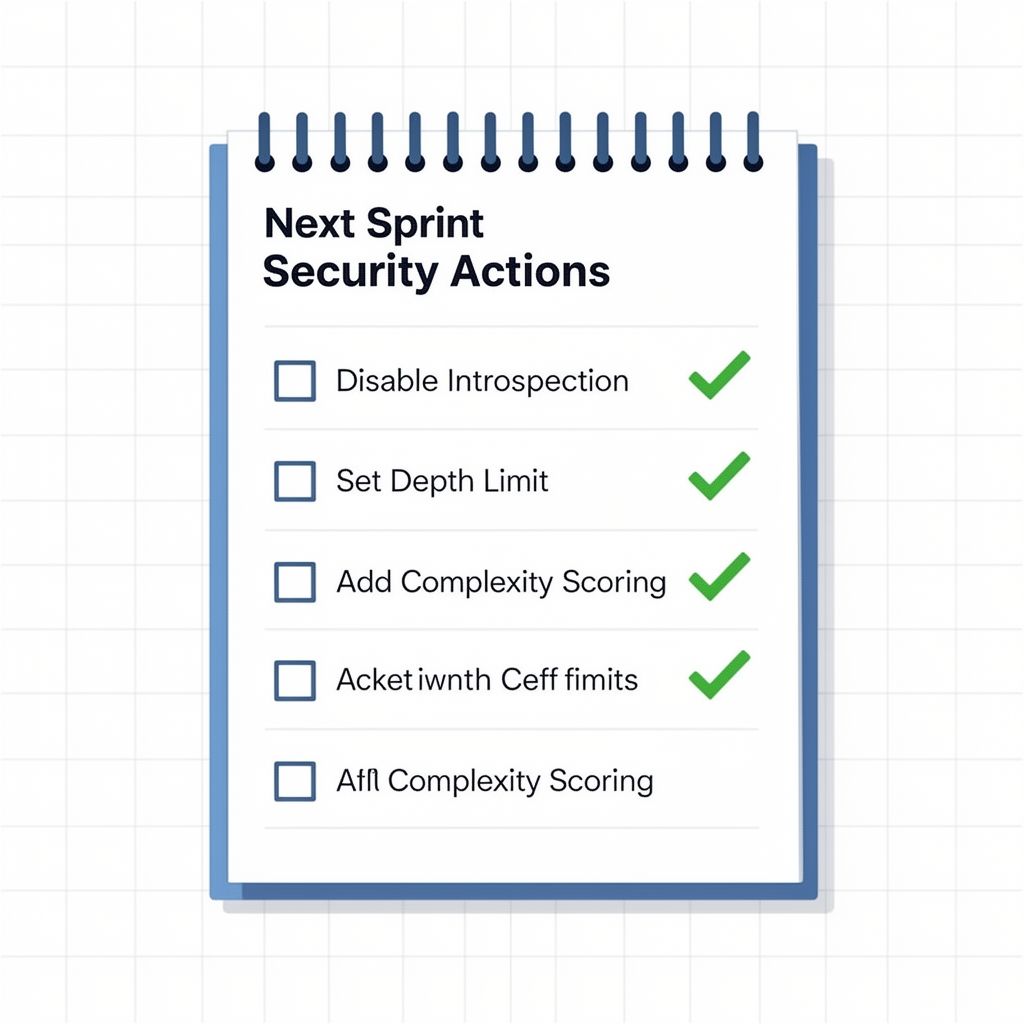
Copy this, paste it into your project management tool, and assign tickets.
- [ ] Disable GraphQL introspection in all non-development environments.
- [ ] Implement and enforce a query depth limit (start with 8, adjust based on your schema).
- [ ] Implement query cost analysis/complexity limiting. Assign a point value to high-cost fields (batch operations, data exports).
- [ ] Audit all resolver functions for direct string concatenation with user input when building database queries or external service calls. Replace with parameterized queries or prepared statements.
- [ ] Add a second layer of validation inside resolvers for business logic constraints (e.g., string length, enum value, ID format).
- [ ] Review all third-party GraphQL modules and libraries for known vulnerabilities. Update immediately.
- [ ] Implement structured logging for GraphQL operations (query hash, operation name, depth, user ID, error type). Omit sensitive variable values.
- [ ] Write 3-5 security unit tests that send malicious queries to your test endpoint and assert they are blocked or error appropriately.
Frequently Asked Questions
How is GraphQL injection different from REST API injection?
GraphQL injection is often more subtle and powerful. In REST, injection typically happens via URL parameters or JSON body fields. In GraphQL, injection can occur through arguments, nested query structures, and even GraphQL directives. An attacker can also craft a single, deeply nested query that acts as a denial-of-service attack by forcing the server to recursively load关联 data—a vector that doesn't exist in simple REST endpoints. The flexible nature of queries means you must defend against resource exhaustion attacks in addition to traditional data injection.
What's the single most effective change to prevent GraphQL attacks in 2026?
Implementing and enforcing a strict query complexity limit with field-level weighting. This single defense blocks the majority of automated denial-of-service attacks and forces attackers to reveal their hand with simpler, more detectable queries. While input validation is crucial, a complexity limit protects your entire system from being overwhelmed, buying you time to detect and respond. Start by analyzing your most expensive resolver, assign it a high cost, and set a total query limit that allows normal user operations but blocks excessive nested queries.
Can I use a WAF (Web Application Firewall) to secure my GraphQL API?
Traditional WAFs struggle with GraphQL because all requests go to a single endpoint (e.g., `/graphql`) with a POST body. The WAF can't inspect the intent of the query without parsing GraphQL syntax, which most don't. However, newer, GraphQL-aware API gateways and security proxies (like Tyk, Kong with plugins, or dedicated tools like Escape) are filling this gap. They can parse the GraphQL operation, apply rate limiting per operation type, and block malicious patterns. For now, rely on application-layer security within your GraphQL server first, and consider a specialized gateway as you scale.
How do I validate and sanitize complex JSON inputs in filter arguments?
This is a common pain point. First, define a strict GraphQL input type for your filter to leverage built-in type validation. Then, in your resolver, parse the filter object and validate it against a business logic schema. For example, use Pydantic in Python to define a second, more restrictive `FilterModel` with validators for date ranges, allowed field names, and value formats. Convert the GraphQL input to this model; if it fails, reject the query. Never pass raw user input directly to a generic database `where` function like `MyModel.objects.filter(**args)`. This is a direct path to NoSQL or SQL injection.
Is it safe to expose a public GraphQL API for my mobile app?
Yes, but with caveats. You must assume the client is hostile. The API keys or tokens embedded in a mobile app can be extracted. Therefore, your security cannot rely on secret API keys alone. You need strong, user-level authentication (like OAuth 2.0) and the layered defenses outlined in this guide: query limits, depth limiting, complexity analysis, and meticulous authorization at the resolver level for all data access. Treat every request as if it comes from an unauthenticated user until your resolvers prove otherwise. Also, consider using persistent query to lock down the allowed query shapes for your mobile app.
What should I log for GraphQL security auditing?
Log enough to detect attacks and debug issues, but never log sensitive data. Essential fields include: a hash of the query string (for pattern detection), the operation name, the calculated query depth/complexity score, the authenticated user ID (or session hash), the client IP, a timestamp, and the type of any GraphQL error (e.g., "VALIDATION_ERROR", "AUTH_ERROR", "INTERNAL_ERROR"). Do NOT log the entire variables object if it contains passwords, payment info, or personal messages. Aggregate these logs to track metrics like "queries per user exceeding complexity threshold" to spot brute-force attacks.
How often should I review and update my GraphQL security measures?
Treat it like any other critical infrastructure. Conduct a lightweight security review of all new resolvers and schema changes during code review (a 5-minute checklist). Perform a full, manual security audit of your entire GraphQL layer at least twice a year, or whenever you add a major new feature domain (e.g., payments, messaging). Subscribe to security advisories for your GraphQL server library and its plugins, and update within 30 days for critical patches. The tools and attack patterns evolve quickly; a structured, time-boxed review is essential for ongoing protection.
The landscape in 2026 isn't about discovering a single silver bullet. It's about building a resilient, multi-layered defense that assumes breach. Start today, not after your first security incident. Your first step should be the 30-minute audit: turn off introspection in production, check your logs for the deepest query this week, and implement a limit just below that. This simple act will block a whole class of automated attacks before lunch. Then, block out time next sprint to implement query complexity scoring. Security is a feature, and for your GraphQL API, it's the feature that keeps all the others running.
Boomlify Team