

AI Web Design Personalization: 2026 Conversion Blueprint
Boomlify Team
Content Creator
AI Web Design Personalization: 2026 Conversion Blueprint
Table of Contents
- The Personalization Gap: What You’re Leaving on the Table (And How to Quantify It)
- The 2026 AI Personalization Stack: A Five-Phase Architecture
- Phase 1: Foundation & Data Instrumentation
- Phase 2: Model Selection & Training
- Phase 3: Dynamic Content Assembly
- Phase 4: Real-Time Decisioning & Serving
- Phase 5: Continuous Learning & Calibration
- Toolscape 2026: From Free to Enterprise
- The Implementation Roadmap: Timelines, Budgets, and Team Structure
- Stage 1: The Startup (Team: 1 Marketer, 0.5 Engineer, Budget: <$500/mo)
- Stage 2: The Growth Team (Team: 1 Growth PM, 1 Data Analyst, 1 Full-Stack Engineer, Budget: $3k-$8k/mo)
- Stage 3: The Enterprise (Team: Dedicated Personalization Squad, Budget: $15k+/mo + Engineering)
- Measuring ROI: It’s Not Just About Conversion Rate
- Four Common Mistakes That Derail AI Personalization (And How to Avoid Them)
- Beyond 2026: Emerging Trends Shaping the Hyper-Personalized Interface
- Frequently Asked Questions
- How can I personalize my website with AI for free?
- What's the best AI personalization tool for a small business website?
- Is AI web design personalization only for e-commerce?
- How do you measure the ROI of AI personalization?
- What are the biggest privacy concerns with AI personalization?
- How much traffic do I need for AI personalization to be effective?
- Can AI personalize dynamic content like videos or interactive tools?
- What technical skills does my team need to implement this?
- Your Next Step: The 30-Minute Personalization Audit
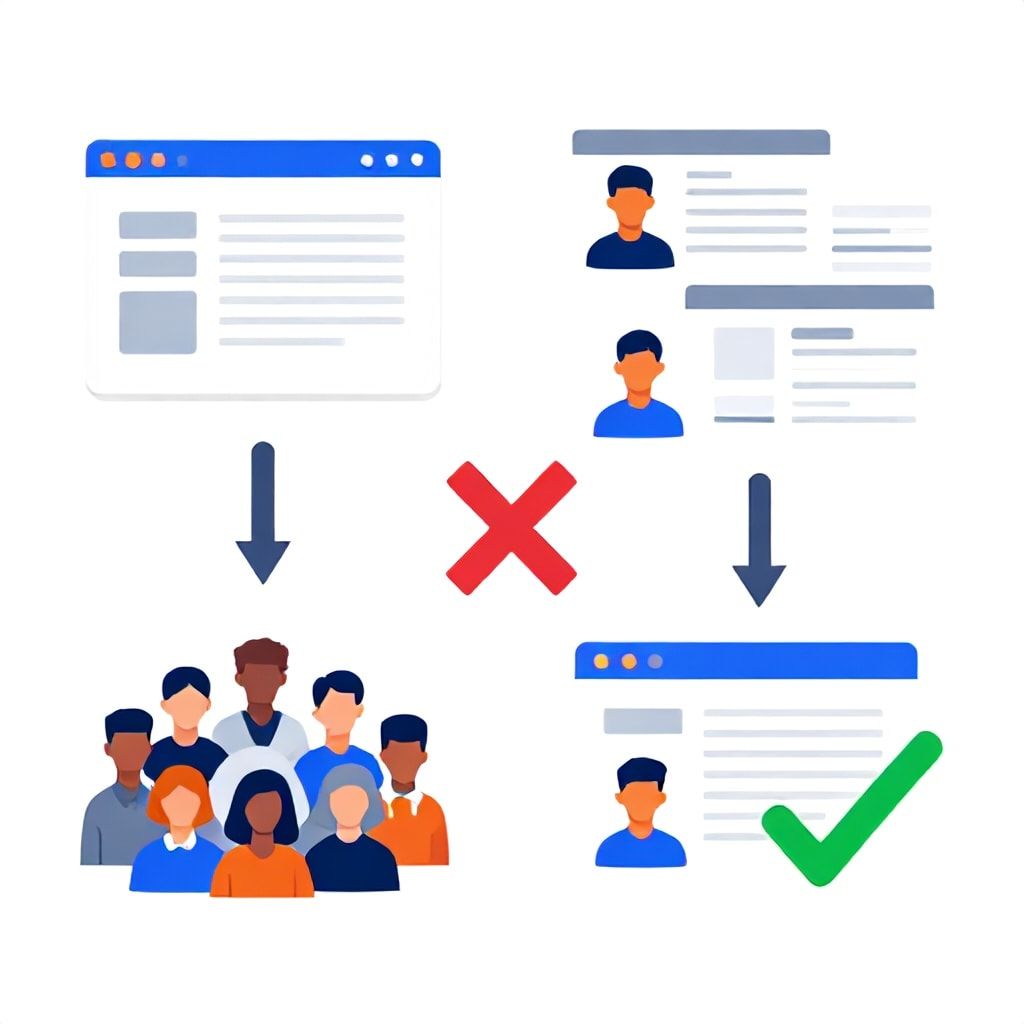
You run an A/B test. The variant wins with a 95% confidence interval. You implement it site-wide, pat yourself on the back, and move on. Here's the brutal truth you're missing: that winning variant is still wrong for at least 40% of your visitors. It's an average solution for a non-average audience. Static web design, even when "optimized," leaves massive conversion lift on the table because it treats every user as the same hypothetical "ideal customer." The future isn't about finding the single best page—it's about assembling the perfect page in real-time for each individual. By 2026, AI-driven personalization will move from a nice-to-have feature to the core engine of web performance. This guide is the operational manual for that shift. I’ll show you a five-phase implementation framework used with SaaS and e-commerce clients to achieve sustained conversion uplifts of 18-35%, the exact tools and budgets for teams of all sizes, and how to measure ROI in a way your CFO will understand.
The Personalization Gap: What You’re Leaving on the Table (And How to Quantify It)
Most websites operate on a broadcast model. You publish content and hope it resonates. Even sophisticated teams using tools like Google Optimize or Optimizely are still just testing a handful of static variations against each other. The limitation is fundamental: you can't manually create enough variations to match the combinatorial complexity of your audience. A visitor's intent, source, device, past behavior, and even their scrolling velocity all signal what they need. A returning customer shouldn't see the same hero section as a first-time visitor from an ad. A price-sensitive shopper from a deals site needs a different value proposition than a researcher from a review blog. When we audit sites, we consistently find that the top 20% of traffic segments (by conversion rate) convert at 3-5x the rate of the bottom 20%. Serving them the same experience is a catastrophic waste of potential. AI personalization closes this gap by using machine learning models to match dynamic content, layout, and offers to micro-segments—often segments of one—in real time. The goal isn't just a higher overall conversion rate; it's minimizing the standard deviation of user success.
The 2026 AI Personalization Stack: A Five-Phase Architecture
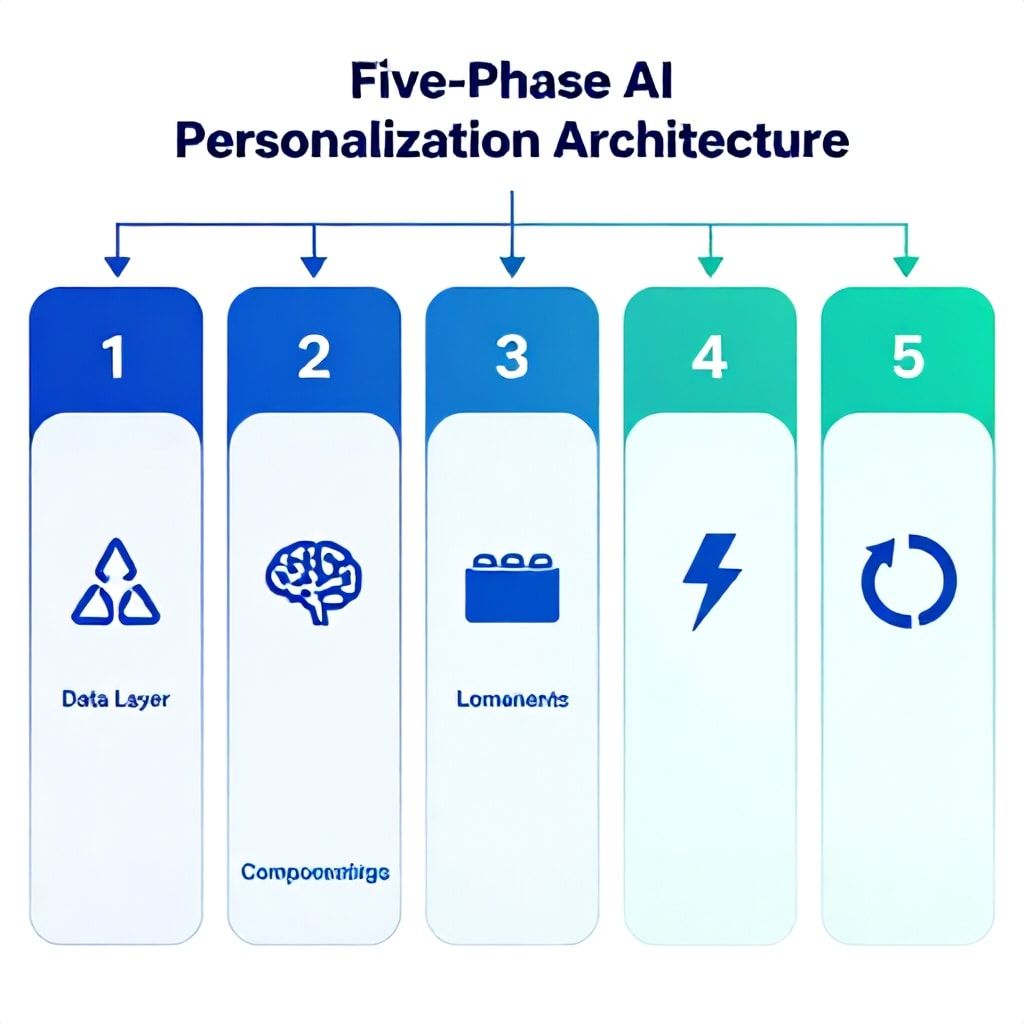
Throwing a script tag for a personalization tool onto your site is a recipe for chaos and poor data. Effective implementation requires a deliberate architecture. This five-phase framework, which we've refined across dozens of implementations, ensures scalability, measurability, and clean data flow.
Phase 1: Foundation & Data Instrumentation
This is where 80% of projects fail before they start. You need a unified data layer that captures first-party behavioral events far beyond standard Google Analytics. You must track: element visibility (how long was the pricing calculator in view?), click heatmaps, scroll depth per session, mouse movement entropy (a proxy for hesitation), and form field interaction time. Tools like Segment or freshpaint.io are critical here. The goal is to create a rich user profile that updates in real-time. For a B2B SaaS site, this might include "viewed case study A," "spent >90 seconds on pricing page," "downloaded whitepaper on topic X." For e-commerce, it's real-time cart value, category affinity, and price sensitivity signals. Without this granular foundation, your AI model is flying blind.
Phase 2: Model Selection & Training
You don't need a PhD in machine learning, but you need to know which type of model to apply. For most marketing teams, start with a collaborative filtering model ("users like you also liked...") or a content-based filtering model ("since you showed interest in X, here's more of X"). These are well-understood and available in many platforms. The next level is reinforcement learning, where the AI tests variations and learns which sequences of content lead to the highest lifetime value, not just a single conversion. The key here is defining your reward signal correctly. Is it a click? An add-to-cart? A purchase? A purchase over $100? The model will optimize ruthlessly for whatever you tell it to. Training requires a period of data collection without intervention—let the model observe natural behavior on your baseline site for 2-4 weeks to establish a benchmark.
Phase 3: Dynamic Content Assembly
This is the execution layer. Based on the model's prediction, what actually changes on the page? We break this into three tiers. Tier 1 (Easy): Swapping text, images, and CTAs. Think different headlines for users from LinkedIn vs. Reddit. Tier 2 (Moderate): Reordering or showing/hiding modules. For a user who always clicks on video testimonials, move that module above the fold. Tier 3 (Advanced): Completely altering the page layout or flow. This requires a component-based design system (like React or Web Components). Your AI doesn't redesign the page; it assembles it from a library of pre-approved, pre-tested components (Hero A, Social Proof B, Pricing Table C) into the predicted optimal sequence. Tools like Mutiny or Builder.io are built for this.
Phase 4: Real-Time Decisioning & Serving
The user lands. In under 100 milliseconds, your system must: 1) fetch their enriched profile, 2) run the prediction model, 3) assemble the component blueprint, 4) serve the fully rendered HTML. Latency is a conversion killer. This is where edge computing becomes essential—running the model on a CDN edge node (like Cloudflare Workers or Vercel Edge Functions) rather than a distant origin server. The decision logic also needs guardrails: rules that override the AI for compliance (e.g., don't show alcohol ads to a profile tagged as underage) or business logic (e.g., always show the enterprise plan to visitors from known competitor IP ranges).
Phase 5: Continuous Learning & Calibration
An AI model is not a "set and forget" tool. It decays. User behavior shifts, your product changes, seasons affect intent. You need a closed-loop feedback system where every user outcome (bounce, conversion, value) is fed back into the model as a labeled data point. More importantly, you must actively manage exploration vs. exploitation. A pure exploitation model will always serve the "safest" predicted winner, but it will never discover new, better patterns. You need to allocate a small percentage of traffic (5-10%) to exploration, testing novel content combinations to find new winners. This is the core of sustained optimization.
Toolscape 2026: From Free to Enterprise
The tool market is maturing rapidly. Your choice depends entirely on your team's technical bandwidth, budget, and scale. Here’s a breakdown of the current and emerging landscape.
| Tool Category | Best For | Example Tools | Implementation Complexity | Estimated Monthly Cost (Starting) |
|---|---|---|---|---|
| No-Code Personalization | Marketing teams with no dev resources; quick surface-level tests. | Mutiny, Omnisend (for email), VWO Personalize | Low. Visual editor, snippet-based. | $300 - $1,000+ |
| AI-Powered CRO Platforms | Growth teams wanting automated testing & personalization. | Dynamic Yield (Adobe), Optimizely, Evolv AI | Medium. Requires strategic setup and data integration. | $2,000 - $10,000+ |
| Composable & Headless | Engineering-led teams with a modern tech stack. | Builder.io, Uniform, Contentful with AI plugins | High. Requires dev work to create components. | Custom (platform fees + dev time) |
| Open-Source & DIY | Tech-heavy teams needing full control, bespoke models. | Apache PredictionIO, TensorFlow.js, own models on AWS SageMaker | Very High. Full ML engineering lifecycle. | Variable (cloud costs + engineering salary) |
| Free Tier / Freemium | Bootstrapped startups, initial concept validation. | Personalize (limited sessions), Google Optimize (sunsetting in 2023, look for successors), open-source RudderStack for data layer. | Low to Medium. | $0 - $100 |
For early-stage startups, I recommend starting with the free tier of a tool like Personalize to run a few high-impact, rules-based experiments (e.g., personalize the CTA for logged-in vs. logged-out users). This proves the concept and generates early data. For scaling companies with a dedicated growth engineer, a composable platform like Builder.io offers the most future-proof flexibility. Enterprises with complex compliance needs often go with Adobe or Optimizely, accepting some vendor lock-in for enterprise support.
The Implementation Roadmap: Timelines, Budgets, and Team Structure
Here’s what getting this live actually looks like, broken down by company stage. These are estimates based on real deployments; your mileage may vary by technical debt.
Stage 1: The Startup (Team: 1 Marketer, 0.5 Engineer, Budget: <$500/mo)
Timeline: 6-8 weeks to first live personalized element.
Focus: Low-hanging fruit with clear rules. Personalize the main headline and CTA based on UTM source (e.g., “Welcome, Hacker News Reader” vs. “Welcome, LinkedIn Professional”). Use a cookie to show returning visitors a “Welcome back” message with a personalized offer.
Tooling: Use a no-code platform's free tier or a freemium model. Implement a basic event tracker like PostHog (free up to 1M events/mo) for foundational data.
Success Metric: Increase in conversion rate for those targeted segments by 10-15%.
Next Step: Document results and use them to justify a budget for a paid tool.
Stage 2: The Growth Team (Team: 1 Growth PM, 1 Data Analyst, 1 Full-Stack Engineer, Budget: $3k-$8k/mo)
Timeline: 3-4 months to a functioning, learning personalization engine.
Focus: Implement the full five-phase architecture. Build a unified data layer with Segment. Choose an AI-powered CRO platform. Personalize not just CTAs but content modules and product recommendations based on behavioral clusters.
Tooling: Segment for data, an AI CRO platform like Evolv or Dynamic Yield, and perhaps a CDN edge function for decision logic.
Success Metric: Overall site-wide conversion lift of 12-25%, measured through a holdback group (a random 5% of users who see the non-personalized site as a control).
Next Step: Integrate personalization with the email/marketing automation stack for a unified cross-channel profile.
Stage 3: The Enterprise (Team: Dedicated Personalization Squad, Budget: $15k+/mo + Engineering)
Timeline: 6-9 months for a global, multi-brand, multi-language deployment.
Focus: Hyper-personalization at scale. Real-time next-best-action predictions across web, mobile app, and email. Integration with CRM (Salesforce, HubSpot) and backend inventory/pricing systems. Advanced use of reinforcement learning for user journey optimization.
Tooling: Enterprise suite from Adobe or Optimizely, or a custom-built system on top of a cloud AI platform (Google Vertex AI, Azure Personalizer). Heavy use of edge computing.
Success Metric: Increase in customer lifetime value (LTV) by 15-30%, reduction in support tickets via predictive help, increase in average order value (AOV).
Next Step: Pioneering privacy-first personalization techniques like on-device inference and federated learning.
Measuring ROI: It’s Not Just About Conversion Rate
If you walk into a board meeting and say “our AI personalization increased conversions by 20%,” you’ll get a polite nod. If you walk in and say “it increased our average customer lifetime value by $127, which translates to an incremental $2.1M in net present value against a $250k annual investment,” you’ll get funding. You must measure the business impact, not just the UX metric. Here’s the formula we use:
Incremental Revenue Lift = (Personalized Group Conversion Rate - Control Group Conversion Rate) * Personalization Traffic Volume * Average Order Value
But go deeper. Measure downstream effects:
- Reduced Support Costs: Do personalized onboarding flows reduce “how-to” support tickets?
- Increased AOV: Do personalized upsell prompts work?
- Improved Retention: Do personalized re-engagement flows bring back more dormant users?
- Higher Content Engagement: Do users spend more time on site, view more pages, signaling better SEO relevance?
Run a formal holdback A/B test for at least 4-6 weeks. 95% of your traffic gets the AI-personalized experience. 5% sees the generic, static site. Compare all the above metrics between the two groups. That’s your true incremental lift, isolated from other marketing activities.
Four Common Mistakes That Derail AI Personalization (And How to Avoid Them)
- Mistaking Rules for Intelligence: If your “AI personalization” is just a bunch of if-then statements you wrote yourself (if source=facebook, show headline A), you’re doing segmentation, not AI. The value of AI is discovering non-obvious patterns you wouldn’t think to code. The Fix: Use rules for compliance guardrails, but let a model handle the primary optimization. Start with a hybrid approach.
- Data Silos and Dirty Inputs: Feeding your AI model only Google Analytics data is like asking a chef to cook a gourmet meal with only salt and flour. You need first-party behavioral data, CRM data, and product usage data. The Fix: Invest in Phase 1 (Data Instrumentation) for a full quarter before expecting magic from Phase 3. A unified customer data platform (CDP) is non-negotiable.
- Ignoring the “Cold Start” Problem: An AI model needs data to make good predictions. A new user with zero history gets a random or poor experience, which can drive them away. The Fix: Design compelling default experiences for unknown users that gather data quickly (e.g., a short preference quiz, clear value propositions for different roles). Use contextual signals (referrer, device, time of day) immediately.
- Neglecting Privacy and Trust: Personalization can feel creepy, not helpful. Using data a user didn’t explicitly share, or making inaccurate inferences (“we see you’re interested in pregnancy products!” to someone who bought a one-time gift) destroys trust. The Fix: Be transparent. Have a clear “Why am I seeing this?” link. Use explicit preference centers. Focus on intent-based personalization (based on their current session behavior) rather than overly sensitive demographic inference. Adhere to a strict ethical framework, similar to the principles outlined in our guide on building trust with Explainable AI.

Beyond 2026: Emerging Trends Shaping the Hyper-Personalized Interface
The trajectory is clear: websites will become adaptive applications. Here’s what’s coming that you should architect for now.
- Adaptive UI/UX Based on Cognitive Load: Models will infer user frustration or confusion (via cursor jitter, rapid tab switching, hesitation) and simplify the interface in real-time, or trigger a chatbot intervention.
- Voice & Conversational UI as a Personalization Layer: AI won’t just change the page; it will change the modality. A user on a mobile device, late at night, might be offered a voice-navigation option instead of tiny touch targets.
- Emotional AI (Affective Computing): While controversial, early experiments use webcam data (with explicit opt-in) or typing cadence to infer broad emotional states and adjust messaging tone—more empathetic for a frustrated user, more celebratory for an excited one.
- Causal AI Over Correlative AI: Moving beyond “people who bought X also bought Y” to “showing product video A causes a 12% higher likelihood of purchase for users with trait B.” This allows for true experimentation and understanding of why things work.
- Privacy-Preserving Personalization: With the death of third-party cookies, personalization will rely on first-party data, contextual signals, and advanced techniques like federated learning (where the model learns on your device, and only the learnings—not your data—are shared) and differential privacy.
Frequently Asked Questions
How can I personalize my website with AI for free?
Start with a freemium tool like Personalize.so or the free tier of a platform like VWO. Focus on rule-based, high-impact changes that don't require complex AI. For example, use UTM parameters to change a headline for traffic from different social platforms, or show a different promo code to returning visitors. The "free" part is limited by monthly visitors or features. Crucially, pair this with a free analytics tool like PostHog or Matomo to build your first-party data foundation. This lets you prove value before investing in a paid AI platform.
What's the best AI personalization tool for a small business website?
For a true small business with limited technical help, a no-code visual editor is essential. Mutiny is excellent for B2B SaaS and startup websites, as its templates are geared towards lead generation. For e-commerce, many Shopify store owners find success with Nosto or Clerk.io, which integrate directly and offer product recommendation engines. The "best" tool is the one you can implement and manage with your existing team. Avoid over-engineered enterprise solutions; you need something that gets you results in weeks, not months.
Is AI web design personalization only for e-commerce?
Absolutely not. While e-commerce has clear, transactional metrics (AOV, conversion), B2B SaaS, media publishers, and even non-profits benefit massively. A SaaS company can personalize its landing page for different user roles (developer vs. manager), showcase relevant case studies based on the visitor's industry, or tailor its pricing page presentation. A media site can personalize article recommendations, newsletter signup CTAs, and ad placements. The principle is universal: increase relevance to increase engagement and drive your key action, whether it's a purchase, a sign-up, a download, or a donation.
How do you measure the ROI of AI personalization?
You must run a controlled experiment. Split your traffic, with a majority receiving the personalized experience and a small holdback group (5-10%) receiving the generic site. Compare the conversion rates, average order values, and even long-term retention metrics between these two groups over a significant period (minimum 4-6 business cycles). The incremental lift in revenue from the personalized group, minus the cost of the software and implementation, is your net ROI. Avoid vanity metrics like click-through rate alone; tie everything to revenue or customer lifetime value.
What are the biggest privacy concerns with AI personalization?
The primary concerns are collecting data without clear consent, making sensitive or inaccurate inferences (like guessing health or financial status), and creating "filter bubbles" that limit user choice. The remedy is transparency and control. Clearly communicate what data you use and how it improves the user's experience. Provide an easy-to-access preference center where users can see their profile, correct inferences, or opt out of specific personalization types. Always prioritize session-based intent signals over creepy, long-term profiling. For a deeper dive on ethical implementation, our framework on AI ethics for content creators offers parallel principles.
How much traffic do I need for AI personalization to be effective?
For the machine learning models to find statistically significant patterns, you need a minimum volume of data. A rough benchmark is at least 10,000 unique visitors per month, with at least 50-100 conversions (or your primary goal) in that period. Below that, the models will struggle to learn due to data sparsity. If you have lower traffic, you can still implement successful personalization, but you should rely more on explicit rules and contextual signals (like referral source, time of day, device) rather than fully autonomous behavioral AI. The key is to start simple and let complexity grow with your data.
Can AI personalize dynamic content like videos or interactive tools?
Yes, and this is a major frontier for 2026. AI can dynamically choose which video version to serve (e.g., a technical deep-dive vs. a high-level business overview), generate personalized video snippets using text-to-video AI, or even alter the narrative path in an interactive video. For interactive tools like configurators or calculators, AI can pre-populate fields based on known user attributes or highlight the most relevant features first. This moves personalization from static content to dynamic experiences, as explored in the context of AI video ad personalization.
What technical skills does my team need to implement this?
For a basic no-code tool, a marketer can handle it alone. For a serious implementation of the five-phase architecture, you need a cross-functional team: a growth marketer to define strategy and segments, a data analyst to instrument tracking and analyze results, a front-end engineer to build reusable components and handle edge serving, and a back-end/data engineer to manage the data pipeline and model integrations. You don't need a machine learning scientist; most platforms provide the models. You need engineers who can work with APIs and data, and a strategist who can ask the right business questions.
Your Next Step: The 30-Minute Personalization Audit
Don't try to boil the ocean. Your action today is to conduct a quick audit. Open your analytics. Segment your last 30 days of conversions by three key dimensions: 1) Traffic Source (Organic, Paid Social, Direct), 2) Device Type (Mobile vs. Desktop), and 3) New vs. Returning Visitor. You will see wild differences in conversion rates. Pick the segment with the highest conversion rate and the segment with the lowest conversion rate. Now, go look at the exact same landing page experience you're serving both groups. That visceral recognition of the missed opportunity is your starting fuel. Then, pick one element—likely the primary headline or CTA—and brainstorm how you would change it for that low-performing segment to better match their intent. That's your first hypothesis. That's where your 2026 blueprint begins.
Boomlify Team