


2026 AI Launch Strategy: Build Trust with Explainable AI
Boomlify Team
Content Creator
2026 AI Launch Strategy: Build Trust with Explainable AI
Table of Contents
- The 2026 Landscape: Why Explainability Is Your Primary Brand Asset
- The Trust-First AI Launch Framework: A 5-Phase Process
- Phase 1: The Explanation Audit (Weeks 1-2)
- Phase 2: Model Selection & Explainability-by-Design (Weeks 3-8)
- Phase 3: The Integrated Feedback Layer (Ongoing)
- Phase 4: Pre-Launch Trust Staging (Weeks 9-10)
- Phase 5: Post-Launch Narrative & Evolution (Weeks 11+)
- Budget & Implementation: A Realistic 2026 Blueprint
- Solo Founder / Tiny Team (Budget: $500-$2k/month for tooling)
- Early-Stage Startup (5-15 people, Budget: $5k-$15k/month + engineering time)
- Growth-Stage / Enterprise Team (50+ people, Dedicated AI/ML team)
- 4 Critical Mistakes That Sink Explainable AI Launches (And How to Avoid Them)
- Integrating Explainability into Your 2026 Go-to-Market Plan
- Frequently Asked Questions
- Does explainable AI mean less powerful AI?
- How do I prioritize which parts of my AI product to explain first?
- Are there specific no-code AI tools good for explainable products in 2026?
- What's the biggest legal risk with non-explainable AI in 2026?
- How do I measure the ROI of investing in explainable AI features?
- Can I add explainability to an existing "black box" AI product?
- How does explainable AI fit into a brand strategy for a startup?
- What's the first step I should take today?
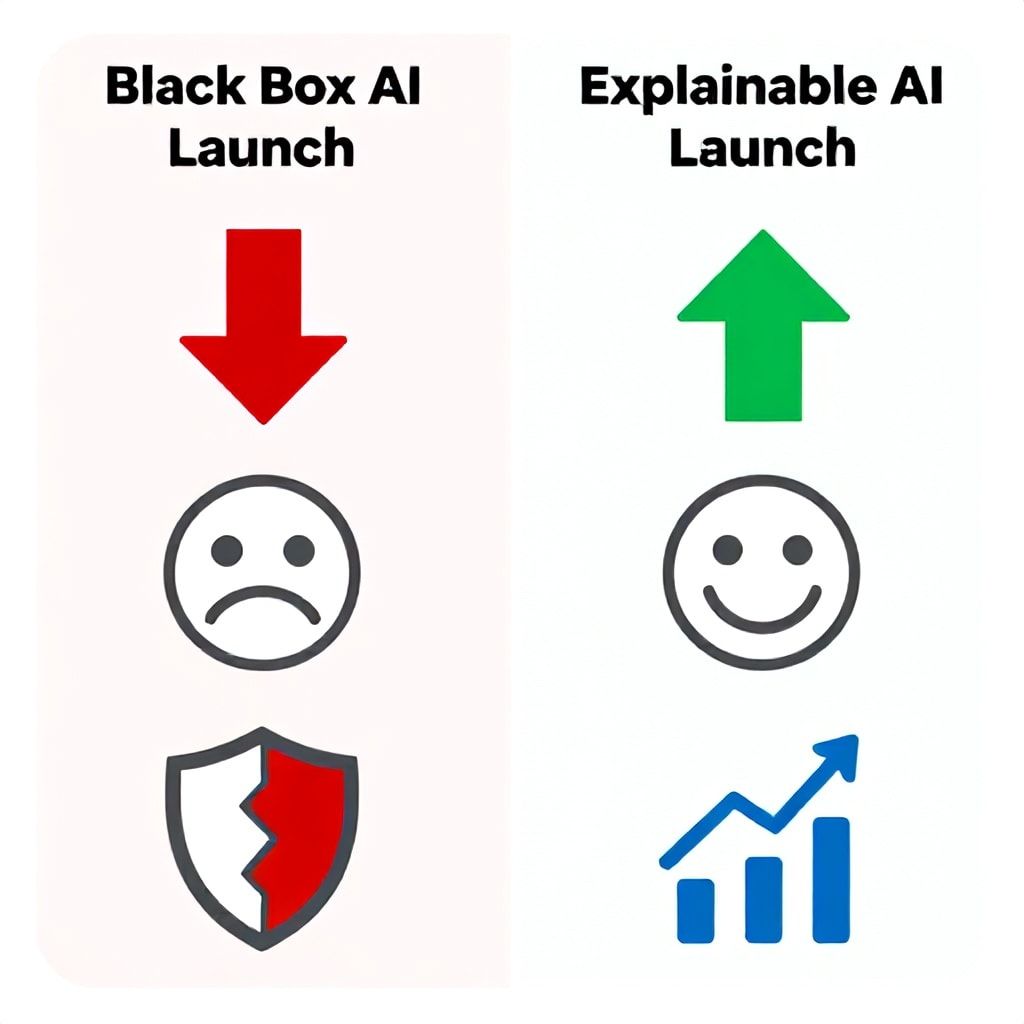
A product manager presents their new AI-powered recommendation engine to the leadership team. The VP of Marketing asks, "Why did it suggest that product to a customer who just bought a competing item?" The room goes silent. The lead engineer fumbles: "It's a black box model. The algorithm found a pattern we can't easily explain." That moment—where technical opacity meets business accountability—is where 80% of AI product launches in 2025 have stumbled, creating what Gartner calls "explainability debt." In 2026, that debt comes due. Customers, regulators, and internal stakeholders won't accept "the AI decided" as an answer. They'll demand transparency, and products that fail to provide it will face immediate brand erosion. This isn't just an engineering problem; it's the core brand strategy challenge for the next generation of tech companies. If you're planning an AI product launch for 2026, your success hinges on one non-negotiable: building a system where the 'why' is as valuable as the 'what.' This article provides a practical, data-driven framework for launching explainable AI products that earn user trust from day one, avoid the hype cycle, and create resilient brand equity that lasts long after the initial PR buzz fades.
The 2026 Landscape: Why Explainability Is Your Primary Brand Asset
Forget the 2023-2024 focus on raw capability. The novelty of "AI that can do X" has worn off. In practice, we've seen teams burn through six-figure budgets building features that users immediately distrust. The 2026 differentiator isn't intelligence—it's accountability. A recent survey by the Pew Research Center shows that 68% of consumers are more concerned than excited about AI in their daily lives, citing a lack of understanding as the primary reason. This isn't a niche concern; it's the mainstream user sentiment you're launching into. Your product's ability to explain itself isn't a compliance checkbox or a nice-to-have UI element. It's the foundation of your value proposition. When an AI content tool explains *why* it suggested a specific headline (e.g., "This matches high-engagement patterns from your past 20 posts and uses 15% simpler language for your target demographic"), it transforms from a mysterious oracle into a collaborative partner. That shift—from magic to mechanics—is where user adoption solidifies and negative feedback loops are prevented. Your brand becomes associated with clarity, not confusion.
This also changes your competitive moat. It's harder to copy a product where the user experience is deeply intertwined with transparent decision-making. A competitor can replicate your model's output, but they can't easily replicate the nuanced trust you've built through consistent, understandable explanations. In 2026, your AI product launch strategy must treat explainability as a first-class feature, architected from day one, not bolted on before a compliance audit. The brands that win will be those that communicate not just what their AI does, but how it thinks, where its confidence lies, and where its limitations are.
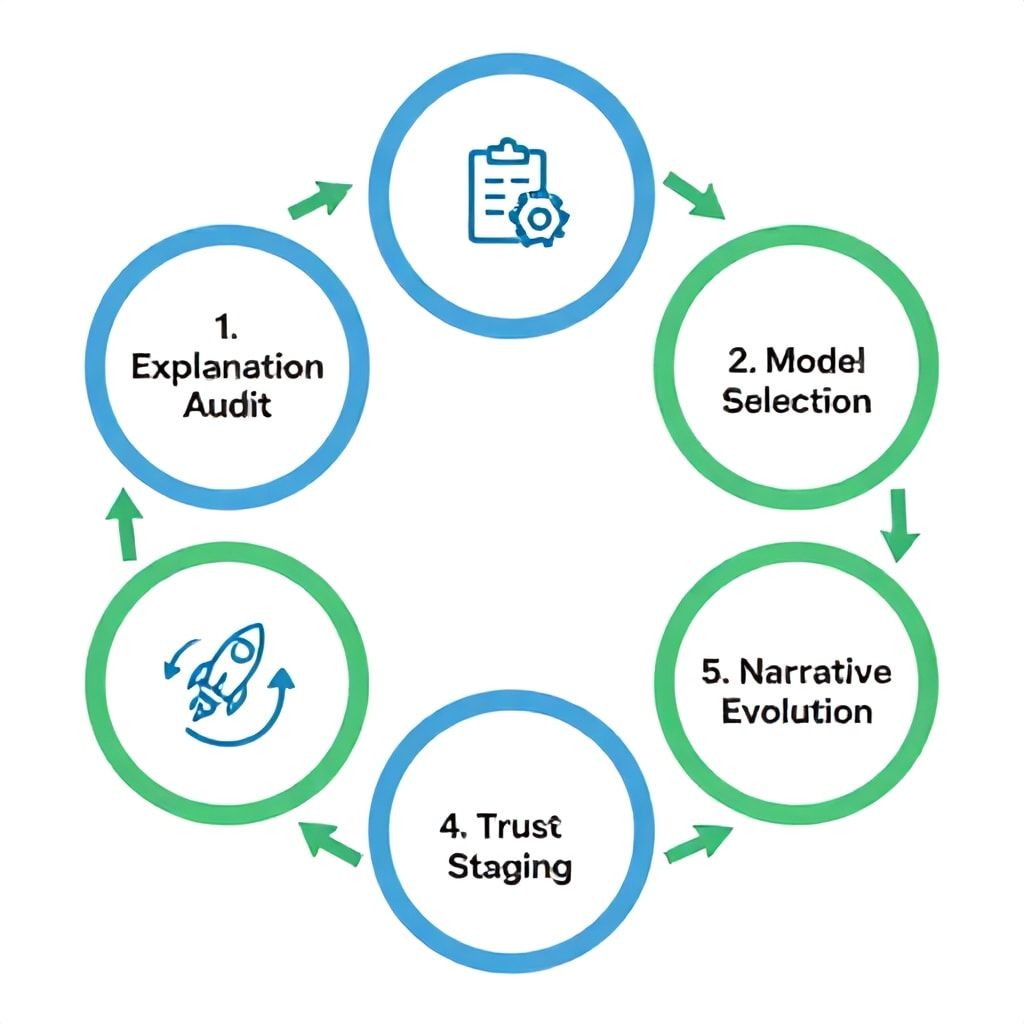
The Trust-First AI Launch Framework: A 5-Phase Process
Most product roadmaps are linear: define, build, test, launch. For explainable AI products, this fails spectacularly because trust isn't a feature you add at the end—it's a property of the entire system. Based on working with over a dozen B2B and B2C startups on their AI-powered product launches, we've developed a non-linear, feedback-driven framework that bakes explainability into every layer. The goal isn't just a successful Day 1 launch, but a Day 100 where user trust has deepened, not decayed.
Phase 1: The Explanation Audit (Weeks 1-2)
Before writing a single line of model code, you conduct an Explanation Audit. This is where most teams skip a crucial step. Don't start with "What will our AI do?" Start with "What decisions will our AI make that a user will need to understand?" Assemble your core team—product, engineering, design, and a subject matter expert from customer support or sales. For each core user story, list every point where the AI provides output, makes a choice, or filters data. Then, for each point, ask three questions:
- Stakeholder Need: Who needs an explanation here? (The end-user, a manager, a compliance officer?)
- Explanation Depth: What level of detail is required? A simple confidence score? The top 3 influencing factors? A full technical rationale?
- Failure Consequence: What is the cost if the explanation is missing or wrong? (Low = minor friction, High = legal risk or catastrophic loss of trust).
Map these onto a 2x2 grid: Consequence (High/Low) vs. Stakeholder Technical Literacy (Low/High). This audit typically surfaces 4-5 critical explanation points that become your product's trust anchors. For a financial forecasting AI, a "High Consequence, Low Literacy" point might be a loan rejection explanation for a small business owner. That single explanation will dictate 30% of your UX and model architecture. You cannot afford to discover it during beta testing.
Phase 2: Model Selection & Explainability-by-Design (Weeks 3-8)
Now, and only now, do you choose your AI approach. This is the most counter-intuitive but critical pivot. Instead of selecting the highest-accuracy model and later trying to explain it (post-hoc explainability), you select a model class based on its native explainability (ante-hoc). The trade-off between accuracy and explainability is real, but for 2026 launches, the brand-risk cost of a black box far outweighs a 2-3% accuracy gain. Use this decision matrix:
| Use Case Context | Recommended Model Class | Native Explainability | When to Avoid |
|---|---|---|---|
| High-Regulation, High-Stakes (Finance, Healthcare) | Decision Trees, Rule-Based Systems, Linear Models | Direct: You can trace exact decision paths. | When dealing with extremely unstructured data (e.g., raw video). |
| Moderate Complexity, Need for Balance (Marketing Analytics, Content Moderation) | Generalized Additive Models (GAMs), Attention-based Models (like Transformers) | Feature Importance: You can show which inputs (words, user traits) weighed most heavily. | When you need real-time, millisecond latency for millions of requests. |
| High Complexity, Lower-Stakes (Creative Ideation, Personalization) | Complex Neural Networks (CNNs, RNNs) with dedicated explainability layers (SHAP, LIME) | Post-hoc Approximation: You can generate a "best guess" explanation of the model's behavior. | When your legal team requires deterministic, auditable logic. |
For early-stage teams, start with a GAM or a well-constrained tree-based model. You'll sacrifice some frontier performance, but you'll gain something more valuable: a story you can tell. Your AI product roadmap template 2026 should have a dedicated "Explainability Architecture" sprint before the core model training sprint.
Phase 3: The Integrated Feedback Layer (Ongoing)
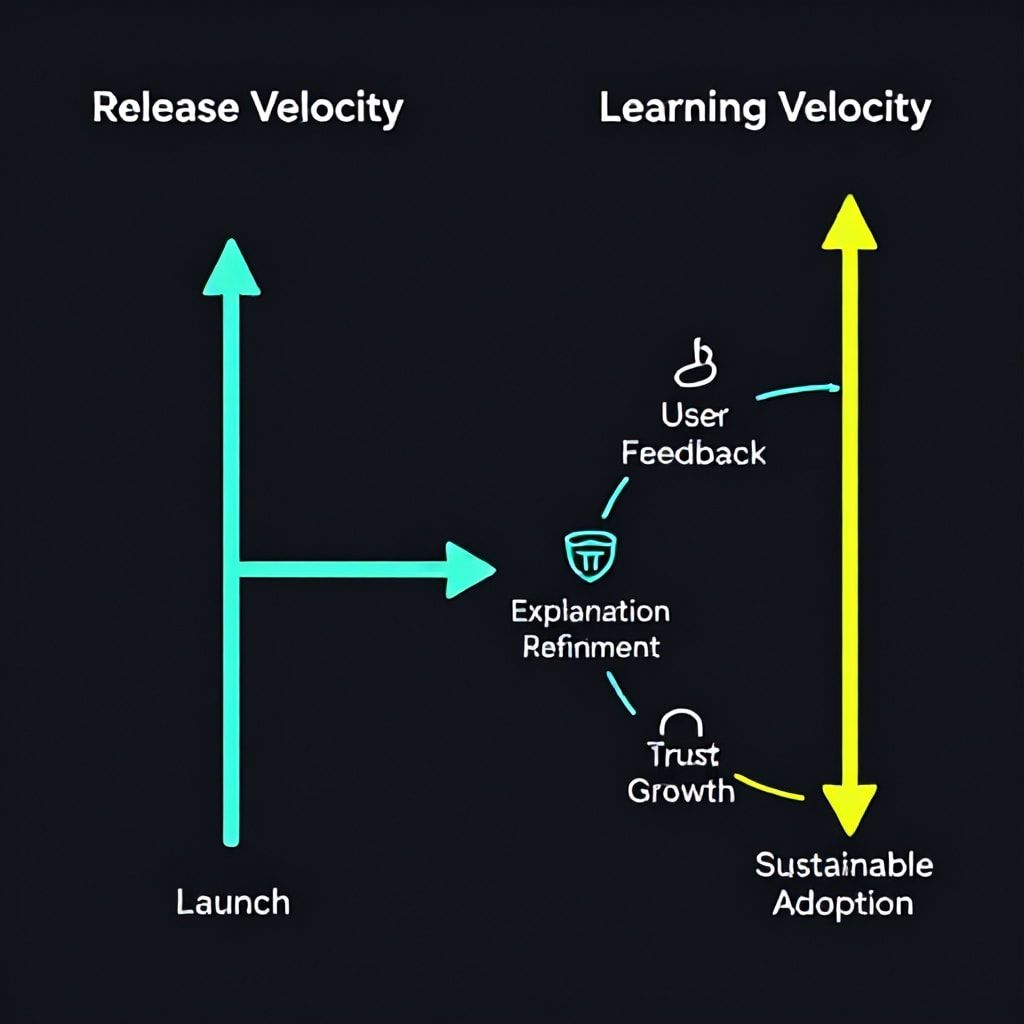
An explanation is not a monologue; it's the start of a dialogue. Your product must have a built-in mechanism for users to respond to the AI's explanation. This is your primary source of learning velocity in AI product management. The classic mistake is measuring success only by whether users accept the AI's recommendation. The critical metric is whether they *understand* it. Implement a lightweight, non-intrusive feedback loop directly tied to explanations. After an AI suggestion with its reasoning, include a simple set of buttons: "Makes Sense," "Unclear," "Seems Wrong." The "Unclear" feedback is gold—it tells you your explanation failed, even if the output was correct. This data drives your product's evolution far more efficiently than tracking generic engagement metrics. In one B2B SaaS case, prioritizing features based on "Unclear" explanation feedback led to a 40% faster adoption curve in enterprise teams because it directly addressed the points of confusion that stalled internal buy-in.
Phase 4: Pre-Launch Trust Staging (Weeks 9-10)
You don't launch an explainable AI product to the whole market at once. You stage the launch of trust. Your beta group isn't just for bug hunting; it's for explanation validation. Recruit two distinct groups: 1) Technical power users who will stress-test the model's logic, and 2) Representative end-users who will stress-test the *clarity* of your explanations. Give them specific tasks focused on the critical explanation points from your Phase 1 audit. The key question for the second group isn't "Is it accurate?" but "Do you feel informed, not just served?" Use their verbatim feedback to rewrite explanation copy. Technical jargon must die here. "High activation in the final convolutional layer" becomes "The AI focused most on the contrast between the subject and background in your image."
Phase 5: Post-Launch Narrative & Evolution (Weeks 11+)
Your digital marketing plan for an AI launch must center on your explainability features. Don't lead with "Our AI is smarter." Lead with "Our AI is more transparent." Create content that showcases the explanation interface. Write case studies on how a user's interaction with an explanation led to a better outcome. Your post-launch development cycles are governed by the feedback from Phase 3. This creates a virtuous cycle: better explanations build trust, which increases usage and feedback, which fuels better explanations. Your release velocity may slow slightly, but your learning velocity—the rate at which you understand and improve the human-AI interaction—will accelerate, creating a more defensible product.
Budget & Implementation: A Realistic 2026 Blueprint
Abstract advice fails here. Let's get concrete about what this framework costs and requires at different stages. The single biggest budget mistake is under-investing in the integrated feedback layer and explanation UX, assuming it's "just copy."
Solo Founder / Tiny Team (Budget: $500-$2k/month for tooling)
Your advantage is agility. Use no-code AI product development platforms that bake in explainability. Tools like Akkio or Obviously AI prioritize interpretable models (like decision trees) and provide built-in feature importance charts. Your launch goal isn't to beat GPT-4; it's to solve a specific, narrow problem with flawless transparency. Spend 70% of your pre-launch time crafting the user journey for your one or two critical explanations. Use a simple embedded survey tool (Typeform, Tally) for your Phase 3 feedback layer. Your timeline from idea to staged launch can be 6-8 weeks. The risk is hitting scalability walls quickly, but for validating an explainable AI product opportunity in a niche, this is the most efficient path.
Early-Stage Startup (5-15 people, Budget: $5k-$15k/month + engineering time)
You need more customization but lack a massive ML team. This is the sweet spot for leveraging managed AI services with explainability APIs. Use Google Vertex AI's Explainable AI tools or Amazon SageMaker Clarify. These add explanation capabilities to your custom models without requiring PhD-level expertise. Allocate one full-stack engineer for 3-4 weeks specifically to integrate the explanation API outputs into your UI. The budget killer here is underestimating front-end work; displaying explanations well is a significant design and engineering task. Plan for a 12-16 week product development life cycle to first trusted beta. At this stage, hiring a product designer with experience in data visualization or complex systems is more valuable than hiring a second ML engineer.
Growth-Stage / Enterprise Team (50+ people, Dedicated AI/ML team)
You have the resources to build bespoke explainability. The danger is over-engineering. Mandate that every model proposal includes its "explainability architecture" as a core section. Invest in an internal explanation platform or dashboard that standardizes how explanations are generated and served across different product teams (this prevents a chaotic user experience). Tools like Arthur AI or Fiddler AI can be cost-effective for monitoring and explaining models in production at scale. Your primary cost is organizational alignment, not software. Ensure your product, legal, and AI teams are using the same language. A realistic timeline from project kickoff to full launch is 5-7 months, with the middle two months dedicated almost exclusively to trust staging and internal compliance reviews.
4 Critical Mistakes That Sink Explainable AI Launches (And How to Avoid Them)
After reviewing post-mortems from dozens of launches, these patterns emerge as the most common and damaging failures.
- Mistaking a Confidence Score for an Explanation: Displaying "92% confidence" tells a user nothing about *why*. It can even backfire, as a high confidence score on a wrong output destroys trust faster. A score must always be accompanied by qualifying factors (e.g., "High confidence because your query matches three clear past examples. Lower confidence when analyzing ambiguous language.").
- Building Explanations for Engineers, Not Users: The explanation output from SHAP or LIME is a starting point, not the final UI copy. A list of feature importance coefficients is meaningless to 99% of users. Your design team must own the translation of raw explanation data into human-understandable insights. This translation layer is a core product feature.
- Letting the Perfect Be the Enemy of the Good: Teams get paralyzed trying to explain every facet of a complex model. Start with explaining the *most important decision* in the *simplest possible way*. A partial, correct explanation is better than a delayed, overly complex one. You can deepen explanations in V2 based on user feedback.
- Neglecting the Internal Go-to-Market: Your sales, support, and success teams are your first users. If they don't understand how the AI works, they can't sell it, support it, or defend it. Create an internal "explainability kit" for them with simple metaphors, FAQs, and scripts for handling tough questions about the AI's logic. Their confidence is the bridge to customer confidence.
Integrating Explainability into Your 2026 Go-to-Market Plan
Your digital marketing strategy must be recast. Content that demystifies your AI is your most powerful asset. Instead of a generic product demo video, create a video that walks through a single user decision and shows the explanation interface in action. Your SEO strategy should target long-tail keywords related to "understanding AI" and "transparent [your industry] tools." For PR, pitch stories about your design process for explanations, not just your funding round. In your sales pipeline, track a new metric: "Explanation Clarity Score" based on prospect questions. If every demo is bogged down in "but how does it know?" your pre-launch explanation work isn't done. This AI integration in business processes only works if the human side of the equation is led, not followed.
Frequently Asked Questions
Does explainable AI mean less powerful AI?
Not necessarily, but it often means a different *kind* of power. You might trade a few percentage points of peak accuracy on a benchmark test for a model whose decisions you can audit, justify, and improve systematically. In many real-world business applications, a 95% accurate model you can trust and debug is far more valuable than a 97% "black box" that fails unpredictably and erodes user confidence. The power shifts from raw output to reliable, understandable utility. For insights on managing this trade-off in a startup context, see our guide on AI Forecasting and Startup Burn Rate.
How do I prioritize which parts of my AI product to explain first?
Use the "Failure Consequence" matrix from Phase 1 of our framework. Focus ruthlessly on explanations for decisions that have a high cost of being wrong (financial loss, legal risk, serious customer dissatisfaction) and that will be encountered by users with low technical literacy. For a medical triage chatbot, explaining why it suggests "go to the ER" is non-negotiable. For a playlist generator, explaining every song choice is overkill—start with explaining the overall theme or mood of a generated playlist.
Are there specific no-code AI tools good for explainable products in 2026?
Yes, but choose carefully. Look for platforms that default to interpretable models like decision trees or linear regression, and that provide visual analytics for feature importance. Akkio and Obviously AI are strong contenders. Avoid no-code tools that are essentially thin wrappers around massive, opaque language models with no insight into the decision process. The tool should make the model's logic a central part of its interface, not an afterthought. For a deeper look at accessible AI development, explore our framework for AI Side Hustle Validation.
What's the biggest legal risk with non-explainable AI in 2026?
Beyond sector-specific regulations (like GDPR's "right to explanation" or upcoming EU AI Act requirements), the overarching risk is contractual. If your AI makes a decision that causes a business loss for a client and you cannot provide a defensible rationale, you are exposed to breach-of-contract and negligence claims. Your terms of service will not fully shield you from liability for an indefensible, opaque system error. Proactive explainability is a primary risk mitigation strategy. For more on compliance frameworks, read our ESG Reporting for Private Equity guide, which covers similar accountability principles.
How do I measure the ROI of investing in explainable AI features?
Track metrics that correlate with trust and reduction in friction: 1) Explanation Engagement: Do users click to see more details? 2) Dispute Rate: How often do users override or reject AI suggestions? A good explanation should lower this rate over time. 3) Support Ticket Volume: Tickets tagged "confused about AI" should drop. 4) User Retention: Do users who interact with explanations stick around longer? 5) Sales Cycle Length: Can your sales team close deals faster because the "how it works" objection is pre-resolved? Quantifying trust is hard, but these proxy metrics are strong indicators.
Can I add explainability to an existing "black box" AI product?
You can, but it's a retrofit, not a redesign, and comes with significant limitations. You'll be reliant on post-hoc explanation techniques (SHAP, LIME, counterfactuals) that approximate the model's behavior. These are better than nothing and can be a good first step, but they are inherently less reliable and complete than explanations from a natively interpretable model. Start by applying these techniques to your highest-risk decision points and communicate the explanations with appropriate humility (e.g., "Based on our analysis, the model was likely influenced by..."). Plan to migrate critical functions to more interpretable architectures over the long term.
How does explainable AI fit into a brand strategy for a startup?
It is your brand strategy in 2026. In a crowded market, transparency is a powerful differentiator. Your brand becomes synonymous with honesty, collaboration, and user empowerment. Weave this into your messaging: "No black boxes, just clear insights." "Work with the AI, not just for it." Feature user testimonials about how understanding the AI helped them. This builds resilient brand equity that isn't dependent on having the absolute most advanced algorithm, but on being the most trusted partner. For more on building an authentic AI brand, see our analysis on AI Voice Cloning Ethics.
What's the first step I should take today?
Schedule a 90-minute workshop with your product and tech leads. Don't talk about features or models. Pick one core user journey your future AI product will address. Walk through it step-by-step and run the Phase 1 Explanation Audit. Identify that single, highest-consequence decision point where a user will demand to know "why?" Document the stakeholder and the potential cost of a bad or missing explanation. This document will become the North Star for your entire AI product launch strategy. It will force the hard, important conversations about trust to happen now, when you can still architect for it, not later when you're trying to patch it. That's the difference between a product that flashes and fades and one that builds a lasting foundation.
Boomlify Team