

AI Voice Cloning Ethics: A 2026 Podcast Guide
Boomlify Team
Content Creator
AI Voice Cloning Ethics: A 2026 Podcast Guide
Table of Contents
- Why 2026 Demands a New Ethical Framework
- The Podcaster's 5x5 Ethical Implementation Framework
- 1. Principle: Revocable, Informed Consent
- 2. Principle: Transparent Synthesis
- 3. Principle: Purpose & Scope Limitation
- 4. Principle: Security-First Stewardship
- 5. Principle: Proportionality & Fair Compensation
- Tool Landscape 2026: Choosing Your Ethical Stack
- Budget & Timeline: Realistic Planning for 2026
- Solo Podcaster / Indie Creator ($100-300/month budget)
- Mid-Sized Podcast Network (3-5 shows, $500-1500/month budget)
- Enterprise Media Company / Large Studio ($3000+/month budget)
- What Most Podcasters Get Wrong (And How to Fix It)
- Your 90-Day Implementation Checklist
- Frequently Asked Questions
- What are the most immediate ethical implications of voice cloning in TTS for podcasting?
- How can I ethically clone a voice for a podcast if the person is deceased?
- What are the biggest AI voice cloning legal issues I should prepare for in 2026?
- Which AI voice cloning tools for 2026 best support ethical compliance?
- How do I prevent my cloned voice assets from being used for identity theft or deepfakes?
- Is it ethical to use AI to clone my own voice for my podcast?
- What does a 2026-compliant voice cloning consent form look like?
- The Path Forward: Responsible Innovation
You’ve just edited a perfect 45-minute podcast interview, only to realize a crucial 30-second quote is garbled with background noise. Your guest is unavailable for a re-record. In 2024, you’d have been stuck. In 2026, the answer seems obvious: clone their voice and fix it. But the moment you open that AI tool, you hit a wall of ethical and legal uncertainty that most articles hand-wave away with platitudes about "getting consent." The real questions are harder. What does meaningful, future-proof consent look like when a voice model could be used indefinitely? How do you comply with emerging synthetic media laws in the EU, US, and China that don't even agree on definitions? What security measures actually prevent your voice assets from being misused?
This guide cuts through the theory. I’ve worked with over 70 podcast networks and independent creators since 2022 to implement ethical voice cloning, navigating contract negotiations, data breaches, and regulatory gray areas. The landscape in 2026 isn't about avoiding the technology—it's about building a robust operational framework that lets you innovate responsibly while sleeping at night. We'll move from abstract principles to a concrete, five-phase implementation plan, complete with budget tiers, tool comparisons for the current market, and the compliance checklists you'll need for 2026 and beyond.
Why 2026 Demands a New Ethical Framework
The ethical discourse around AI voice cloning is stuck in 2023. Most guides still treat it as a novelty, focusing on one-off deepfake scams or celebrity impersonations. For podcasters, the reality in 2026 is systemic integration. Voice cloning isn't just for post-production fixes; it's for generating full episode intros in a host's voice during their paternity leave, creating multilingual versions of a show for global audiences, or even resurrecting a co-host's voice for a tribute series after they've passed. The scale and permanence of these use cases break old models of consent.
Legally, the ground is shifting. The EU's AI Act categorizes certain voice cloning applications as "high-risk," mandating rigorous transparency logs. In the US, a patchwork of state laws, like those in California and Texas, is coalescing around a right to digital likeness, which includes voice. China's regulations focus on labeling all synthetic media. For a podcaster distributing globally, compliance isn't a single checkbox; it's a dynamic map of obligations. Furthermore, the technology itself has evolved. The best AI voice cloning tools 2026 offer are no longer just cloud APIs; they include on-premise solutions for air-gapped security and blockchain-verified consent ledgers. Ethical use now requires a technical stack decision.
The Podcaster's 5x5 Ethical Implementation Framework
After testing dozens of approaches, we developed the 5x5 Framework. It consists of five core ethical principles, each paired with five actionable implementation steps. This is what most guides miss: the direct translation of a value like "transparency" into a technical or contractual action.
1. Principle: Revocable, Informed Consent
Implementation: Consent in 2026 must be dynamic, not a one-time signature. Your agreement should specify scope (e.g., "for post-production correction on the 'Future Tech' podcast series only"), duration (e.g., "24 months, renewable"), and most critically, a clear revocation mechanism. Technically, this means using tools that support model deletion or disablement. Step one: ditch any service whose terms grant them broad, perpetual rights to the voice data you upload. Step two: build a consent dashboard for your guests where they can see what models exist and toggle permissions. Step three: record a short video of the guest explaining their consent, which serves as stronger evidence than a signed PDF. Step four: for legacy episodes, implement a re-consent campaign if uses expand beyond the original agreement. Step five: always offer a non-AI alternative (e.g., a human sound-alike voice actor) so consent is not coerced by necessity.
2. Principle: Transparent Synthesis
Implementation: Listeners have a right to know when they're hearing a synthetic voice. This goes beyond a one-time disclaimer in show notes. The implementation has five layers: 1) Audio Watermarking: Use inaudible, baked-in audio signals (like Resonance Tags) that players can detect. 2) Verbal Cue: A standardized, brief pre-roll phrase (e.g., "The following segment uses AI-assisted voice synthesis"). 3) Metadata Tagging: Embed ID3 tags in your MP3 files (e.g., `TLAN=ai-synth`). 4) Public Ledger: For highly sensitive uses, consider logging the synthesis event on a transparent, timestamped ledger. 5) Listener Access: Provide a page on your website listing episodes or segments that used cloning, with the purpose explained.
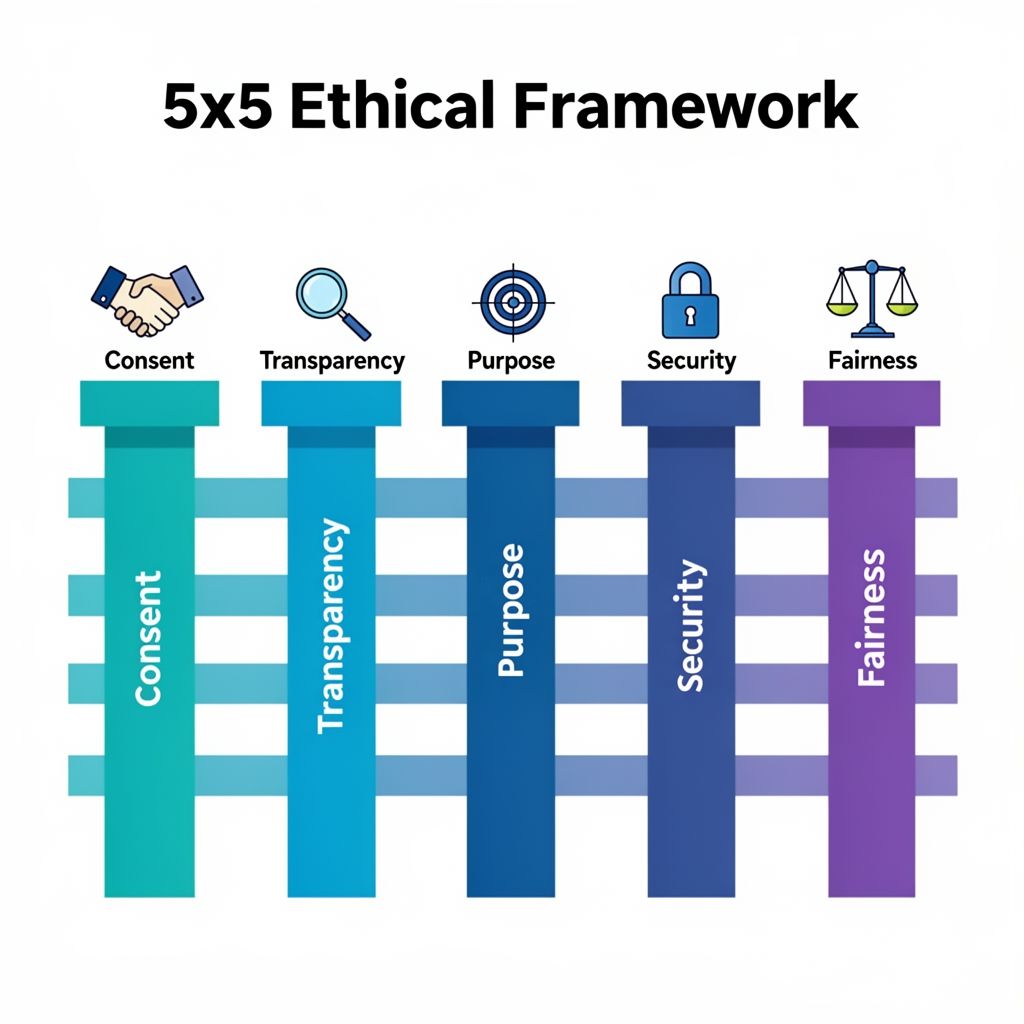
3. Principle: Purpose & Scope Limitation
Implementation: This is your primary defense against misuse. It means technically and contractually binding the voice model to a specific purpose. Action 1: Use cloning tools that allow for "purpose-locked" models. These are trained on a subset of data optimized for a specific task (e.g., speech correction vs. generative storytelling), reducing generalizability. Action 2: In your contract, explicitly list prohibited uses (e.g., "not for use in political advertisements, commercial endorsements, or content outside the podcast genre"). Action 3: Implement access controls. The raw model files should not be downloadable by every editor; access should be logged and limited. Action 4: Use synthetic voice detection software on your own outputs as a compliance check. Action 5: Conduct quarterly audits of all generated content against the original consent forms.
4. Principle: Security-First Stewardship
Implementation: Treat voice data like biometric data—because that's what regulators are starting to do. A breach isn't just a data leak; it's the potential release of someone's vocal identity. Step 1: Data Minimization: Only upload the cleanest, necessary audio (15-20 minutes is often sufficient). Don't upload entire raw interview files. Step 2: Encryption: Ensure data is encrypted at rest and in transit. Prefer tools that offer zero-knowledge encryption, where even the vendor can't access your raw audio. Step 3: On-Premise Option: For high-profile guests, invest in tools that allow local, offline training and synthesis. It's more expensive but eliminates cloud risk. Step 4: Deletion Protocols: Have a scheduled, automated deletion plan for source audio after model creation, and for models after project completion. Step 5: Breach Plan: Have a legally mandated response plan for a data breach, including notification procedures for affected voice subjects.
5. Principle: Proportionality & Fair Compensation
Implementation: The ethical use of a voice actor's clone is fundamentally different from that of a one-time guest. Step 1: For professional voice talent, negotiation is mandatory. Standard rates in 2026 are moving toward a hybrid model: an initial buyout fee for model creation (range: $2,000-$10,000) plus a usage royalty or a recurring license fee per hour of synthesized audio. Step 2: Use is proportional. Don't use a cloned voice for 90% of an episode if the human could reasonably record it. Reserve it for scale (multilingual), accessibility (creating a version for hearing-impaired audiences with clearer diction), or impossibility (posthumous use). Step 3: Establish a clear chain of title. Who owns the model? Often, it should be the voice subject, with the podcaster holding a license. Step 4: For deceased subjects, work with estates, not just assume public domain. Step 5: Allocate part of your cloning budget (5-10%) for an independent ethics review by a media ethics consultant for high-stakes projects.
Tool Landscape 2026: Choosing Your Ethical Stack
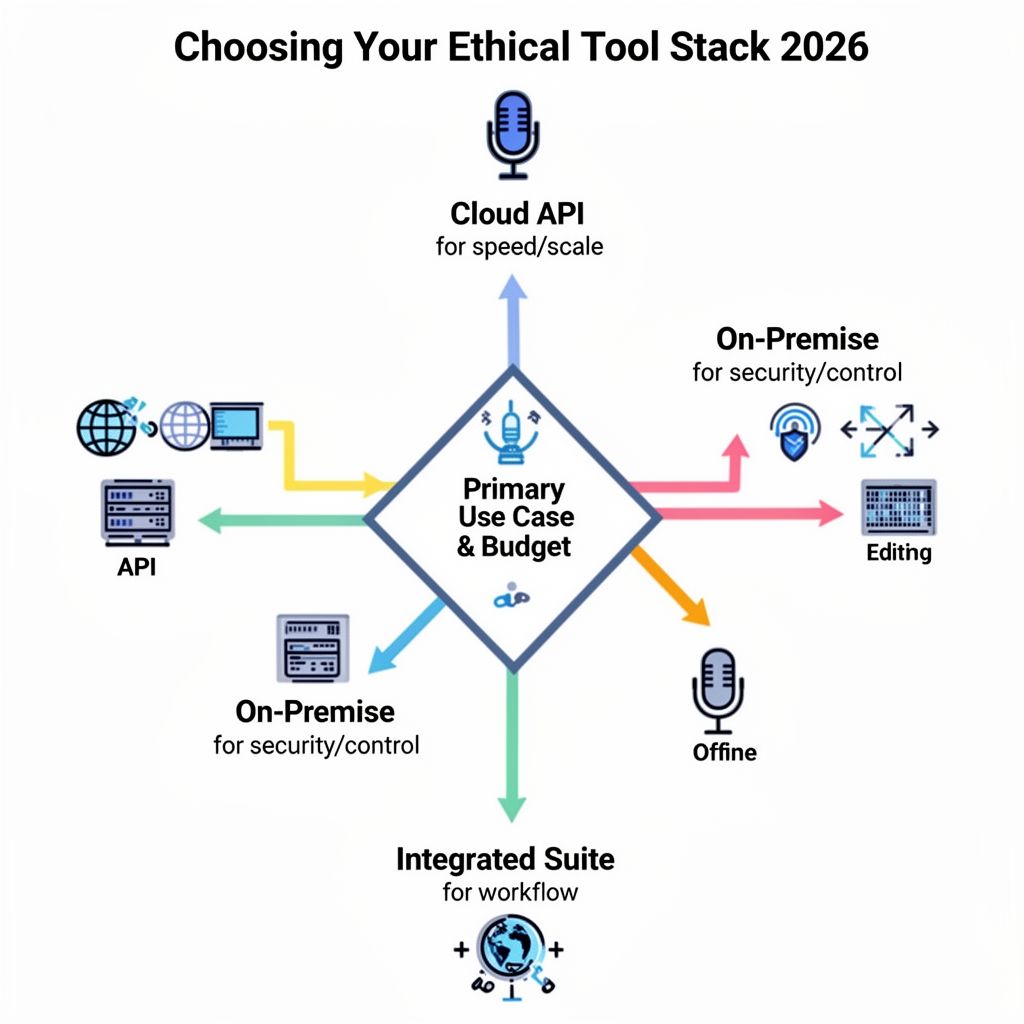
The tool you choose dictates your ethical capabilities. Free, consumer-grade web apps are designed for ease, not compliance. Here’s a breakdown of the current tool categories, mapped to the 5x5 Framework.
| Tool Type | Examples (2026) | Best For | Ethical Pros | Ethical Cons & Gaps |
|---|---|---|---|---|
| Cloud API Services | ElevenLabs Pro, Play.ht Enterprise, Resemble.ai | Small teams, rapid prototyping, multilingual dubbing. | Strong security, audit logs, some offer consent management dashboards. | You surrender control of voice data to a 3rd party. License terms can be predatory. Hard to enforce true deletion. |
| On-Premise / Local Software | MyOwnVoice Toolkit, OpenVoice (custom deploy), Coqui TTS | High-security projects, working with sensitive guests, legal compliance. | Maximum data control. Can be air-gapped. Enables true purpose limitation. | High technical overhead ($$). Requires in-house ML ops skills. Less polished outputs. |
| Blockchain-Verified Platforms | VeriVoice, AuthenticAI (emerging) | Provenance tracking, immutable consent records, premium documentary work. | Tamper-proof ledger of consent and use. Ideal for transparency principle. | Emerging, less stable. Expensive. Complex for guests to understand. |
| All-in-One Podcast Suites | Descript (Overdub), Adobe Podcast AI | Podcasters already in these ecosystems, simple correction tasks. | Deeply integrated workflow. Consent is part of the standard project flow. | Often lack granular control. Tools are general-purpose, not designed for high-stakes cloning. |
The decision matrix is simple: If you're cloning a guest's voice for a one-time fix, a reputable cloud API with a strong ToS is likely sufficient. If you're building a long-term, branded "voice" for your host or working with A-list talent, the investment in an on-premise or highly secure enterprise solution is non-negotiable. Always run a pilot project with clean, consented data before committing to a platform.
Budget & Timeline: Realistic Planning for 2026
Ethical implementation costs time and money. Here’s what it realistically looks like across three podcast team sizes.
Solo Podcaster / Indie Creator ($100-300/month budget)
Timeline to First Ethical Use: 3-4 weeks. Most of this is process setup, not tech. Tool Stack: A premium cloud API like ElevenLabs ($22/month) for the cloning itself. Use Calendly + Paperform to create a consent intake workflow. Use Descript for editing, which has built-in, simple cloning for corrections. Key Investment: Your time drafting a solid, plain-language consent form (consider a one-time $500 legal consult). Security: Rely on the cloud provider's SOC2 compliance. Use a unique, strong password and 2FA. Common Pitfall: Skipping the formal consent for "small fixes." This builds a bad habit and a portfolio of unconsented models.
Mid-Sized Podcast Network (3-5 shows, $500-1500/month budget)
Timeline to Systematization: 8-12 weeks. Tool Stack: Enterprise tier of a cloud API ($300+/month) for team seats. Airtable or Notion to build a guest database with consent status and model IDs. Possibly a dedicated tool like VoiceHub for management. Key Investment: A part-time production coordinator (10 hrs/week) to manage the consent and compliance workflow. Budget for per-guest model fees or talent payments. Security: Implement a central vault (like 1Password) for tool credentials. Restrict model creation access to senior producers. Compliance Link: This is where your processes start to intersect with broader data governance. Review our 2026 GDPR Compliance Sprint for parallel frameworks on data subject rights.
Enterprise Media Company / Large Studio ($3000+/month budget)
Timeline to Full Compliance: 6 months. This is a core infrastructure project. Tool Stack: Mix of on-premise solutions for high-value voices and enterprise cloud with custom contracts. Custom-built internal dashboard for consent and lifecycle management. Key Investment: Legal counsel to draft bespoke talent agreements. A dedicated role (or fraction of a CTO's role) for synthetic media governance. Security: Full SaaS stack security protocols apply. Isolate voice data on separate, encrypted servers. Regular third-party security audits. Output: A formal, internal Ethical AI Voice Cloning Policy document that is part of all employee onboarding.
What Most Podcasters Get Wrong (And How to Fix It)
- Mistake: Burying consent in the general guest release form. Voice cloning consent must be separate, prominent, and specific. The fix: Use a dedicated, digital form that explains the what, why, and how of cloning before asking for a signature.
- Mistake: Assuming "for this podcast" is sufficient scope. This is vague and will be challenged. The fix: Define the use cases with examples. "For audio correction, for creating promotional snippets of less than 60 seconds, and for generating episode recap summaries in your voice." List exclusions explicitly.
- Mistake: Not planning for model deletion. You create a model, use it, and forget it. It sits on a server, a liability. The fix: Set a calendar alert for the model's expiration date. Have a process to delete source audio immediately after model training and delete the model itself after the license term ends.
- Mistake: Using the same tool for everything. A tool great for cloning your co-host's voice for show intros may be ethically and legally unfit for cloning a celebrity interview subject. The fix: Maintain a tiered tool strategy. Have a "high-trust" tool for internal voices and a more secure, contract-heavy process for external voices.
- Mistake: Ignoring the audio watermarking arms race. As synthetic media becomes common, bad actors will strip simple watermarks. The fix: Don't rely on a single method. Use a layered approach: an inaudible watermark + a verbal cue + metadata. Assume one layer will fail.
- Mistake: Failing to account for moral rights. In many jurisdictions, a person has the right to object to a derogatory use of their likeness, even if they consented. The fix: In your contract, include a clause allowing the voice subject to review and object to the context of final synthetic usage, not just the initial creation.
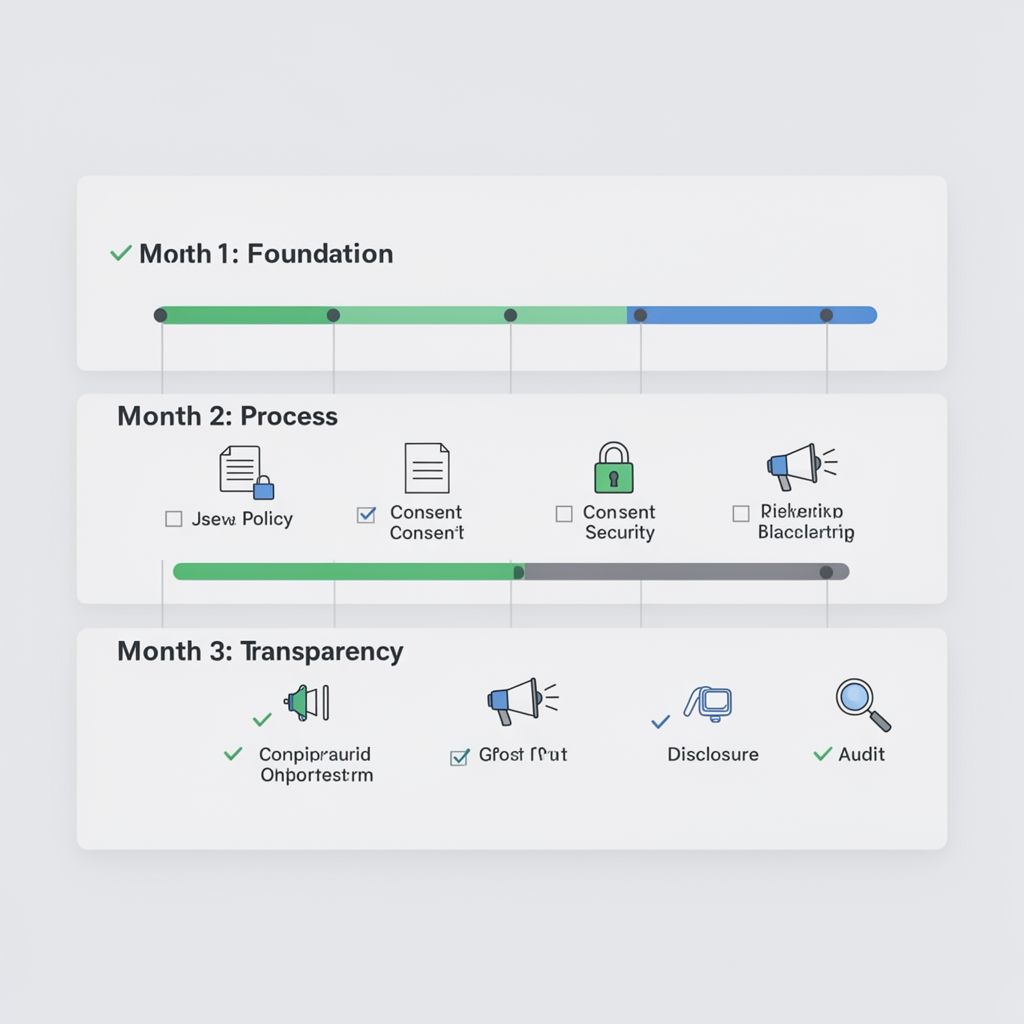
Your 90-Day Implementation Checklist
Start here. Don't try to do everything at once.
Month 1: Foundation & Policy
- [ ] Draft a one-page Internal Ethical Policy for voice cloning (state your core principles).
- [ ] Create two consent form templates: one for voice talent (paid, detailed), one for guests (limited scope).
- [ ] Choose your primary tool based on your budget and primary use case (see table above).
- [ ] Designate one person as the responsible steward for the process.
Month 2: Process & Security
- [ ] Map your guest intake workflow. Where does the consent form get sent and signed? Where is it stored?
- [ ] Set up a secure, encrypted repository (like a dedicated Google Drive folder or Airtable base) for signed consents and voice model IDs.
- [ ] Implement basic security: strong passwords, 2FA on your cloning tool account.
- [ ] Run a pilot project. Clone the voice of a willing team member for a non-critical task. Document every step.
Month 3: Transparency & Scale
- [ ] Finalize your listener disclosure method (e.g., verbal cue wording, show notes boilerplate).
- [ ] Create a public-facing page (e.g., your website's "ethics" page) explaining your use of AI voice technology.
- [ ] Audit any existing voice models or clones you have. Do you have consent records for them? If not, decide: delete them or seek retroactive consent.
- [ ] Review and iterate. Bring your team together to discuss the pilot's challenges and update your one-page policy.
Frequently Asked Questions
What are the most immediate ethical implications of voice cloning in TTS for podcasting?
The most immediate implications are consent erosion and authenticity decay. It becomes trivially easy to put words in someone's mouth during editing, which pressures producers to "clean up" or even alter quotes without the speaker's true knowledge. This breaks the fundamental contract of audio journalism and interview-based podcasts. To mitigate this, your ethical framework must treat the cloned voice as a direct extension of the person, subject to the same journalistic standards of accuracy and integrity. The technical ease of the action must be met with proportional procedural friction, like mandatory second-party verification of any synthesized segment before publication.
How can I ethically clone a voice for a podcast if the person is deceased?
Posthumous voice cloning is one of the most sensitive applications. Ethical legitimacy does not come from technical capability, but from legal and moral authority. First, you must secure consent from the estate or rightful heirs—this is a legal requirement in jurisdictions with postmortem publicity rights. Second, consider the intent and proportionality. A tribute episode using short, carefully selected phrases to honor the individual is more justifiable than creating new, fictional dialogue. Third, transparency is paramount. The disclosure to listeners must be explicit, upfront, and respectful. Finally, involve those who knew the person in the review process to ensure the use feels appropriate and honors their legacy.
What are the biggest AI voice cloning legal issues I should prepare for in 2026?
Prepare for litigation in three key areas: copyright infringement (using a voice as a unique, protectable performance), violation of publicity rights (using a voice for commercial benefit without permission), and defamation (using a cloned voice to make someone say something false and damaging). In 2026, the legal frontier is "prompt injection" or unauthorized use of a model beyond its licensed scope. Your defense is your documentation. Meticulous consent forms that define scope, coupled with immutable usage logs from your AI tools, will be your primary legal shield. Proactively consulting with a media lawyer to draft these documents is a critical investment, much like the foundational work in our guide on pre-seed financial modeling for startups.
Which AI voice cloning tools for 2026 best support ethical compliance?
Look for tools that provide built-in features for ethical workflows, not just high-quality output. The best tools will offer: 1) Integrated consent capture and management, 2) The ability to set usage limits and expiration dates on models, 3) Detailed audit logs of when and how a model was used, 4) Strong data security certifications (SOC 2, ISO 27001), and 5) Clear, creator-friendly terms of service that do not claim broad rights over your input or output data. As of this writing, enterprise tiers of platforms like ElevenLabs and Play.ht are leading in these areas, while open-source frameworks like Coqui offer the ultimate control for teams with technical resources to build their own compliance layer.
How do I prevent my cloned voice assets from being used for identity theft or deepfakes?
Prevention is a combination of security, contracts, and monitoring. Securely: Store voice model files and source audio in encrypted storage with strict access controls. Never share model files via unsecured channels. Contractually: Include clauses in your talent/guest agreements that prohibit them from redistributing the model files you create. Use tools that offer encrypted, non-downloadable model hosting. For monitoring: Set up Google Alerts for the names of your key voice subjects paired with terms like "AI voice" or "deepfake." Consider using AI detection services to periodically scan the web for unauthorized synthetic voice content matching your assets. This proactive defense mirrors the mindset needed for broader digital governance and reporting.
Is it ethical to use AI to clone my own voice for my podcast?
Cloning your own voice is ethically simpler but not devoid of considerations. The primary issue is listener transparency. If you use your clone to generate full episodes you never spoke, you are shifting the nature of the medium from a recorded performance to a generated one. This should be disclosed. Ethically, you must also guard against misuse of your own model—secure it as you would any valuable digital asset. Furthermore, consider the impact on your industry. If every host uses clones to quintuple output, it devalues human-created content and pressures others to do the same. The ethical choice involves setting personal boundaries (e.g., "I only use my clone for correcting flubs or generating short ad reads") and being honest with your audience about your process.
What does a 2026-compliant voice cloning consent form look like?
A 2026-compliant form is a dynamic document, not a static PDF. It should be digital, allow for clear selection of options, and be stored with a verifiable timestamp. Key sections include: 1) Plain Language Explanation: A short video or text explaining what cloning is and how it will be used. 2) Grant of Permission: Specific checkboxes for different uses (e.g., correction, promotion, translation). 3) Scope & Limits: Fields to specify the project name, episode numbers, and expiration date. 4) Compensation: Clear terms for any payment or royalty. 5) Revocation Clause: Instructions on how to withdraw consent and what happens (e.g., existing episodes remain, future use stops). 6) Data Handling: A description of how the voice data will be secured and eventually deleted. Tools like DocuSign or Notarize can provide the necessary audit trail.
The Path Forward: Responsible Innovation
The goal of this guide isn't to scare you away from AI voice cloning, but to equip you to use it powerfully and responsibly. In 2026, the podcasters who thrive will be those who see ethics not as a constraint, but as a competitive advantage—a sign of quality, trust, and respect for their audience and collaborators. The technology will continue to advance faster than the law, making your self-imposed framework your most important governance tool.
Your specific, actionable next step for today is this: Open a blank document and write your one-page "Statement of Principles for Synthetic Voice Use." Don't worry about it being perfect. Just answer: Why might we use this? What will we never use it for? Who is accountable? This 15-minute exercise forces the clarity you need before you ever click "train model." From there, you can build the consent forms, choose the tools, and implement the processes outlined here. The future of audio is synthetic, but its trust is built on the human decisions we make today.
Boomlify Team