

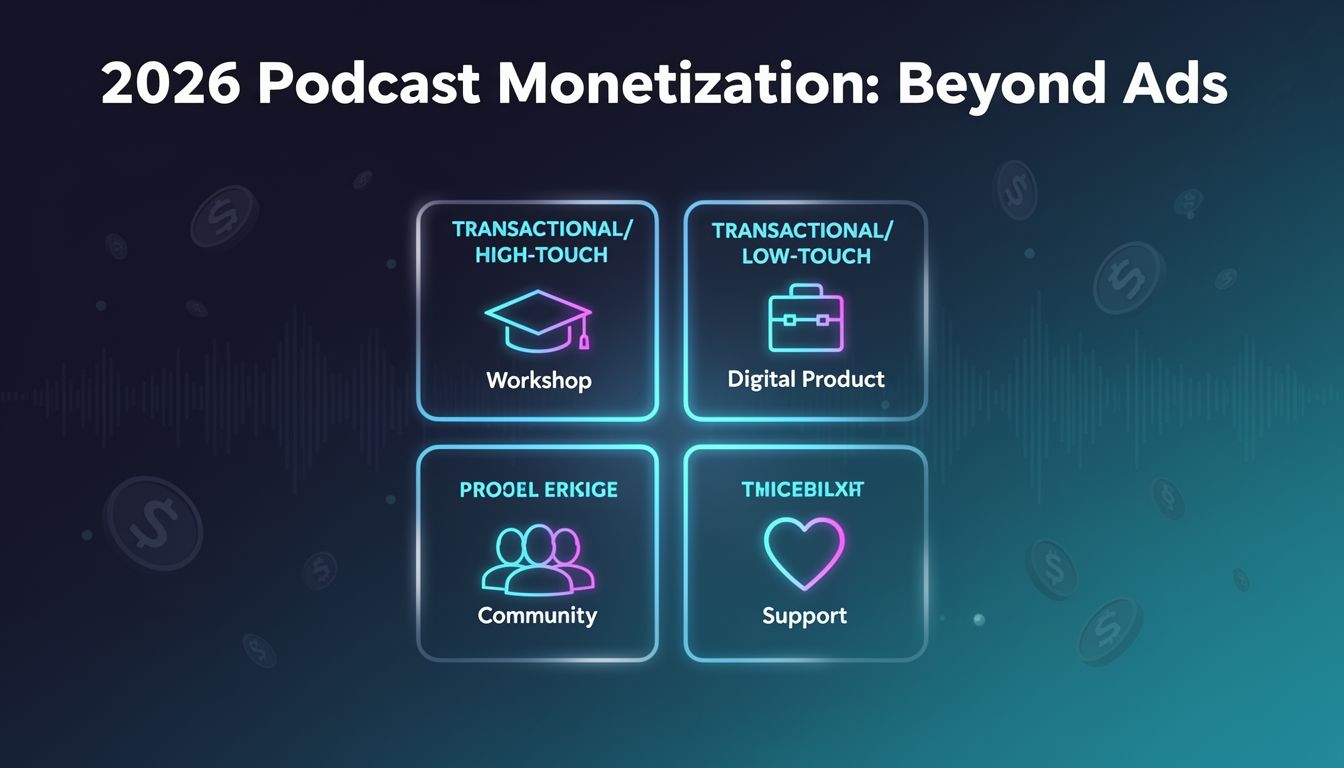
2026 Podcast Monetization: Beyond Ads Strategies for Niche & B2B Success
Boomlify Team
Content Creator
2026 Podcast Monetization: Beyond Ads Strategies
Table of Contents
- The 2026 No-Ads Monetization Matrix: A 4-Quadrant Framework
- Step-by-Step: Building Your Primary Revenue Stream (2026 Edition)
- Phase 1: The Deep-Dive Audience Audit (Weeks 1-2)
- Phase 2: The Minimum Viable Product (MVP) Test (Weeks 3-4)
- Phase 3: Product Scaffolding & Packaging (Weeks 5-8)
- Phase 4: The Integrated Launch Cycle
- Phase 5: Systematization & Scale
- Monetization Channel Deep Dives: 2026 Tactics
- Digital Products & Workshops: The High-Margin Engine
- Strategic Affiliate Partnerships (Not Just Links)
- Membership & Community Models That Actually Work
- YouTube as a Monetization Multiplier (Not Just a Repost)
- Comparison: Choosing Your Primary 2026 Monetization Path
- What Most Podcasters Get Wrong (And How to Fix It)
- Realistic Budgets & Timelines by Podcast Stage
- Bootstrapped Solo Creator (< 1k downloads/episode)
- Growing Niche Authority (2k-10k downloads/episode)
- Established B2B / Industry Show (10k+ downloads/episode)
- Frequently Asked Questions
- How do I monetize a podcast with a small audience (under 1,000 listeners)?
- What's the best no-ads monetization strategy for B2B podcasts in 2026?
- Can I really make money from a podcast without sponsors or ads?
- How do I integrate video (YouTube) without doubling my work?
- What’s a realistic percentage of listeners who will become paying customers?
- How do I choose between a membership model and selling digital products?
- Are paid newsletter platforms like Substack a good podcast monetization method?
- What's the biggest ethical pitfall in no-ads monetization?
Let’s be real: if you have fewer than 10,000 downloads per episode, sponsorships are a waste of your time. You’ll burn hours pitching for $50 CPMs while devaluing your credibility. The old playbook of chasing ads and mid-roll reads is breaking for niche and B2B creators. In 2026, the most successful podcasters I work with—the ones building sustainable six-figure revenue businesses—aren't chasing advertisers. They’re building monetization models directly aligned with their audience's deepest needs, treating their podcast as the core of a diversified product ecosystem. This guide provides a step-by-step, tactical blueprint for implementing those models, specifically for podcasts with smaller, dedicated audiences and B2B industry shows. You’ll learn the exact frameworks, from assessing your audience's commercial intent to launching your first high-value digital product, without ever splicing in an ad.
The 2026 No-Ads Monetization Matrix: A 4-Quadrant Framework
Forget lists. You need a strategic model to diagnose your audience and choose your primary monetization vector. Over the last two years, I’ve developed a simple but powerful matrix that evaluates your podcast across two axes: Audience Mindset (Transactional vs. Aspirational) and Value Depth (High-Touch vs. Low-Touch). This determines your optimal entry point.
Transactional audiences are actively seeking solutions to a specific, often professional, problem. Think developers listening to a show about cloud architecture or marketers listening to a SaaS growth podcast. Aspirational audiences are engaged in a topic for personal enrichment or community—think a history podcast or a show about mindfulness. Value Depth refers to the intensity of the transformation you offer. A high-touch outcome, like mastering a complex skill, justifies a premium price. A low-touch outcome, like entertainment or a quick tip, supports a lower-friction model.
Here’s how the matrix breaks down:
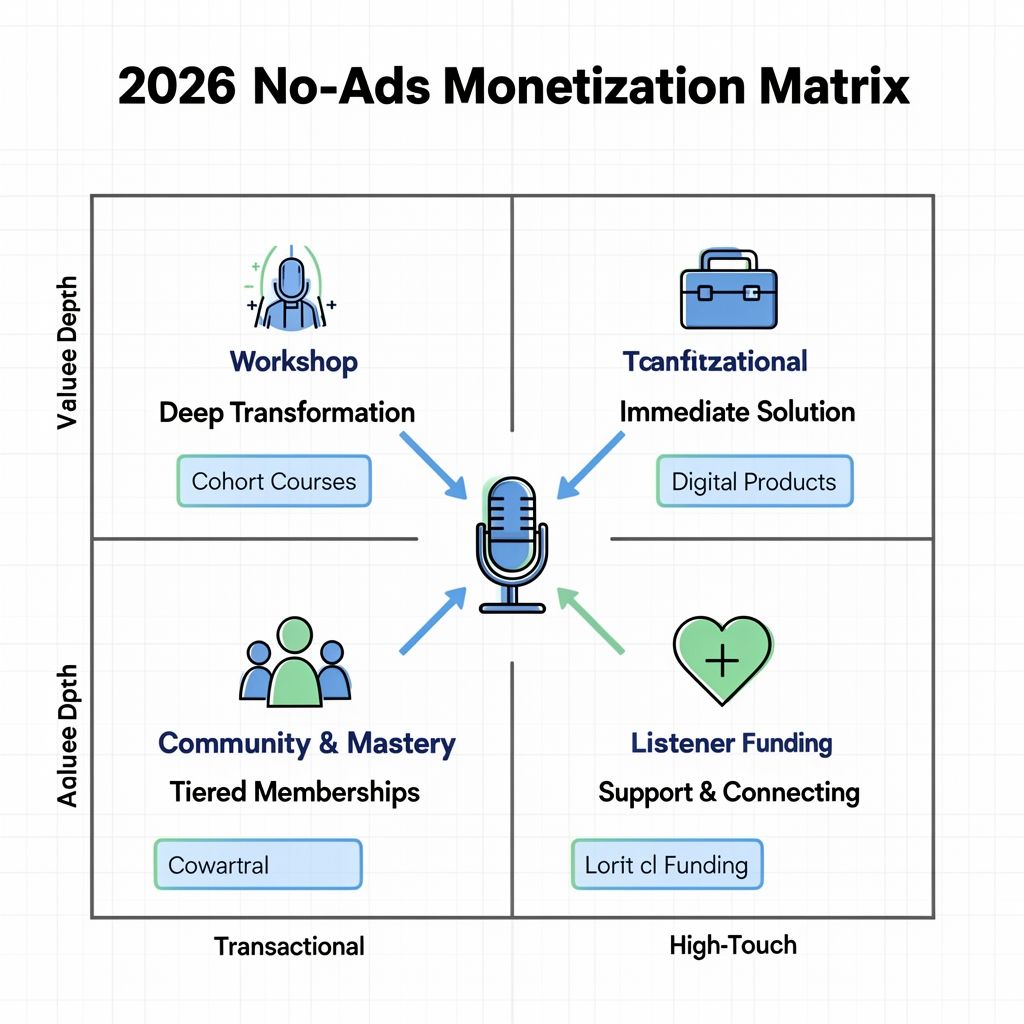
- Quadrant 1: Transactional + High-Touch. Your audience needs a deep, expert-led transformation. Primary Monetization: Premium workshops, cohort-based courses, or high-tier consulting. For example, a B2B cybersecurity podcast sells a $3,500 8-week ‘CISO Tabletop Exercise’ workshop to 15 listeners. The podcast episodes serve as lead gen and proof of expertise.
- Quadrant 2: Transactional + Low-Touch. Your audience needs specific, actionable tools or information to solve an immediate problem. Primary Monetization: Digital product suites (templates, swipe files, toolkits), curated affiliate deals, or low-cost SaaS tools. A podcast for freelance writers sells a $97 ‘Pitch Database’ and earns 40% affiliate commissions on recommended writing software.
- Quadrant 3: Aspirational + High-Touch. Your audience seeks community and guided mastery in a passion area. Primary Monetization: Tiered membership communities (e.g., Patreon, Circle.so) with exclusive content, live Q&As, and mastermind access. A philosophy podcast runs a $25/month ‘Socratic Salon’ with 400 members.
- Quadrant 4: Aspirational + Low-Touch. Your audience primarily seeks engaging content and a sense of connection. Primary Monetization: Voluntary listener support (Buy Me a Coffee, Ko-fi), paid early access, or small-scale digital products (e.g., episode transcripts, eBooks). A true crime podcast offers ad-free episodes 48 hours early for $5/month.
The first step is to honestly plot your show. A B2B SaaS podcast is almost always in Quadrant 1 or 2. A hobbyist woodworking podcast likely sits in Quadrant 3. This placement dictates your entire strategy and resource allocation.
Step-by-Step: Building Your Primary Revenue Stream (2026 Edition)
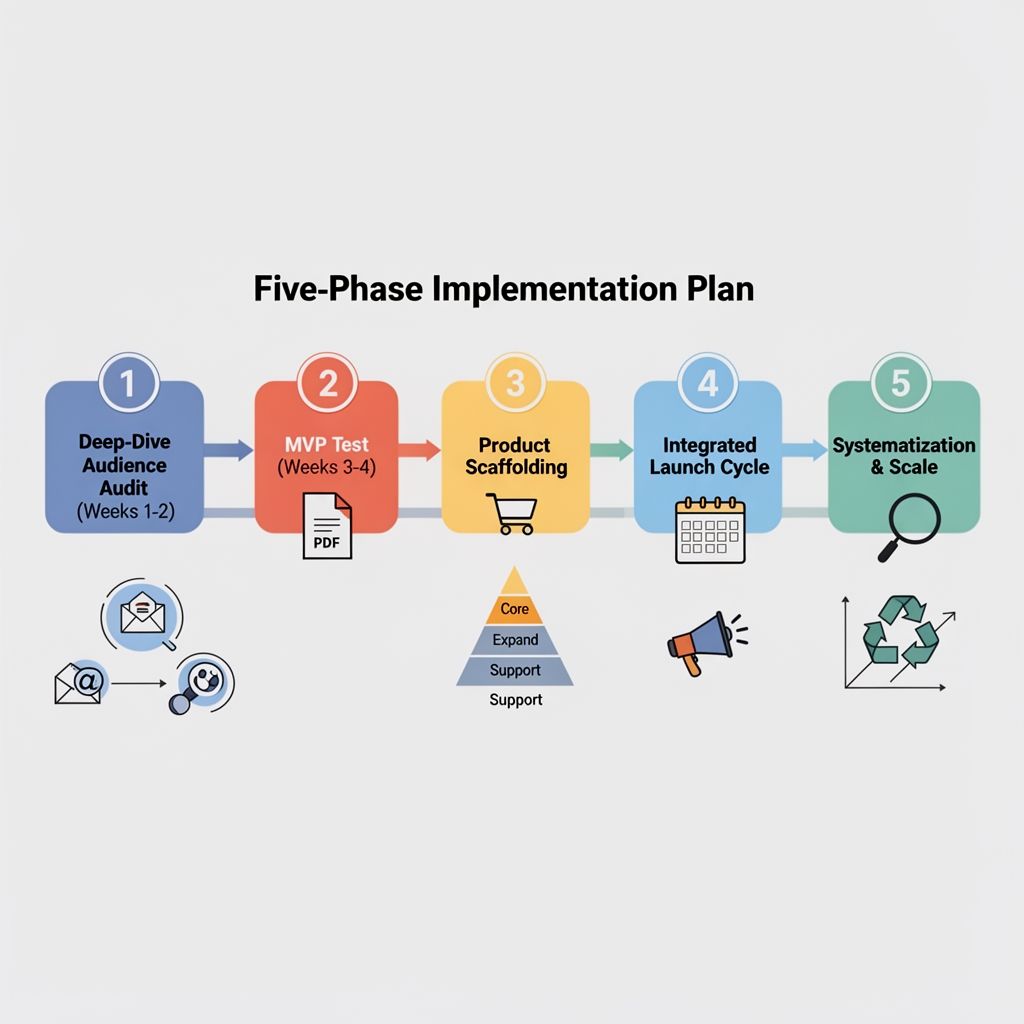
Once you've identified your quadrant, follow this five-phase implementation plan. I’ve seen creators skip Phase 2 and launch a $200 course to crickets; this sequence prevents that.
Phase 1: The Deep-Dive Audience Audit (Weeks 1-2)
Don't guess what your audience will buy. Audit your existing engagement to find commercial intent. Tools like Podsights (for attribution) are useful, but start manually.
- Analyze 100+ listener emails/DMs: What are they asking for help with? Categorize questions into “How do I…”, “What tool for…”, and “Can you recommend…”.
- Run a single-question poll via your newsletter or social: “What’s the ONE thing holding you back from [achieving the podcast’s core topic goal]?” Offer three multiple-choice answers you hypothesize plus “Other.”
- Scour Reddit, niche forums, and LinkedIn groups where your listeners congregate. Use tools like SparkToro to understand their pain points. The goal is to identify a specific, urgent problem they’re willing to spend money to solve.
Phase 2: The Minimum Viable Product (MVP) Test (Weeks 3-4)
Before you build a full course or SaaS tool, validate demand with a low-effort offer. This is the most skipped and most critical step.
- For Quadrant 1/2 (Transactional): Create a detailed PDF guide or a Notion template addressing the #1 pain point from your audit. Price it at $27-$47. Announce it in a single podcast episode, framing it as a “deep-dive resource I made for you.” Don’t create a sales page; use a simple Gumroad or Lemon Squeezy link. Track conversions. Aim for a 1-2% conversion rate from episode listeners to buyers as validation. If you get 2,000 listens and 20 sales at $47, you’ve validated a $940 product and a willing audience.
- For Quadrant 3/4 (Aspirational): Launch a “Founding Member” tier on Patreon or Ko-fi. Offer one compelling, exclusive benefit (e.g., a monthly bonus episode, a behind-the-scenes newsletter). Promote it for two weeks. If you can convert 2-5% of your most engaged listeners (those who email you), you have a viable community model.
Phase 3: Product Scaffolding & Packaging (Weeks 5-8)
Based on MVP results, build out your core revenue product. Structure it using the “Core, Expand, Support” model:
- Core Product (80% of revenue): This is your flagship offer. For Quadrant 1, it’s a $1,500-$5,000 workshop or course. For Quadrant 2, it’s a $97-$297 digital toolkit. For Quadrant 3, it’s a $20-$50/month membership. For Quadrant 4, it’s a $5-$10/month support tier.
- Expand Product (15% of revenue): An upsell or companion. A course add-on like 1:1 office hours. A membership tier with physical merch. A template bundle extension.
- Support Product (5% of revenue): Low-friction, one-time offers. An eBook, a recorded webinar replay, or a curated list of resources.
Your podcast content should now explicitly support this product ladder. Episodes should provide immense value while naturally pointing to the deeper, paid solution you offer.
Phase 4: The Integrated Launch Cycle
Launch your product to your existing audience using a content-driven, soft-launch sequence—no hard sales blitz.
- Episode Teaser (2 weeks out): Record an episode tackling a related problem. In the outro, casually mention you’re “putting together something more structured to solve this” and invite listeners to join a waitlist via your newsletter for early details. This builds a pre-qualified list.
- Episode Deep-Dive (Launch week): Release your best-ever episode on the core topic. Provide a complete, actionable framework. At the end, announce your paid product as the “done-for-you” or “guided” version of what you just taught. Offer a launch discount for the first 48 hours or first 50 buyers.
- Email Sequence: A three-email sequence to your waitlist: 1) The problem (story), 2) The solution (your framework), 3) The tool (your product with a clear call to action).
Phase 5: Systematization & Scale
Document this launch process. Create templates for your email sequence, episode scripts, and sales page. Now, you can run this cycle 2-3 times per year, each time with a new or updated product. This turns monetization from a desperate scramble into a predictable, repeatable business process.
Monetization Channel Deep Dives: 2026 Tactics
Digital Products & Workshops: The High-Margin Engine
For B2B and niche expertise podcasts, digital products are your profit center. The key in 2026 is moving beyond generic eBooks to “actionable systems.” A podcast about ESG reporting should sell a plug-and-play ESG dashboard template in Google Sheets, not a PDF about sustainability. A show for startup founders should offer a Notion-based pre-seed financial model, not just advice.
Workshops have evolved from webinars to cohort-based experiences. Use platforms like Maven or Circle to run a 4-6 week live workshop with weekly Zoom sessions, a dedicated community space, and peer accountability. Price between $500 and $5,000. Your podcast is your marketing funnel; the workshop is your high-touch service product. The margins are 80%+ after platform fees.
Strategic Affiliate Partnerships (Not Just Links)
Affiliate revenue in 2026 is about deep integration, not passive links. The most successful podcasters negotiate custom commission structures (25-40% instead of standard 5-10%) by offering value beyond a promo code.
- Create a dedicated “Tools & Resources” page on your website, curated and annotated.
- Record a mini-review episode or a detailed tutorial showing how you use the tool to solve a specific problem you’ve covered on the show.
- Bundle affiliate tools into your digital products. Your $297 “Content Marketing Toolkit” can include exclusive discounts for recommended SEO, graphic design, and email marketing software, with you earning on every conversion.
Focus on 3-5 core tools your audience genuinely needs. Promoting 50 different products dilutes your authority and cripples your earnings.
Membership & Community Models That Actually Work
The “$5/month for bonus content” model is saturated. In 2026, successful communities are built around access and acceleration.
- Tier 1: Accelerator ($20-$50/month): Monthly masterclass workshops (live), exclusive Q&A threads, and a curated resource vault.
- Tier 2: Inner Circle ($100-$300/month): Small-group mastermind sessions (6-10 people), direct messaging with you, and early feedback on your work.
Use a platform like Circle that combines forums, events, and courses. The podcast episode becomes the “front porch” that invites listeners into the “living room” of the paid community. Limit tiers to two, and always offer a clear, tangible outcome for joining.
YouTube as a Monetization Multiplier (Not Just a Repost)
Uploading your audio with a static image is a wasted opportunity. In 2026, YouTube Podcast SEO is a distinct strategy. Repurpose your podcast into multiple high-engagement YouTube assets to drive traffic to your core offers:
- Clips Channel: Create a separate YouTube channel posting 60-90 second hooks from your episode. Some creators utilise a text to video workflow to quickly transform key podcast moments into short visual clips. Use bold captions and fast cuts. Link in the description to the full episode (on your site or main channel) and your lead magnet.
- Visual Deep-Dives: For your main channel, film yourself recording key segments. Use screen shares to show data, diagrams, or tools you’re discussing. This visual context makes the abstract concrete and builds greater trust.
- YouTube-Exclusive Series: Create a short, complementary video series that expands on a podcast topic. Offer the “next step” in the video description—a free webinar that promotes your digital product.
YouTube’s algorithm favors watch time and session duration. A viewer who watches your clip, clicks to your full episode, and then browses your website creates powerful signals that can drive significant traffic to your monetization hub.
Comparison: Choosing Your Primary 2026 Monetization Path
| Strategy | Best For Audience Size | Time to First Revenue | Revenue Potential (per 1k Engaged Listeners) | Key Success Metric | Biggest Pitfall |
|---|---|---|---|---|---|
| Digital Product Suite (Templates, Toolkits) | 1,000 - 10,000 | 4-6 weeks | $5,000 - $25,000 | Conversion Rate (Aim for 2-5%) | Creating a product in a vacuum without MVP testing. |
| Cohort-Based Workshop | 500 - 5,000 | 8-12 weeks | $15,000 - $75,000 (for 15-30 students) | Student Completion Rate (>80%) & NPS Score | Underestimating the live facilitation and support workload. |
| Tiered Membership Community | 2,000 - 20,000 | 2-4 weeks | $2,000 - $10,000/month (MRR) | Monthly Retention Rate (>95%) | Failing to provide ongoing, unique value, leading to churn. |
| Strategic Affiliate Funnels | Any size, but needs high intent | 1-2 weeks | $500 - $5,000/month | Earnings Per Click (EPC) | Promoting too many or low-quality products, damaging trust. |
| Listener Support / Donations | 5,000+ (with super-fans) | 1 week | $200 - $2,000/month | Number of Sustaining Supporters | Being vague about how funds are used; lack of donor perks. |
What Most Podcasters Get Wrong (And How to Fix It)
- Mistake: Monetizing too early, before establishing core value. You need 15-20 episodes that consistently solve a specific problem before anyone will pay you. Fix: Map out your first 20 episodes as a “free foundation course.” Only then introduce a paid “advanced track.”
- Mistake: Creating a product nobody asked for. Building a $997 course because you see others doing it, without validating demand. Fix: Implement the MVP Test (Phase 2) with a <$50 product. Let sales data guide your investment.
- Mistake: Treating all listeners the same. Your super-fans (the 5% who email you) have different needs and willingness to pay than your casual listeners. Fix: Segment your audience. Create offers specifically for super-fans (high-touch, high-price) and broader offers for the general audience (low-touch, low-price).
- Mistake: Ignoring the backend tech stack. Using five different, unconnected platforms (Mailchimp, Gumroad, Patreon, Zoom) creates a terrible user experience and operational hell. Fix: Choose a central hub. For most, this is a professional email service provider (ConvertKit, Beehiiv) connected to a robust digital product platform (Podia, Kajabi, Lemon Squeezy).
- Mistake: Underpricing due to imposter syndrome. Pricing a 4-week workshop at $197 when your listeners are B2B professionals whose time is worth $300/hr. Fix: Price based on the value of the outcome, not the cost of your time. If your workshop helps a founder raise $500k, a $5,000 price tag is a no-brainer. Survey your audience on what they’ve paid for similar solutions.
Realistic Budgets & Timelines by Podcast Stage
Your monetization runway depends on your starting point. Here’s what to expect:
Bootstrapped Solo Creator (< 1k downloads/episode)
- Monthly Budget: $50-$100. Spend on a good microphone, basic hosting (Buzzsprout, Captivate), and a landing page tool (Carrd, ConvertKit Free).
- Primary 2026 Strategy: Affiliate Funnels + Low-Cost Digital Product. Create one incredible $27-$47 template or guide based on listener questions.
- Realistic Timeline to $1k MRR: 6-9 months. Focus on depth over breadth. Nail a single offer.
- Tool Stack: Buzzsprout ($12/mo), ConvertKit Free, Gumroad (10% fee), Canva Pro ($13/mo).
Growing Niche Authority (2k-10k downloads/episode)
- Monthly Budget: $200-$500. Invest in professional editing, a premium email service provider, and a community platform.
- Primary 2026 Strategy: Tiered Membership or Digital Product Suite. Launch a $20/month community tier and a $197 flagship toolkit.
- Realistic Timeline to $5k MRR: 9-15 months. Systematize your launch cycle.
- Tool Stack: Captivate ($19/mo), ConvertKit Pro ($29/mo), Circle.so ($39/mo), Lemon Squeezy (5% fee + $0.50).
Established B2B / Industry Show (10k+ downloads/episode)
- Monthly Budget: $1,000+. Allocate for a part-time producer, premium analytics, and a robust course platform.
- Primary 2026 Strategy: High-Ticket Workshops + Strategic Affiliate. Run quarterly $2,500 cohort workshops and negotiate 30%+ affiliate deals with 2-3 core software vendors.
- Realistic Timeline to $20k+ MRR: 12-24 months from this stage. Build a small team to manage operations.
- Tool Stack: Transistor ($19/mo), Kajabi ($119/mo), Slack for community, AI SEO tools for content repurposing.

Frequently Asked Questions
How do I monetize a podcast with a small audience (under 1,000 listeners)?
Focus on depth, not breadth. A small, hyper-engaged audience is more valuable than a large, passive one. Start by conducting the Deep-Dive Audience Audit to identify their single biggest pain point. Then, create one highly specific, problem-solving digital product—like a detailed checklist, a Notion template, or a swipe file—and price it between $27 and $97. Promote it directly to your most engaged listeners (those who email you or comment) with a personal touch. With a 5% conversion rate from 200 super-fans, you can generate $270-$970 from a single, focused offer, proving the model before scaling.
What's the best no-ads monetization strategy for B2B podcasts in 2026?
For B2B, the highest-potential strategy is the cohort-based workshop or executive roundtable. Your podcast demonstrates thought leadership; the workshop provides implemented results. Structure it as a 4-6 week program with weekly live sessions, peer accountability, and actionable frameworks. Price it between $1,500 and $5,000 per seat, targeting the specific job titles you speak to (e.g., marketing directors, startup founders). Your podcast episodes serve as continuous lead generation, with each episode subtly highlighting a problem your workshop solves. This model builds authority and creates high-margin revenue without ad negotiations.
Can I really make money from a podcast without sponsors or ads?
Absolutely, and often more reliably. Ads tie your revenue to download numbers and the volatile ad market. Direct monetization (products, memberships) ties revenue to the perceived value you provide. I’ve seen podcasters with 5,000 engaged listeners generate $15,000+ per month through a combination of a $197 digital product (selling 30 copies/month) and a $50/month membership community (with 150 members). This is $11,850/month. To earn that from ads, you’d need roughly 80,000 downloads per episode at a $30 CPM—a far harder benchmark to hit for a niche show.
How do I integrate video (YouTube) without doubling my work?
Don't just repost audio. Use a batch-production system. Record your podcast on Zoom or Riverside with video on. From that single recording: 1) Use the audio for your podcast. 2) Use the video (with multi-camera if possible) for your main YouTube full episode. 3) Use a tool like Descript or Riverside’s editor to automatically create 3-5 short, high-impact clips (60-90 seconds) for YouTube Shorts, TikTok, and Instagram. Repurpose the transcript into a blog post and newsletter. This multiplies your content from one session with minimal extra effort. For a detailed system, see our guide on YouTube Podcast SEO Mastery.
What’s a realistic percentage of listeners who will become paying customers?
It varies wildly by model and audience intent. For voluntary listener support (donations), expect 0.5%-2%. For a low-cost digital product ($27-$97) solving a clear, transactional problem, aim for 2%-5% of your engaged listeners (those who regularly open emails or engage on social). For a high-ticket workshop ($1,500+), a 0.5%-1.5% conversion rate from your total audience is excellent. The key is segmenting your audience and measuring conversion from your warmest leads (e.g., email subscribers) rather than total downloads.
How do I choose between a membership model and selling digital products?
Use this simple decision matrix: If your audience seeks ongoing community, updates, and interaction (Aspirational/High-Touch), start with a membership. If your audience needs a specific, one-time solution to a painful problem (Transactional), start with a digital product. You can—and should—eventually do both, but lead with the one that matches your audience's primary desire. A membership requires consistent, recurring effort to provide fresh value. A digital product is a one-time creation with recurring sales, but requires marketing each new product.
Are paid newsletter platforms like Substack a good podcast monetization method?
They can be a powerful component, but rarely a standalone solution for audio-first creators. Use a paid newsletter as your “Tier 1” membership product ($5-$10/month), offering extended show notes, curated links, and exclusive analysis. However, the real leverage comes from bundling it with other perks like ad-free episodes, bonus segments, or community access to justify a higher price tier ($20-$50/month). The newsletter is the consistent touchpoint; the podcast remains the flagship brand-builder. Think of it as the connective tissue in your monetization ecosystem.
What's the biggest ethical pitfall in no-ads monetization?
The risk shifts from ad disclosure to exploitative guru culture. When you sell transformation, you must avoid overpromising results or creating false urgency. The ethical framework is simple: Your paid offer must deliver significantly more value than your free content. Be transparent about what the paid product includes and who it’s for. Avoid manipulative “fake scarcity” (e.g., “Closing cart in 24 hours!” when you reopen it monthly). Build trust by under-promising and over-delivering. For more on ethical considerations in audio, consider the implications discussed in our piece on AI Voice Cloning Ethics.
The landscape of podcast monetization in 2026 rewards specificity, direct audience value, and strategic patience. Stop chasing the dwindling returns of generic ad reads. Start treating your podcast as the core of a focused business. Your action for today: Open a document, list your last 50 listener questions, and categorize them. Within an hour, you’ll have the raw data to identify the single problem your audience is most desperate to solve. That’s the foundation of your first revenue product. Build that, and you’re not just a podcaster—you’re a sustainable media business owner.
Boomlify Team