

Startup R&D Tax Credit 2026 Strategy: Maximize Savings
Boomlify Team
Content Creator
Startup R&D Tax Credit 2026 Strategy: Maximize Savings
Table of Contents
- R&D Tax Credit Eligibility: More Than Just a Lab Coat
- What Actually Counts: Breaking Down Qualified Research Expenses (QREs)
- The Payroll Tax Offset: A Pre-Revenue Startup’s Cash Lifeline
- The 2026 Amortization Cliff and Strategic Planning
- The 5-Phase R&D Credit Implementation Framework (2026 Edition)
- Common Mistakes That Invalidate Claims or Trigger Audits
- Software R&D: A Specialized Strategy
- Implementation Roadmap: Budgets, Tools, and Timelines by Stage
- Frequently Asked Questions
- Can a pre-revenue startup with no tax liability still benefit from the R&D credit?
- Does routine software development or bug fixing qualify for the R&D tax credit?
- What is the $500,000 payroll tax offset limit? Is it per year or total?
- How do state R&D tax credits work alongside the federal credit?
- What documentation do I need to survive an IRS audit on my R&D claim?
- Should I hire a specialist firm or can my CPA handle the R&D credit?
- Your Next Step: The 2025 Pre-Cliff Assessment
You’ve spent $500,000 on developer salaries and cloud infrastructure this year, building something new. The burn rate is real, and the next fundraise is a constant pressure. Now imagine pulling $75,000 of that spend back into your runway, not as a loan or a dilutive note, but as a cash credit from the IRS. This isn't hypothetical; it’s the reality for startups that correctly harness the R&D Tax Credit. But most founders and their early-stage CPAs treat it as a messy annual afterthought, scrambling for receipts at tax time and leaving tens of thousands on the table—or worse, inviting an audit. The game is changing in 2026. This article isn’t a generic overview; it’s a forward-looking financial playbook. You'll learn how to integrate R&D credit strategy into your core financial operations, anticipate and adapt to major legislative shifts, and build a documented process that secures maximum, defensible savings for 2026 and beyond.
R&D Tax Credit Eligibility: More Than Just a Lab Coat
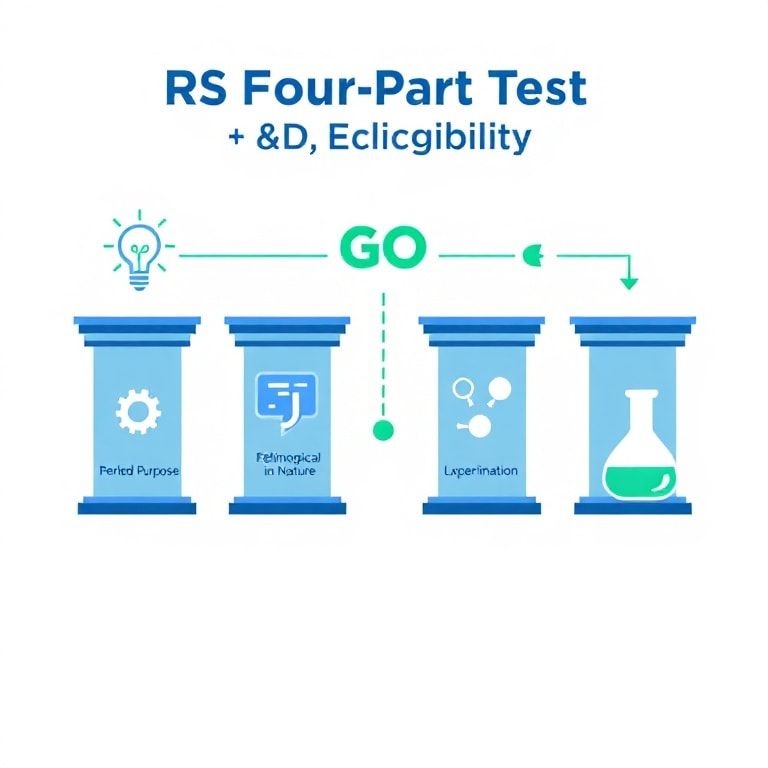
Forget the image of scientists in white coats. The IRS definition of "research" is surprisingly broad and startup-friendly. The core test, established in Section 41, is called the Four-Part Test. To claim a credit, your activities must pass all four of these gates. Let’s translate them from legalese to startup operations.
First, Permitted Purpose: The activity must aim to create a new or improved business component’s function, performance, reliability, or quality. In practice, this covers 90% of early-stage software development. Building a novel recommendation algorithm? Yes. Scaling your backend to handle 10x more concurrent users? Yes. Developing a proprietary data pipeline? Yes.
Second, Technological in Nature: The work must fundamentally rely on principles of computer science, engineering, or physical/biological science. For software startups, this is a given. But it’s important to note: the business problem you're solving can be in marketing or finance, but the means of solving it must be technical.
Third, Elimination of Uncertainty: This is the heart of R&D. You must be attempting to eliminate uncertainty about the method or capability of developing or improving a product/process. Uncertainty about development is key. "We didn’t know if we could implement this architecture within our latency requirements" qualifies. "We weren't sure if customers would like the feature" does not. The IRS wants to see you wrestling with technical feasibility, not market fit.
Fourth, Process of Experimentation: This means you engaged in an evaluative process. You formulated hypotheses, tested them (through modeling, simulation, systematic trial and error), and analyzed the results. A developer iterating through three different database schemas to find the one that meets speed requirements is conducting a process of experimentation. Writing production code for a known, routine feature is not.
The Startup-Specific Gate: The Payroll Tax Offset Election. Since 2016, qualified small businesses (QSBs) can apply up to $500,000 of their R&D credit against their payroll tax liability, not just income tax. This is a game-changer for pre-revenue companies. To be a QSB, you must have: 1) Gross receipts for the tax year of less than $5 million, and 2) No gross receipts for any tax year before the five-tax-year period ending with the current tax year. Essentially, you’re a startup in your first five years of revenue generation. If you meet this, you elect this payroll tax offset on your timely filed tax return (including extensions) using Form 6765. It then applies to the first calendar quarter after you file your return. This timing is critical for cash flow planning.
What Actually Counts: Breaking Down Qualified Research Expenses (QREs)
Eligible activities are only half the battle. You need to attach dollar amounts. QREs fall into three primary buckets, and misallocating here is the most common accounting error I see.
1. W-2 Wages (The Biggest Slice): You can claim wages for employees who are directly engaging in, directly supervising, or directly supporting qualified research. A "supporting" employee’s work must be essential to the research. Examples:
- Direct Engagement: Your lead backend engineer architecting a new microservice.
- Direct Supervision: Your CTO or VP Engineering overseeing that engineer’s technical work.
- Direct Support: A DevOps specialist who builds a custom CI/CD pipeline specifically to test the new architecture.
The Pitfall: You must allocate time. You can’t claim 100% of an employee’s salary if they spent 30% on R&D, 50% on routine bug fixes, and 20% on meetings. You need a reasonable method. In the absence of detailed time-tracking (which most early startups lack), the IRS accepts other methods. We’ve successfully used project-based allocation or a documented percentage estimate signed off by a manager. The key is creating and consistently applying a defensible methodology from Day 1.
2. Supply Costs: These are tangible property used up in the R&D process. For software startups, this is almost exclusively cloud computing costs (AWS, GCP, Azure). The critical nuance: you can only claim the portion used for development, testing, and staging environments for qualified projects. Your production server costs for serving customers are not eligible. You need to segment these costs in your cloud billing. Use tagging or separate projects for R&D workloads. If you can’t segregate perfectly, a prorated estimate based on compute hours or data egress for R&D projects is acceptable with documentation.
3. Contract Research Expenses: Payments to third parties (like a design firm or a specialized dev shop) for performing qualified research on your behalf. You can claim 65% of these payments. However, the contractor cannot claim the credit on the same work. You need a written agreement stating you will retain the IP and claim the R&D credit. This is a non-negotiable clause to add to any contractor agreement.
What Doesn’t Count: Routine data collection, market research, customer surveys, aesthetic design changes (unless it impacts functionality), and costs funded by grants or other third parties.
The Payroll Tax Offset: A Pre-Revenue Startup’s Cash Lifeline
This is the most powerful, yet misunderstood, mechanism for early-stage companies. Here’s exactly how it works, step-by-step, with the 2026 planning twist.
Let’s say your startup, founded in 2024, has $0 in gross receipts in 2024 and 2025. In 2025, you incur $400,000 in QREs. You calculate your R&D credit for 2025 using Form 6765, and it comes to $30,000 (credits are typically 6-10% of QREs for startups). You are a QSB (under $5M in gross receipts, within first 5 years).
The Election: When you file your 2025 federal income tax return in 2026 (say, by the September 15th extension deadline), you check the box on Form 6765 to elect the payroll tax offset.
The Application: This $30,000 credit can now be applied against the employer portion of your Social Security (FICA) tax liability, which is 6.2% of employee wages. It starts with the first quarter after you file the return. Since you filed in Q3 2026, the credit first applies to your Q4 2026 payroll tax liability (Form 941). You will continue to apply it quarter-by-quarter until the $30,000 is exhausted. The maximum you can offset per year is $500,000 of the credit. If your credit is larger, the excess can be carried forward for future income tax liability.
2026 Forward-Looking Strategy: The payroll tax offset is currently scheduled to sunset for tax years beginning after December 31, 2025. This is a massive deal. Unless Congress acts (which it often does, but never assume), startups that begin operations in 2026 may not have access to this cash-saving tool. This makes aggressive acceleration of QREs into 2025 a potential strategic move. If you’re planning a major R&D push, consider front-loading it before this potential cliff.
The 2026 Amortization Cliff and Strategic Planning
This is the single biggest tax change impacting startup R&D planning, and most generalist advisors are sleeping on it. Under the Tax Cuts and Jobs Act (TCJA), a harmful provision took effect in 2022: Section 174 Amortization.
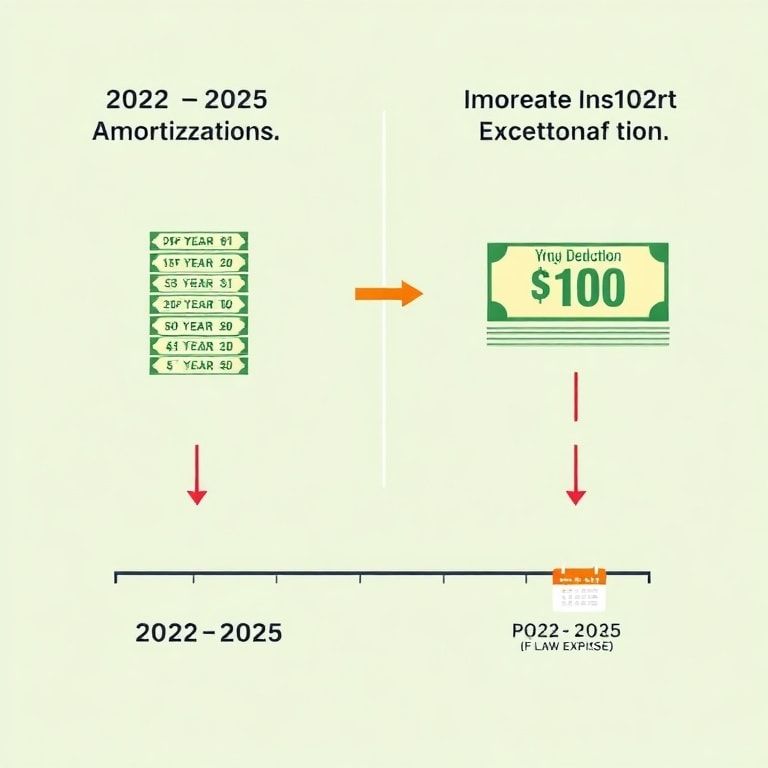
Old Rule (Pre-2022): R&D expenses could be fully deducted in the year they were incurred. This created a significant tax benefit, especially when paired with the R&D credit.
New Rule (2022-2025): Domestic R&D expenses must be amortized (deducted) over 5 years. Software development costs must be amortized over 5 years (15 years for foreign research). This drastically reduces the current-year deduction, increasing taxable income for profitable companies. For loss-making startups, it defers the net operating loss (NOL).
The 2026 Cliff: The mandatory amortization requirement is also scheduled to expire for tax years beginning after December 31, 2025. If it expires, we revert to immediate expensing. This creates a complex planning landscape.
Strategic Implications:
- For Pre-Revenue Startups (No Taxable Income): Amortization is mostly a timing nuisance, delaying your NOLs. Your primary weapon is the payroll tax offset on the credit. Your 2025 strategy should be to maximize QREs to capture as large a credit as possible before the payroll offset potentially sunsets. The amortization rule itself is secondary for you.
- For Startups Becoming Profitable (~2025/2026): This is the tricky spot. If you have taxable income in 2025, amortization hurts you by reducing your deduction. You want the credit, but you also want the deduction. In 2026, if amortization expires, your deduction benefit returns. The interplay is complex. You may benefit from accelerating some expenses from late 2025 into early 2026, depending on your projected profit margins. This requires modeling with a specialist.
Here is a simplified comparison of the two regimes and their impact:
| Scenario | Pre-2022 / Post-2025 (If Law Expires) Immediate Expensing |
2022-2025 Mandatory Amortization |
|---|---|---|
| Startup with $1M in QREs, $0 Taxable Income | Creates a $1M NOL to carry forward. R&D Credit (~$70k) is primary benefit. | Only $200k deduction in Year 1 ($1M/5). $800k deduction deferred. NOL creation is slower. R&D Credit (~$70k) remains primary benefit. |
| Startup with $1M in QREs, $500k Taxable Income | $1M deduction wipes out income. Tax saved = $210k (21% rate). Plus R&D Credit. | Only $200k deduction. Taxable income becomes $300k. Tax owed = $63k. Immediate tax bill is $147k HIGHER than under expensing, even with the R&D credit. |
You must model your cash flow under both scenarios to make informed hiring and spending decisions for 2025-2026.
The 5-Phase R&D Credit Implementation Framework (2026 Edition)
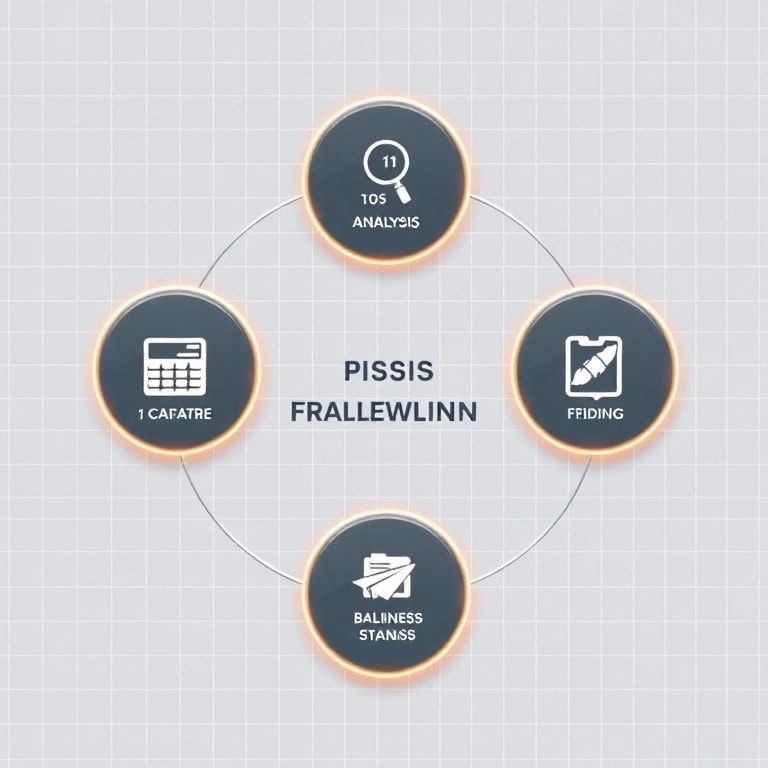
Treating this as a year-end scramble guarantees lost money and audit risk. Integrate this framework into your quarterly financial operations.
Phase 1: Quarterly Identification & Capture (Ongoing) Every quarter, the engineering/product lead should provide a brief (1-2 page) summary of projects that encountered technical uncertainty. Use a simple template: Project Name, Technical Challenge, Hypotheses Tested, Results. Simultaneously, finance tags cloud costs and allocates engineering payroll based on project time estimates. This turns a year-long reconstruction project into a 4-hour quarterly task. Tools like Jira or Linear, with proper labeling, are your friend here.
Phase 2: Annual Quantitative Analysis (Q1 of following year) Now you have all the raw data. Aggregate QREs: compile total eligible wages (using your allocation %), eligible cloud costs, and 65% of contract research. Perform the credit calculation. There are two methods: the Regular Credit Method (complex but often higher for companies with a long R&D history) and the Alternative Simplified Credit (ASC) – almost always better for startups, as it’s based on current-year QREs over a base period. Use the ASC. This phase often requires a specialist or robust software.
Phase 3: Documentation Assembly (Parallel to Tax Prep) This is your audit shield. Create a single, well-organized PDF for the tax year that includes:
- Executive Summary of qualified projects.
- Technical Project Narratives (from Phase 1).
- Wage Allocation Methodology & Ledger.
- Cloud Cost Analysis & Segregation Report.
- Contracts for Contract Research.
- Form 6765 Calculation.
Phase 4: Filing & Election (Tax Filing Deadline) Work with your CPA to ensure Form 6765 is completed correctly and attached to your timely filed return (even if on extension). Crucially, check the box for the payroll tax offset if you are a QSB. Missing this box forfeits the cash benefit for the year.
Phase 5: Credit Utilization & Reporting (Post-Filing) If you used the payroll offset, instruct your payroll provider (Gusto, Rippling, ADP) to apply the credit to the correct quarter's Form 941. Track the remaining credit balance. If you have income tax liability, the credit will apply automatically when your return is processed.
Common Mistakes That Invalidate Claims or Trigger Audits
After reviewing hundreds of startup claims, these are the errors I see constantly.
1. Claiming Entire Employee Salaries Without Allocation. The IRS knows your engineers also fix bugs and attend all-hands meetings. Claiming 100% is a red flag. Develop a reasonable, consistent allocation method (e.g., 70% of Lead Engineer time, 30% of Junior Dev time) and document how you arrived at it.
2. Poor or Non-Existent Technical Documentation. Sending the IRS a pile of GitHub commits and AWS bills is not a defense. They need a narrative in plain English explaining the uncertainty and experimentation for each project. A well-written 2-page summary per major project is worth more than 1000 lines of commit logs.
3. Misclassifying Routine Software Updates. Adding a new field to a form is not R&D. Re-architecting the database to allow for dynamic, user-defined fields with real-time validation is. The line is “technical uncertainty.” If the solution is found on Stack Overflow in 5 minutes, it’s probably not qualified.
4. Forgetting State R&D Credits. Over 30 states offer their own R&D credits, often with more generous rules. California, New York, Texas, and Massachusetts have significant programs. These are separate filings and can sometimes be refundable or sellable, providing immediate cash. This is often a six-figure oversight.
5. DIY-ing It with a Generalist CPA. Most early-stage startup CPAs are tax compliance experts, not R&D credit specialists. The credit calculation and documentation standards are a niche. Using a specialist firm for the initial study and setup (cost: $5k-$15k) typically pays for itself many times over in a larger, defensible credit. They also provide audit support insurance.
Software R&D: A Specialized Strategy
The IRS has specific guidance for software in Rev. Proc. 2000-50. The key concept is the distinction between internal-use software and commercial software.
Commercial Software (software you sell, license, or SaaS) is held to a lower standard—it just needs to pass the standard Four-Part Test. This covers most B2B and B2C SaaS companies.
Internal-Use Software (software used internally for management, administration, etc.) faces a higher, three-part hurdle in addition to the Four-Part Test. It must be: 1) Innovative (intended to reduce cost/improve speed beyond commercially available options), 2) Involve significant economic risk (you spend >$X to develop it), and 3) Not commercially available. Developing your own internal analytics dashboard might not qualify; developing a proprietary fraud detection system for your fintech platform’s internal operations likely would.
Strategy: When writing project narratives, explicitly frame how your software development is either for commercial offering or, if internal, how it meets the higher innovative/risk threshold. Link the technical challenges directly to business outcomes—e.g., “We developed a novel caching layer (technical) to achieve sub-100ms response times (performance), which is a key requirement of our enterprise SLA (business component).”
Implementation Roadmap: Budgets, Tools, and Timelines by Stage
Here’s what this looks like in practice, depending on your startup’s size and budget.
Bootstrapped / Pre-Seed (Team: 1-5, Burn: <$50k/mo): Budget: $0 for software, potential one-time $2k for a consultant review. Tool Stack: Google Sheet for quarterly project logging. Use tagged branches in GitHub/GitLab to identify R&D commits. Basic AWS/GCP cost allocation tags. Process: Founder/CTO writes 2-3 project narratives at year-end. Use the ASC method on Form 6765 yourself (guidance is on the IRS form). Focus on capturing clear wage allocation (use 80/20 rule for devs) and segregated cloud costs. The goal is to establish a baseline, defensible claim. Don’t overcomplicate it. Timeline: 10-15 hours total per year.
Series A (Team: 15-40, Burn: $150k-$400k/mo): Budget: $5k-$10k for a specialist firm to conduct a formal study and set up processes. Tool Stack: Dedicated R&D credit software like CreditSnap or Boast.AI to automate data collection from payroll (Gusto/Rippling), code repos, and cloud bills. These tools create the audit trail automatically. Process: Implement the 5-Phase Framework formally. Specialist handles calculation and documentation assembly. Your internal team spends ~5 hours per quarter feeding it project data. Timeline: Specialist work takes 4-6 weeks. Internal ongoing effort is 20 hours/year.
Series B+ / Preparing for Exit (Team: 50+, Profitable or Near-Profitable): Budget: $15k-$25k annually for a top-tier specialist firm with audit defense. Tool Stack: Enterprise-grade R&D software integrated with your ERP (NetSuite, Sage Intacct) and advanced project management tools (Jira Align). Process: Fully integrated. R&D credit forecasting is part of the annual financial model. Specialist firm handles everything, including preparing due diligence packages for acquirers. A clean, maximized R&D credit history is a tangible asset on the balance sheet during an acquisition. Timeline: Continuous process, with major annual review.
Frequently Asked Questions
Can a pre-revenue startup with no tax liability still benefit from the R&D credit?
Absolutely, and this is the most common scenario. Through the payroll tax offset election, qualified small businesses (under $5M in revenue within their first 5 years) can apply the credit against their employer-side Social Security tax liability (6.2% of wages). This generates direct cash savings each quarter, effectively extending your runway. For example, a $50,000 credit could eliminate over $12,000 in quarterly payroll taxes until the credit is used up, providing real cash back to the business.
Does routine software development or bug fixing qualify for the R&D tax credit?
Generally, no. The core requirement is eliminating technical uncertainty. Routine bug fixes, maintenance, or implementing features using well-established methods and libraries do not qualify. However, if fixing a bug requires investigating an unknown root cause in a complex system or developing a novel patch that doesn't exist in standard documentation, that investigative and experimental work can qualify. The line is “Was the solution readily determinable by a competent professional?” If not, the time spent figuring it out is potentially eligible.
What is the $500,000 payroll tax offset limit? Is it per year or total?
The $500,000 limit applies to the amount of R&D credit you can elect to use against payroll taxes per tax year. It's not a lifetime cap. So, if you generate a $600,000 credit in 2025, you can elect to apply $500,000 of it against future payroll taxes. The remaining $100,000 can be carried forward to offset future income tax once you're profitable. This limit is crucial for planning, as very R&D-intensive startups may hit it.
How do state R&D tax credits work alongside the federal credit?
State credits are separate, parallel programs with their own rules, rates, and forms. Over 30 states have them. Some, like California, are very generous. You can claim both federal and state credits for the same qualified expenses—they do not reduce each other. In some states (e.g., Louisiana), the credits are refundable, meaning you get a check even with no tax liability. In others, they are only usable against state income tax. You must file a separate state tax return or schedule to claim them, and the documentation requirements often mirror the federal standard. Missing state credits is a major oversight.
What documentation do I need to survive an IRS audit on my R&D claim?
You need contemporaneous documentation that proves the Four-Part Test. This isn't just receipts. It includes: 1) Project Narratives: Plain-English summaries of each project's technical challenges and hypotheses tested. 2) Time Tracking: Records showing how employee time was allocated to qualified projects (timesheets, Jira reports, manager attestations). 3) Expense Records: Invoices and ledgers for supplies/contractors, with clear links to projects. 4) Technical Records: Design documents, meeting notes, prototype plans, test results. 5) Calculation Backup: The worksheets backing up your Form 6765. The goal is to tell a coherent, believable story of innovation.
Should I hire a specialist firm or can my CPA handle the R&D credit?
For any startup with significant R&D spend (over $200k in dev wages), a specialist firm is almost always worth the investment. Generalist CPAs are experts in compliance, not in maximizing this specific, nuanced credit. Specialists understand the optimal calculation methods, the evolving case law, and how to craft bulletproof documentation. They also typically provide audit defense, which is invaluable. The fee (often a percentage of the credit found) is easily justified by the larger, secure credit they identify and the peace of mind they provide. Your CPA should remain your overall tax filer, working in concert with the specialist's report.
Your Next Step: The 2025 Pre-Cliff Assessment
The deadlines aren't just tax day. The potential sunset of the payroll tax offset and the amortization rules creates a tangible 2025 planning cliff. Don't wait until you file your 2025 return in 2026. The strategy needs to be set now. Your immediate action is a preliminary assessment. In one hour, answer these questions: 1) What were your total W-2 wages for software/engineering staff in 2023 and 2024? 2) What was your approximate annual cloud spend for development/staging environments? 3) Are you in your first five years of having gross receipts? 4) Do you have a basic list of major technical projects from the last year? With these numbers, you can ballpark your potential credit using a 7-10% rule of thumb on QREs. If that number is meaningful (>$25k), commit to implementing Phase 1 of the framework next quarter. For deeper strategy involving 2025/2026 shifts, schedule a consultation with a specialized R&D tax advisor. Treat this credit not as a tax deduction, but as a non-dilutive funding source for your core innovation engine. The companies that integrate this into their financial DNA will have a longer runway and a stronger balance sheet in 2026.
Integrating rigorous financial compliance, like the R&D credit, is part of building a mature, scalable operation. Just as you need a proactive roadmap for navigating SEC AI regulations, a defined strategy for technical tax incentives is a hallmark of a professionally managed startup. Furthermore, the project documentation and process discipline required for a robust R&D claim can directly improve your team's operational clarity, much like implementing the structured frameworks found in our guide to collaboration tool adoption metrics.
Boomlify Team