
Mail.tm Alternative: Why Boomlify Is a More Complete Temporary Email Platform
Mail.tm is a popular temporary email service for users and developers who need disposable email addresses without creating a traditional email account. It is especially known for its simple inbox experience and free API. Instead of asking users to register with personal information, Mail.tm gives them a temporary email address that can receive messages instantly. This makes it useful for quick signups, testing email verification flows, avoiding spam, and protecting a personal inbox from websites that may send unwanted messages later.
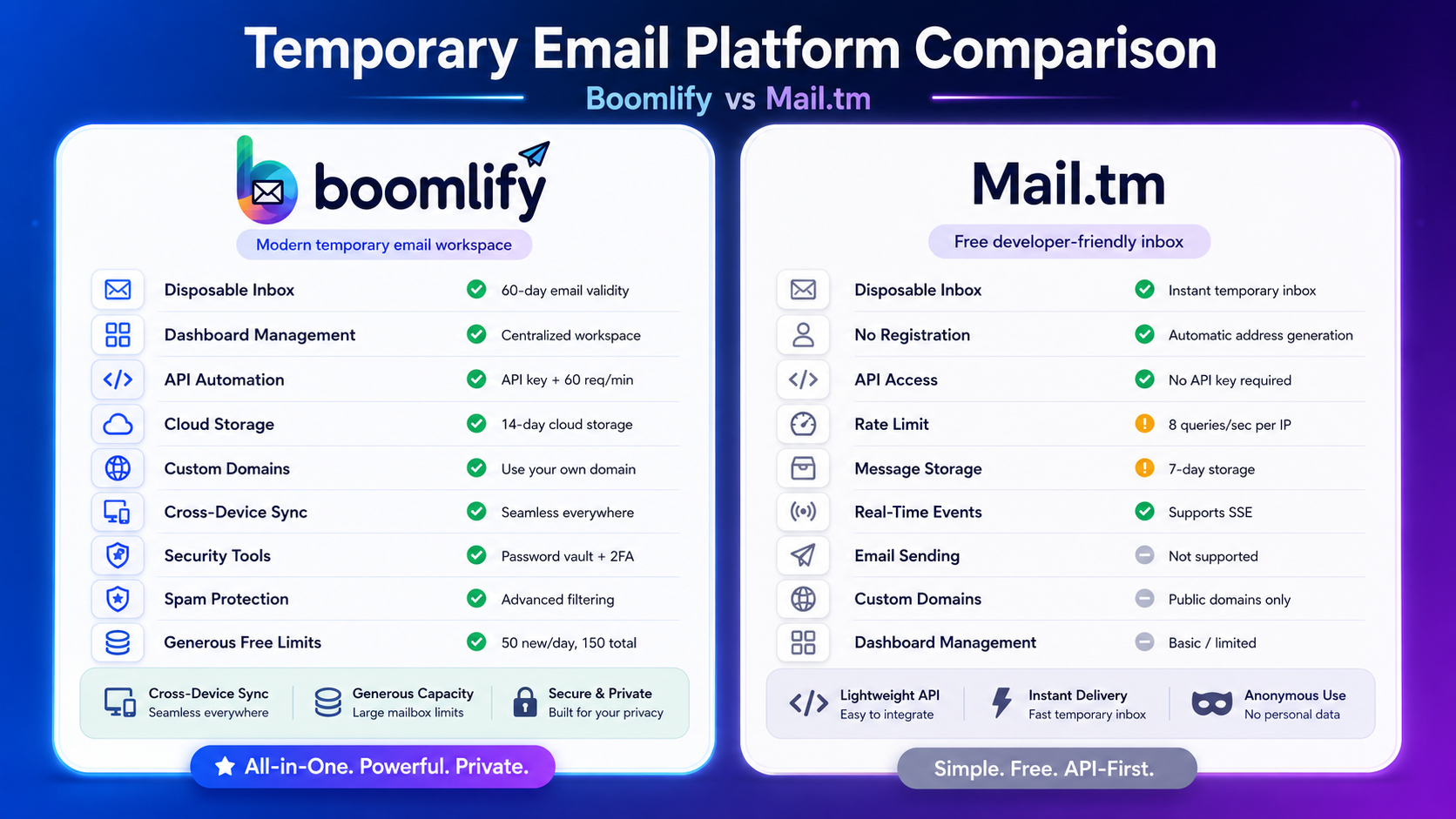
One of the strongest parts of Mail.tm is its developer-friendly API. The service allows users to get available domains, create a temporary email account, generate an access token, and fetch incoming messages through REST API requests. Its API documentation says no API key is required, there are no paid tiers, and the general quota limit is 8 queries per second per IP address. For developers who want a quick disposable email API for testing, Mail.tm is easy to understand and easy to start with. That is why it is often used in automation experiments, QA testing, and email verification workflows.
However, temporary email needs are becoming more advanced. Many users no longer need only a free inbox or a basic API. Developers need organized mailbox history, higher throughput, clear account limits, and predictable scaling. QA teams need a dashboard where they can manage many test inboxes from one place. Privacy-focused users want longer control, custom domains, cloud storage, and tools that help them manage temporary identities safely. This is where Boomlify becomes a strong Mail.tm alternative. Boomlify offers temporary email, but it also adds dashboard management, flexible mailbox lifetimes, API credits, custom domain control, security tools, and paid plans for users who need more capacity.
What Mail.tm Does Well
Mail.tm does a good job at keeping temporary email simple. Its FAQ explains that disposable email does not require registration, messages are delivered instantly, and the email address is generated automatically. This is useful for users who do not want to create a full account just to receive a verification message. If someone needs a quick inbox for a test signup, newsletter confirmation, download page, or low-risk account registration, Mail.tm can be a practical option.
Mail.tm also has a clear privacy angle. The service is designed for people who want to avoid using their real email address on questionable or temporary websites. A disposable address can reduce spam, protect the user’s main inbox, and make online signups feel safer. For casual browsing and simple verification tasks, this is exactly what many users need.
The API is another major advantage. Mail.tm is more developer-friendly than many basic temporary email sites because its API is public and easy to call. Developers can fetch available domains, create accounts, authenticate, and retrieve messages. The API can also support real-time message handling through server-sent events. For technical users, this is useful because it allows temporary email to be included in scripts, test suites, and signup automation flows.
Where Mail.tm Can Feel Limited
Mail.tm is powerful for a free API service, but it can feel limited when users need a complete temporary email workspace. One limitation is message retention. Mail.tm says incoming messages are stored for only 7 days. That may be enough for quick verification codes, but it can be too short for users who need to revisit emails later. Developers and QA testers sometimes need to inspect older onboarding emails, password reset messages, account confirmation links, and test records after more than a week. A short storage window can make that harder.
Another limitation is sending. Mail.tm says it does not provide email sending. That is acceptable for many disposable email use cases because most users only need to receive messages. Still, some workflows require internal replies, controlled sending, or more advanced mailbox behavior. Boomlify includes internal reply support and positions broader sending improvements as part of its product roadmap, which gives users a more flexible path as their needs grow.
Mail.tm also focuses more on temporary inboxes and API access than on a full dashboard-based SaaS experience. It is useful for creating and reading disposable mailboxes, but it is not positioned as a complete mailbox management system with plan-based storage, custom domain capacity, security tools, credit bonuses, and team-style scaling. Users who create many inboxes every day may eventually need a stronger dashboard and clearer upgrade path.
Why Boomlify Is a Strong Mail.tm Alternative
Boomlify is designed for users who want temporary email with more structure and control. It provides disposable email addresses, but it also gives users a centralized dashboard where they can manage many mailboxes from one account. This is important because temporary email is often used repeatedly. A user may create different inboxes for different websites. A developer may need one inbox for each automated signup test. A QA team may need to check invite emails, password reset emails, OTP messages, and onboarding flows. Boomlify makes those inboxes easier to manage from one place.
The free Boomlify plan is especially useful because it gives users generous limits without requiring an immediate upgrade. Free users can create up to 50 new mailboxes per day and keep up to 150 total mailboxes. They also get a centralized dashboard, smart inbox preview, cross-device sync, captcha protection, 14-day cloud message storage, and a 60-day email validity window. Compared with a basic short-term temporary inbox, this gives users more room to manage real workflows.
Boomlify also gives every account API access. Free users receive an API key, 60 requests per minute, and daily free credits. Mailbox creation uses credits, but reading emails, fetching emails, listing mailboxes, deleting or renaming mailboxes, checking mailbox status, and managing API keys are described as free actions. This is a useful model because most automated testing workflows do more reading and checking than creating. A developer can create a mailbox, receive a message, fetch the inbox, verify the result, and clean up the mailbox without paying for every small action.
Better for Developers and QA Teams
Mail.tm is a good option for developers who want a free temporary email API. Boomlify is better for developers who want API access plus a larger product environment. The difference matters when temporary email becomes part of serious testing. A small script may only need one inbox. A QA pipeline may need hundreds or thousands of inboxes, reliable storage, rate limits that can scale, and a dashboard for debugging. Boomlify supports that progression more clearly.
Boomlify’s paid plans increase mailbox capacity, daily creation limits, API rate limits, storage duration, custom domains, and credit bonuses. This gives users a path from free testing to heavier production-style workflows. Basic, Pro, Pro Plus, Ultra Pro, Elite, and Unlimited plans allow users to upgrade only when they need more throughput, longer retention, more domains, or more capacity. For developers and teams, that type of scaling is often more practical than relying on a single free API limit forever.
Custom Domains and More Control
Custom domains are another reason to choose Boomlify over Mail.tm. Public disposable email domains are useful, but they are sometimes blocked by websites. A custom domain gives users more control over the address they use, the brand identity of the inbox, and the structure of their testing workflow. This is especially helpful for startups, agencies, QA teams, SaaS developers, and privacy-focused power users.
Boomlify includes custom domain support in its plan structure. Free users receive limited custom domain access, while paid plans increase the number of domains, daily custom-domain mailbox creation, and total custom-domain mailbox capacity. This makes Boomlify stronger for users who want temporary email under their own domain instead of relying only on public disposable domains.
Privacy, Security, and Everyday Use
Both Mail.tm and Boomlify help users protect their real email address from spam. Mail.tm is good for quick anonymous inbox usage, while Boomlify expands the privacy workflow with additional tools. Boomlify includes a password generator, local password vault, 2FA manager, anonymous inbox features, spam protection, and a Chrome extension. These tools fit naturally with temporary email because users often create accounts, receive verification codes, generate passwords, and manage temporary access at the same time.
Users should still treat all disposable email services responsibly. Temporary email should not be used for banking, government accounts, private business records, medical accounts, legal communication, or anything that requires permanent secure recovery. Disposable inboxes are best for low-risk signups, software testing, spam prevention, trial accounts, and privacy separation. Boomlify and Mail.tm both help in those areas, but Boomlify gives users more organization and longer control.
Mail.tm vs Boomlify: Which One Should You Choose?
Choose Mail.tm if you want a simple free temporary inbox with a public API and do not need advanced dashboard features. It is a strong option for quick receiving, simple tests, and developers who want a lightweight API without paid setup. Its no-registration style, automatic address generation, and free API make it convenient for fast use.
Choose Boomlify if you want a more complete temporary email platform. Boomlify is better for users who need dashboard management, many mailboxes, longer storage, API credits, daily free credits, custom domains, cross-device sync, security tools, and scalable paid plans. It is especially useful for developers, QA testers, privacy-focused users, and teams that need more than a basic disposable inbox.
Final Verdict
Mail.tm is a useful temporary email service with a strong free API. It is simple, anonymous, developer-friendly, and practical for receiving emails during short-term tasks. Its 7-day message storage, no-registration model, and free API make it a popular choice for quick testing and spam protection.
Boomlify is the better Mail.tm alternative for users who want more control and a complete workspace. It combines temporary email with a centralized dashboard, generous free limits, 14-day free cloud storage, 60-day email validity, API access, daily credits, custom domains, password tools, 2FA management, and scalable paid plans. For casual users, Boomlify protects the main inbox from spam. For developers, it supports automated verification workflows. For QA teams, it makes repeated email testing easier. For power users, it adds custom-domain control and longer retention options. If Mail.tm is a strong free disposable email API, Boomlify is a more complete temporary email SaaS platform built for modern privacy, testing, and automation.