

VC Due Diligence AI Tools 2026: Expert Integration Guide
Boomlify Team
Content Creator
VC Due Diligence AI Tools 2026: The Practitioner's Integration Playbook
Table of Contents
- The 2026 Landscape: Why "Assisted" Diligence Is Dead
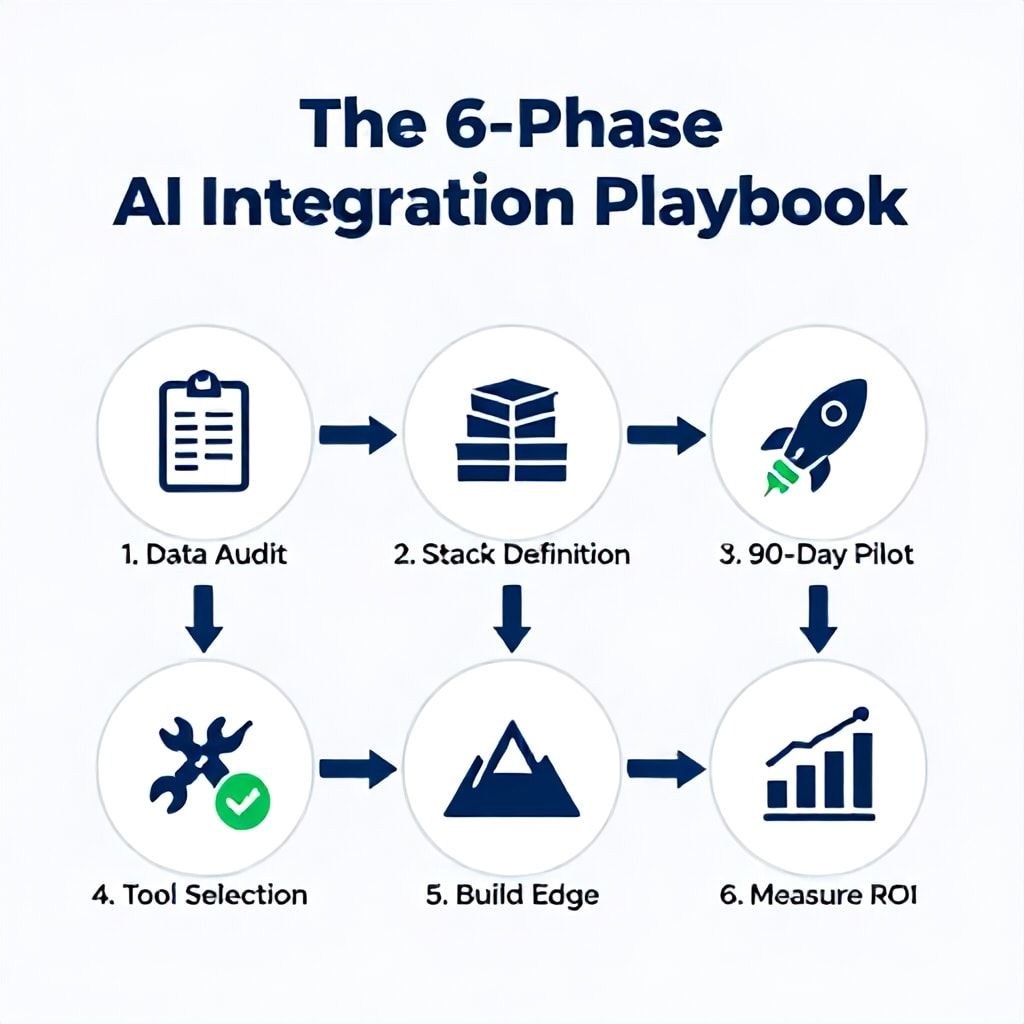
- The 6-Phase AI Integration Playbook for VC Funds
- Phase 1: Audit & Architect Your Data Pipeline (Weeks 1-4)
- Phase 2: Define Your AI Stack & Tool Taxonomy
- Phase 3: The 90-Day Pilot: Prove Value on a Live Deal
- Tool Selection for 2026: A Strategic Comparison
- Building Your Proprietary AI Edge: Beyond Off-the-Shelf Tools
- Measuring Real ROI: It's Not Just About Time Saved
- Common Pitfalls & What Most Guides Get Wrong
- Implementation Roadmap: Budgets, Timelines & Team
- Frequently Asked Questions
- How do we ensure the AI isn't missing crucial, non-quantifiable factors like founder grit or team culture?
- What's the biggest data privacy risk when feeding sensitive startup data into AI tools?
- Can AI actually predict startup success, or is it just pattern matching on the past?
- How do we get senior partners, who are skeptical of technology, to adopt and trust AI outputs?
- What technical skills does our investment team need to manage this?
- Is it worth building a custom AI solution vs. buying off-the-shelf SaaS?
- How will generative AI change the diligence process by 2026?
- What's the single most important first step to take this month?
Three months ago, a $500M venture fund nearly wired $15 million to a Series A SaaS company. Their preliminary analysis was glowing—strong growth, impressive logos, a cohesive founding team. It took a specialized AI tool running on a custom graph database to flag what seven weeks of human diligence missed: a web of undisclosed related-party transactions linking the CTO to three of the company's five largest "customers." The contracts were real, but the revenue was circular. By 2026, this won't be a lucky catch; it will be table stakes. The venture landscape is shifting from a world where AI assists diligence to one where AI orchestrates it, and funds that treat these tools as mere "productivity enhancers" will be systematically outmaneuvered.
This guide is not a list of tools. It's an operational framework distilled from integrating AI across diligence pipelines for funds ranging from $50M to $2B in AUM. We'll move beyond the generic promises of "efficiency" and build a concrete, phased implementation playbook for 2026. You'll learn how to architect your data, select tools that compound in value, measure real ROI beyond time saved, and navigate the emerging risks and ethical considerations that come with handing core judgment calls to algorithms. This is the manual for turning AI from a cost center into a structural advantage.
The 2026 Landscape: Why "Assisted" Diligence Is Dead
Let's clarify the starting point. Most funds today use AI in a fragmented, reactive way. An associate runs a company name through a sentiment analyzer. A partner uses ChatGPT to draft a few market questions. This is AI-as-a-Google-search, not AI-as-a-core-competency. The fundamental shift by 2026 is the move from discrete tools to an integrated system. This system isn't just about reading documents faster; it's about creating a persistent, queryable knowledge graph of your entire portfolio and pipeline.
Imagine this: every data room document, every call transcript, every cap table, every customer review, and every line of code (via secure scans) is ingested, parsed, and linked. The AI doesn't just summarize; it builds relationships. It can answer: "Show me all companies in our pipeline where founder equity retention post-series B is below 20% and customer concentration in the top 3 accounts exceeds 40%." It can proactively alert you: "The SaaS company you evaluated 4 months ago just had its CTO listed as an inventor on a patent filed by a direct competitor." This is the level of contextual intelligence that will separate top-decile performers. The catalyst is the maturation of multimodal LLMs that can reason across financial statements, legal contracts, and technical documentation simultaneously, a capability that was experimental in 2023 but will be production-ready by 2026.
The 6-Phase AI Integration Playbook for VC Funds
Implementing AI haphazardly creates more noise than signal. This framework forces discipline, starting with the least glamorous but most critical step: data foundation.
Phase 1: Audit & Architect Your Data Pipeline (Weeks 1-4)
You cannot automate insight from chaos. The single biggest failure point is launching an AI tool atop a fractured data swamp. Start with a ruthless audit. Catalog every data source: your CRM (DealRoom, Affinity), your data room provider (Dropbox, Box, specialized VDRs), your email/calendar, your internal memo repository, and any third-party data feeds (PitchBook, Crunchbase, Glassdollar).
The goal is to establish a single source of truth—a centralized data lake or warehouse. In practice, for most small-to-mid-sized funds, this starts with a cloud data warehouse like Snowflake or BigQuery. Use a data integration platform (Fivetran, Stitch) to pipe in structured data from your CRM and financial databases. For unstructured data—PDFs, Word docs, transcripts—you'll need a dedicated processing pipeline. This is where 80% of the work lies. You must standardize naming conventions (e.g., "YC23_StartupCo_SAFT.pdf"), enforce a universal folder structure in your data room, and implement OCR (Optical Character Recognition) for scanned documents. Budget 3-4 weeks and $15k-$25k in initial setup costs for a fund under $250M AUM. The ROI isn't in the AI yet; it's in the simple human time saved from never having to hunt for a file again.
Phase 2: Define Your AI Stack & Tool Taxonomy
Don't buy a "VC AI" suite. Build a stack of specialized tools that excel at specific jobs. Think in three layers:
- The Intelligence Layer: Tools for deep analysis. This includes financial model auditors (like Eqvista's AI or custom GPTs trained on cap table math), code scanners for tech due diligence (Sourced, Codacy), and contract analyzers (Kira Systems, Leverton).
- The Orchestration Layer: The connective tissue. This is a platform like Hebbia or a custom-built RAG (Retrieval-Augmented Generation) system that pulls data from your warehouse and coordinates queries across your specialist tools. It's your central command.
- The Generation & Synthesis Layer: Tools for output. This is where generative AI (GPT-4, Claude 3) creates first drafts of investment memos, competitive landscapes, and management biographies from the synthesized data.
Your stack will evolve, but start with one core tool from the Intelligence Layer that addresses your fund's biggest pain point. For a deep-tech fund, that's the code scanner. For a growth-stage consumer fund, it might be a sentiment aggregator for product reviews.
Phase 3: The 90-Day Pilot: Prove Value on a Live Deal
Skip the sandbox. The fastest way to learn and prove ROI is to run a parallel-track diligence on a live, mid-priority deal. Select a company that's typical of your thesis. The goal is not to replace human diligence but to augment it aggressively.
Here's the exact protocol we've used: Assign one analyst to run the standard process. Assign another analyst (or the same one, post-initial review) to run the AI-augmented process with your new stack. Task the AI with specific, high-volume jobs: "Extract all change-of-control clauses from the customer contracts and list them in a table with the customer name and clause trigger." Or: "Compare the headcount growth in the financial model to the actual hiring plans discussed in the management call transcripts from the last three months and flag discrepancies greater than 15%."
Measure everything: time per task, number of risks identified, depth of questions generated. The tangible output you want after 90 days is a side-by-side comparison memo showing where the AI surfaced unique insights, missed critical context, or saved 40+ analyst hours. This pilot isn't about perfection; it's about building internal credibility and a use-case library.

Tool Selection for 2026: A Strategic Comparison
The tool market is noisy. Choosing based on a feature checklist is a mistake. You must choose based on how a tool fits into your evolving workflow and data architecture. Below is a comparison of tool archetypes, not specific vendors, as the leaders in each category will shift by 2026. The criteria focus on strategic integration potential.
| Tool Archetype | Primary 2026 Value | Integration Complexity | Best For Fund Stage | Key 2026 Consideration |
|---|---|---|---|---|
| Specialized Analyzers (e.g., Code Scanners, Contract AI) |
Deep, domain-specific accuracy. Replaces expert consultants for initial screens. | Medium. Often have APIs but require custom data piping. | All stages, especially early-stage (where technical/legal risk is paramount). | Beware of black-box outputs. Insist on tools that provide source citations and confidence scores for their findings. |
| Orchestration Platforms (e.g., AI Workflow Builders) |
Connects your entire data ecosystem. Turns discrete tools into a cohesive process. | High. Requires upfront data architecture work. | Growing funds ($100M-$1B AUM) scaling deal flow. | Vendor lock-in is a major risk. Prioritize platforms with open APIs and exportable workflows. |
| Generative Synthesis Engines (e.g., Advanced LLMs like GPT-4o, Claude 3) |
Drafting memos, generating hypotheses, summarizing vast qualitative data. | Low to Medium (via API). High if fine-tuning on proprietary data. | All stages. | Hallucination is the killer. Implementation MUST be grounded in Retrieval-Augmented Generation (RAG) using your own data lake. |
| Proprietary Data Aggregators (e.g., AI that scrapes dark web, app stores, review sites) |
Provides unique, non-obvious data points competitors lack. | Low (stand-alone report) to High (integrated feed). | Stage-agnostic, thesis-dependent. | Legal and ethical compliance is critical. Ensure data sourcing methods are above board and privacy-compliant (e.g., GDPR). |
Building Your Proprietary AI Edge: Beyond Off-the-Shelf Tools
By 2026, competitive advantage won't come from using the same SaaS platform as the fund down the street. It will come from the proprietary data and models you build. This is where you graduate from a tool consumer to a system builder. Start with your own historical data—your past investment memos, post-mortems, portfolio performance data, and even your notes from board meetings.
The project is to create a fine-tuned model that predicts outcomes specific to your thesis. For example, a healthcare VC could fine-tune an open-source LLM (like Llama 3) on thousands of clinical trial documents and FDA submission guidelines to create a specialist that can pre-flag regulatory risks in a biotech startup's pipeline. A consumer fund could build a model trained on decades of consumer brand lifespans to identify patterns of early traction that are predictive of durability versus fads.
The budget for this is not trivial but is increasingly accessible. Using cloud services (Azure AI, Google Vertex AI), you can run a fine-tuning project for $5,000-$20,000, plus the cost of a machine learning engineer or data scientist for 2-3 months. The key is to start small: pick one highly specific prediction task your partnership argues about constantly (e.g., "Will this founder be an effective scale-phase CEO?") and build a model to inform that one decision. The model's output is not the answer; it's a powerful, data-driven input to your debate.
Measuring Real ROI: It's Not Just About Time Saved
If you measure AI success by hours reduced on diligence, you're leaving 80% of the value on the table. The real ROI for a 2026 fund is in improved decision quality and increased optionality.
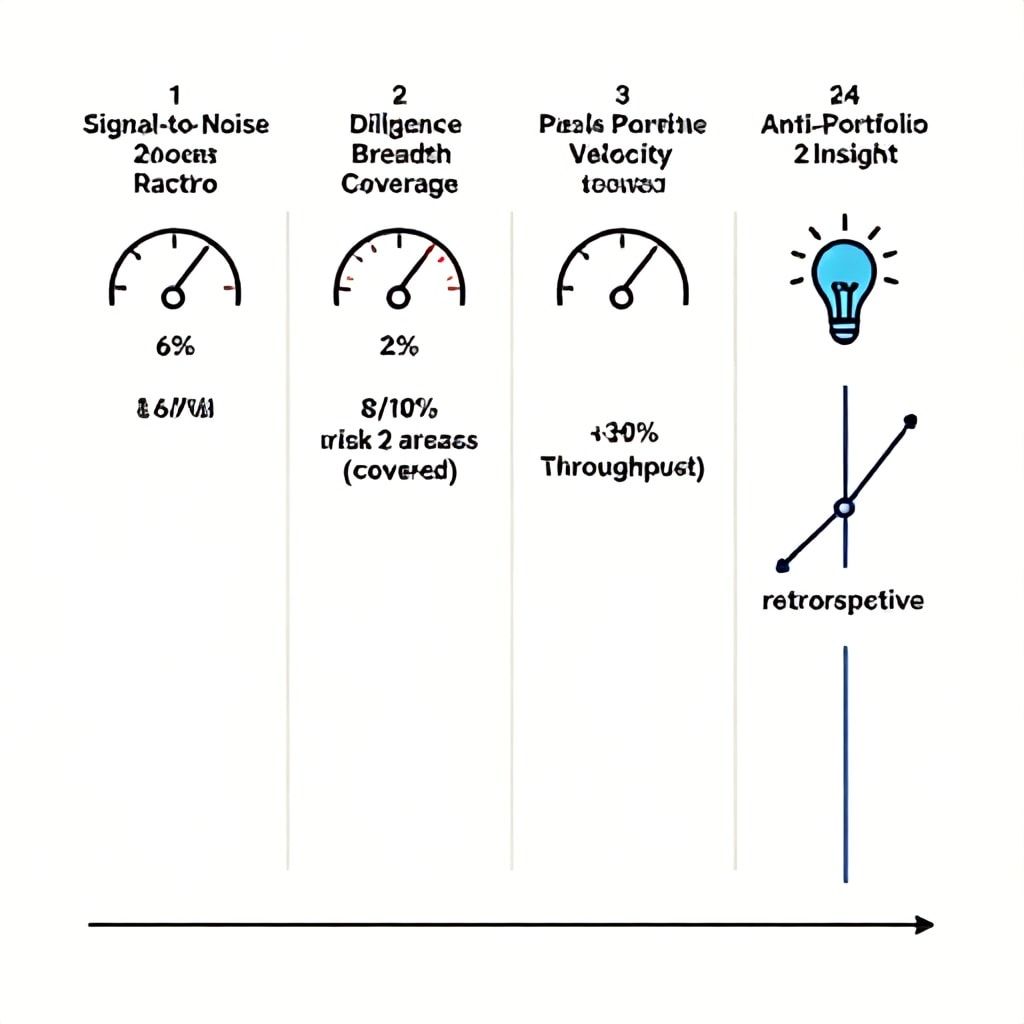
Track these four metrics:
- Signal-to-Noise Ratio: What percentage of the issues flagged by AI during initial screening were ultimately deemed material in the final partnership decision? Aim for a ratio above 60%. If it's below 30%, your AI is generating false positives and creating more work.
- Diligence Breadth Coverage: Historically, a time-constrained team might deep-dive on 3 out of 10 risk areas. With AI, you can cover 8 or 9 superficially and then allocate human time to the 2-3 that the AI flags as highest risk. Measure the increase in risk areas assessed per deal.
- Pipeline Velocity & Throughput: Can you evaluate 30% more companies per partner with the same team? This isn't about doing deals faster; it's about looking under more rocks to find the exceptional one.
- Anti-Portfolio Analysis: This is the ultimate test. Use your AI system to re-evaluate companies you passed on 12-24 months ago. Did the AI, with its systematic scan, identify the fatal flaw that led to their eventual stagnation or failure? Or did it see potential you missed? This retrospective analysis sharpens your models and your team's judgment.
Common Pitfalls & What Most Guides Get Wrong
After overseeing dozens of these integrations, I see the same costly mistakes repeated. Avoid these at all costs:
1. The "Boil the Ocean" Launch: Teams try to automate the entire diligence process on day one. They buy three platforms, mandate their use, and drown associates in confusing outputs and broken workflows. The fix: Start with one repetitive, high-volume, rules-based task. Automating the extraction of financial covenants from credit agreements is a perfect starter project. It's painful, time-consuming, and well-suited to AI. Success here builds confidence for more complex tasks.
2. Treating AI Output as Gospel: This is the most dangerous pitfall. An AI highlights a "potential regulatory risk" in a contract. A junior analyst, trusting the tool, escalates it as a major red flag without understanding the context (it's a standard, non-material clause). This erodes trust and wastes senior time. The fix: Institute a rule: "All AI-generated findings must include the source citation and be accompanied by a human-generated 'So What?' statement." Force the team to contextualize the output.
3. Neglecting Data Hygiene: Garbage in, gospel out. If you feed the AI poorly scanned PDFs, inconsistent file names, and uncategorized documents, its analysis will be fragmented and unreliable. The investment in Phase 1 (Data Architecture) is non-negotiable. The fix: Appoint a "Data Steward" on the investment team—often a senior associate—who owns the quality and structure of all incoming deal data. Make it a key performance metric.
4. Ignoring the Ethical & Compliance Layer: Using AI to scrape founder social media, analyze vocal stress in pitch meetings, or infer demographics from team photos is a legal and reputational minefield. By 2026, regulations will have caught up. The fix: Develop a clear AI Ethics Charter for your fund. Explicitly list prohibited use cases. Have your legal counsel review your data sourcing and model training processes for compliance with evolving laws like the EU AI Act.
Implementation Roadmap: Budgets, Timelines & Team
Your starting point dictates your path. Here’s a realistic breakdown by fund profile.
For a Seed-Stage Fund ($50M - $150M AUM):
Focus: Efficiency on a shoestring. You can't build, so you must cleverly assemble.
Stack: Start with a single orchestration-layer SaaS (like Hebbia or a customized ChatGPT Team plan) connected to your core data sources (Google Drive, email). Add one specialist tool for your thesis (e.g., a code analysis tool if you're deep tech).
Budget: $1,500 - $4,000/month in SaaS fees.
Team: One partner-in-charge, one tech-savvy associate as lead operator. No dedicated hire needed.
Timeline to Value: 60 days to a working pilot, 6 months to full integration into the workflow for all new deals.
For a Growth-Stage Fund ($250M - $1B AUM):
Focus: Quality, depth, and proprietary edge.
Stack: A multi-tool intelligence layer (contract, financial, code analysis) fed by a central data warehouse (Snowflake). An orchestration platform to manage workflows. Experiments with fine-tuning open-source models on your historical data.
Budget: $8,000 - $20,000/month in SaaS fees + $50k-$100k one-time setup/data architecture costs.
Team: A dedicated "Data & Automation" associate or a fractional machine learning engineer (10-20 hours/week). Investment team must dedicate 10% of their time to training and feedback.
Timeline to Value: 90-day structured pilot, 12 months to develop a measurable proprietary edge (e.g., a fine-tuned model).
For a Mega-Fund ($1B+ AUM):
Focus: Building a defensible, institutional-scale platform.
Stack: Custom-built RAG system on a private cloud. Multiple best-in-class AI tools integrated via API. Significant investment in fine-tuning and training proprietary models on a massive, curated historical dataset.
Budget: $200k+ annual budget, including a full-time team (data engineer, ML engineer, product manager).
Team: A dedicated AI/Data squad of 2-4 people embedded within the investment team.
Timeline to Value: 6-month build phase, with continuous iteration. ROI is measured in basis points of improved portfolio performance.
Frequently Asked Questions
How do we ensure the AI isn't missing crucial, non-quantifiable factors like founder grit or team culture?
You don't, and you shouldn't try. The AI's role is to handle the quantifiable, data-dense aspects of diligence—financial analysis, contract review, market sizing—to free up more human time for the qualitative assessment. The goal is to shift the partner's time from 50% data-sifting and 50% judgment to 20% data-review (of AI-highlights) and 80% judgment and relationship-building. Use the time saved to have an extra dinner with the founding team or visit their office unannounced. AI informs human judgment; it cannot replace it for these nuanced factors.
What's the biggest data privacy risk when feeding sensitive startup data into AI tools?
The primary risk is data leakage and unauthorized model training. When you use a cloud-based AI SaaS, you often grant a license for the provider to use your inputs to improve their model. For sensitive deal data, this is unacceptable. The mitigation is twofold: First, only use tools that offer explicit "zero-data retention" or "private instance" guarantees in their contract, meaning your data is not used for training and is isolated. Second, for the most sensitive data (e.g., full cap tables, underlying customer PII), consider on-premise or virtual private cloud (VPC) deployments of open-source models where you maintain full physical control over the data and the system.
Can AI actually predict startup success, or is it just pattern matching on the past?
It's sophisticated pattern matching, which is valuable but incomplete. AI trained on historical data excels at identifying companies that look like past failures (e.g., certain burn rate patterns coupled with specific customer churn metrics). However, it is inherently backward-looking and will struggle with—or actively dismiss—truly novel, category-creating companies that don't fit historical patterns. Therefore, its predictions should be used as a strong risk indicator, not a success oracle. The most valuable use is in stress-testing an investment thesis: "AI, show me every way this company resembles startups that failed within 24 months."
How do we get senior partners, who are skeptical of technology, to adopt and trust AI outputs?
Forced adoption fails. The most effective strategy is "competitive insight showcase." In a partnership meeting, present a side-by-side analysis: the traditional memo on a company vs. the AI-augmented memo. Highlight one or two non-obvious, material insights the AI surfaced that the human team missed (e.g., a discrepancy between a founder's public interview and the internal financial projection). Frame it not as "the AI is smarter," but as "this tool gives us a systematic second set of eyes to de-bias our thinking and catch what we might overlook under time pressure." Start by having them use it for portfolio monitoring first, where the stakes feel lower, to build comfort.
What technical skills does our investment team need to manage this?
They don't need to code. They need to develop two new core competencies: 1. Prompt Engineering: The ability to write precise, iterative instructions for AI tools to get useful outputs (e.g., "Compare these two SaaS margin structures and list the three largest drivers of difference, then estimate the impact on scalability"). 2. Data Fluency: Understanding basic data concepts—what a clean dataset looks like, what an API connection is, what "hallucination" means—to effectively brief and manage technical resources. Invest in a 2-day workshop for the whole team focused on these applied skills, not theoretical AI concepts.
Is it worth building a custom AI solution vs. buying off-the-shelf SaaS?
The breakeven point typically comes at around $300M-$500M in AUM and 50+ active diligence processes per year. Below that, the flexibility and speed of curated SaaS tools outweigh the benefits of custom builds. The decision hinges on your proprietary data asset: if you have a unique, structured dataset (like a decade of detailed sector-specific investment memos), building a fine-tuned model on top of it can create a true edge. Otherwise, you're just rebuilding a generic solution at 5x the cost. Start with SaaS, but architect your data to be "build-ready" for when you cross that threshold.
How will generative AI change the diligence process by 2026?
Generative AI will shift the focus from information gathering to hypothesis testing. Instead of an associate spending weeks building a competitive landscape, a GenAI tool will draft a 90% complete version in an hour, pulling from the latest news, job postings, and product launches. The associate's job becomes validating, stress-testing, and adding sophisticated nuance. Furthermore, generative AI will enable dynamic scenario modeling during diligence: "Simulate the impact on this company's burn rate if enterprise sales cycles lengthen by 30% and two key engineers depart." The process becomes more interactive, creative, and focused on strategic implications than rote compilation.
What's the single most important first step to take this month?
Run a data audit. Before you talk to a single vendor, spend two weeks cataloging every piece of information that flows into a typical deal at your firm. Map where it comes from, what format it's in (PDF, Excel, email), and where it's stored. You'll immediately see the fragmentation—the 12 different places where cap tables live, the 5 naming conventions for data rooms. This audit delivers two things: a clear blueprint for your Phase 1 data architecture, and a shocking, quantifiable picture of your current operational inefficiency. That picture is the business case you'll use to secure budget and buy-in for the entire integration journey.
The integration of AI into venture capital due diligence is no longer a speculative future. It is an ongoing operational transition, akin to the move from paper memos to spreadsheets decades ago. The funds that will win in 2026 aren't those waiting for a perfect, all-in-one solution. They are the ones executing on a phased, disciplined playbook today—building their data foundation, running focused pilots, and cultivating a culture where technology amplifies human judgment, not replaces it. Your competitive edge won't be the AI you buy; it will be the unique, proprietary system you build around it and the wisdom your team develops in wielding it. Start with the audit. The next deal you miss might be the one your future AI system would have helped you champion.
Boomlify Team