

When a website serves users across multiple markets, the experience can vary significantly depending on where the visitor is located. Language, currency, redirects, promotional content, search results, and even registration flows may change based on the visitor’s geographic location and network environment.
This means that if you need to test how a website performs in markets such as the United States, United Kingdom, Germany, or Japan, simply using different email addresses is not enough to simulate users from different regions.
A more complete testing environment needs to consider both the network source and the test email. The network environment determines the geographic origin visible to the target website, while the test email handles registration, verification, and follow-up communication.
For teams working on international website testing, advertising verification, SEO monitoring, market research, or regional QA, residential proxies can become an important part of the testing environment.
Why Multi-Region Testing Requires More Than Different Email Addresses
Many website testing workflows appear straightforward: create a new email address, visit the website, complete the registration process, and check the verification email.
This approach can work for basic registration testing. However, it becomes insufficient when the purpose of the test is to evaluate regional differences.
A website may not know which email provider you are using, but it can identify the network source of your request.
For example, a website may automatically change its currency based on the visitor’s location. It may also use the visitor’s IP address to determine their country and adjust the language, content, advertising, or redirect behavior accordingly.
If every test is performed through the same network exit, creating ten different test email addresses still means that all ten tests are taking place in essentially the same network environment.
For this reason, email is only one testing variable. The network environment needs to be controlled as well.
Why Residential Proxies Are Useful for Multi-Region Testing
The value of a residential proxy is not simply that it changes an IP address. More importantly, it allows testers to access websites through network environments associated with different geographic locations.
This becomes particularly useful when testing location-sensitive website content.
For example, you may need to verify whether an e-commerce website displays USD for users in the United States and GBP for users in the United Kingdom. You may also need to determine whether an advertising landing page redirects visitors to different pages depending on their country.
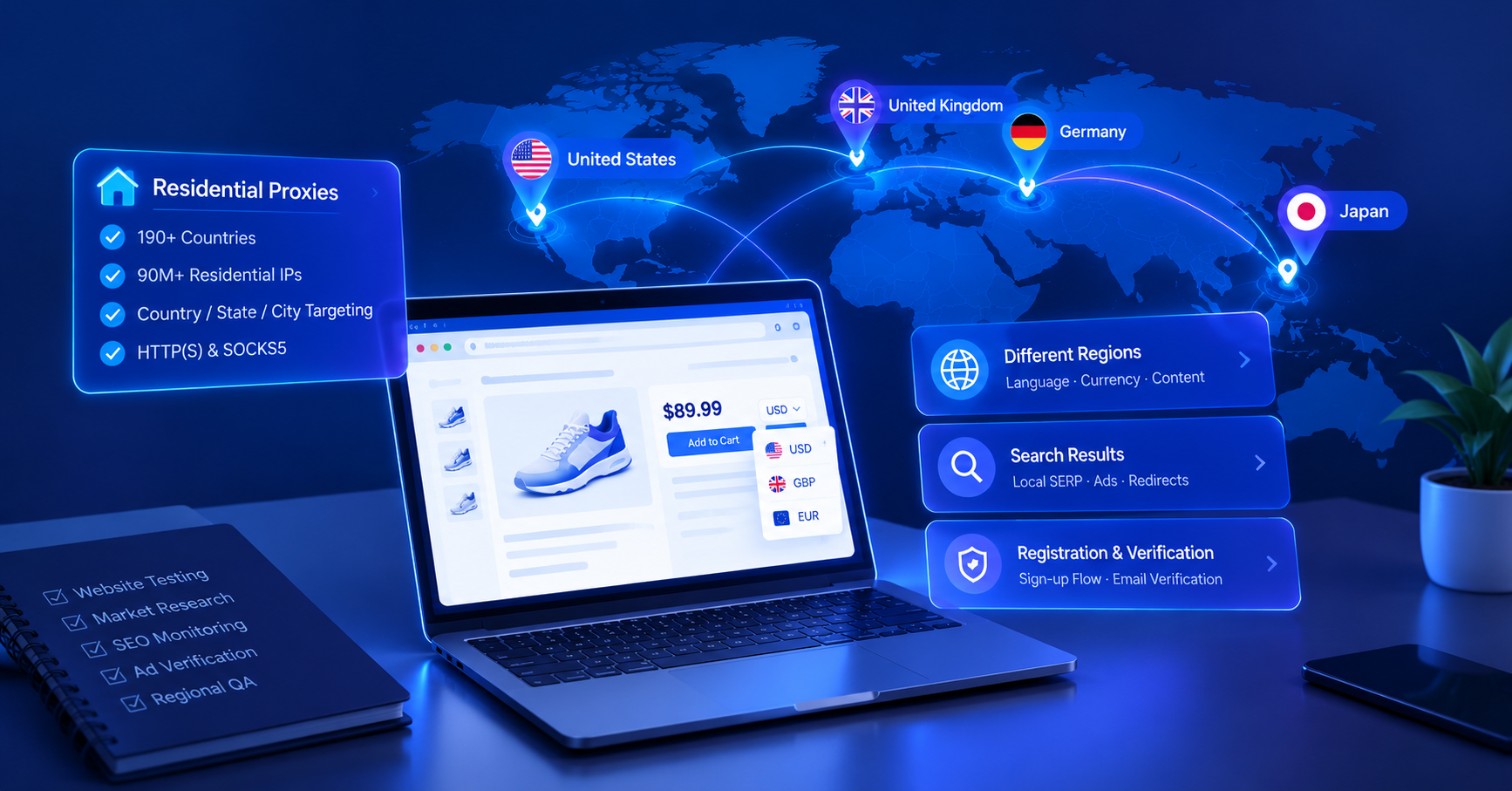
If every request comes from the same geographic location, it becomes difficult to obtain a complete picture of how the website behaves across different markets.
IPFLY residential proxies provide residential proxy resources across multiple countries and regions, with support for country, state, and city-level targeting. According to IPFLY's official information, its residential proxy network includes more than 90 million residential IPs across 190+ countries and regions, with support for HTTP(S) and SOCKS5.
For testers, this makes it possible to select a network exit that matches the target market instead of relying on a single IP environment for every test.
Country-Level Targeting Is Only the Beginning
When people first start testing international websites, they often focus only on which country to select.
However, country-level targeting may not always be enough when the testing project is geographically sensitive.
Take the United States as an example. New York, Los Angeles, and Chicago are all located in the same country, but local search results, advertising content, service availability, and regional website experiences can still vary.

If the target website provides city-specific content, testers may need to consider city-level targeting as well.
This is one of the practical advantages of residential proxies for regional testing. More precise geographic targeting can make the test environment closer to the network conditions that users in a specific location may actually experience.
At the same time, a proxy should not be treated as the only signal used by a website to determine a visitor’s location. Websites may also consider browser language, cookies, GPS information, account details, and other signals. A residential IP is therefore best viewed as an important testing variable rather than the only factor that determines geographic behavior.
How to Choose Between Rotating Residential IPs and Stable Sessions
Different testing scenarios require different IP strategies.
If your goal is to compare website experiences across multiple locations, such as the United States, United Kingdom, Germany, and Japan, rotating residential proxies can provide greater flexibility when switching between testing environments.
However, if you are testing a complete registration workflow, constantly changing the IP address may not be desirable.
The registration page, CAPTCHA, email verification, and login process may all belong to the same user session. If the network source changes unexpectedly during the workflow, the final result may be affected by additional variables.
The goal of multi-region testing is therefore not to change IPs as frequently as possible. Instead, the IP strategy should match the testing objective. Some tests require different IPs, while others require a consistent network environment throughout the session.
Static residential proxies can also be useful for testing scenarios that require a stable network environment over a longer period.
IPFLY static residential proxies provide dedicated residential IP options with support for city-level targeting and long-term use cases. For projects that require continuous observation of a website from a specific location, a fixed network environment can reduce additional variables caused by IP changes.
Building a More Complete Multi-Region Testing Environment
Suppose you need to test the registration process of a website targeting users in the United Kingdom.
The first step is to establish a UK-based network environment. After selecting a suitable UK residential proxy, you can verify the geographic location of the current exit IP to make sure that it matches the testing requirements.

You can then access the target website.
If the website automatically changes its language, currency, or page content based on location, record the initial result before moving on to the registration process.
The email environment should also remain separate.
For registration testing, you can use Boomlify temporary email to create a dedicated test mailbox. This prevents test messages from being mixed with personal emails and makes it easier to separate registration records across different testing environments.
Boomlify provides temporary email, Smart Inbox, multi-mailbox management, and API capabilities that can be used for website registration, account verification, and software testing scenarios.
Once the test mailbox has been created, use it to complete the registration process.
When the verification email arrives, do not simply confirm that the message was received. You can also check whether the verification link works correctly, whether the email content is accurate, and whether the website behaves as expected after verification.
This creates a basic but more complete regional testing environment.
A Practical Example: Testing a UK Registration Flow
Suppose a website primarily serves users in the United Kingdom and you need to verify the complete registration experience for UK users.
Start by establishing a UK residential proxy environment and confirming the geographic location associated with the exit IP.
Open the website and record the language, currency, and regional redirect behavior displayed on the page.
Next, create a dedicated test email and use it to complete the registration process.
When the verification email arrives, check whether it was delivered correctly. Open the verification link and observe whether the resulting page continues to reflect the expected UK environment.
If the website includes additional steps after registration, such as login, account initialization, or follow-up emails, those steps should also be tested.
After completing the first test, you can repeat the process using another UK city.
This allows you to compare website behavior across different city-level network environments rather than simply considering the entire UK market as one test case.
This approach can be particularly useful when testing location-sensitive content because it combines the network environment, email environment, and actual user workflow into a single testing process.
Why Session Consistency Matters During Testing
One issue that is often overlooked in multi-region testing is the accidental change of testing variables.
For example, imagine starting a registration process through a London residential IP and then switching to an IP from another city before completing email verification.
From a testing perspective, multiple variables have now changed during the same workflow.
A website may record the IP address, cookies, session information, browser parameters, and account activity. If several of these conditions change during a single test, it becomes much harder to determine whether the final result was caused by geographic differences or changes in the testing environment.
For complete registration or login workflows, it is therefore more practical to keep the same testing session as consistent as possible.
IPFLY residential proxies support Sticky Sessions, which can be useful when a testing scenario requires session continuity.
The key point is not that every test should use a fixed IP. Instead, the network environment should remain stable for as long as the specific testing objective requires.
Different Testing Objectives Require Different Proxy Strategies
If the goal is to compare website content across different countries, geographic coverage is usually the primary consideration.
If you want to observe how the same website behaves across different access sources within a market, residential IP rotation becomes more relevant.
For complete registration, login, or account verification workflows, session stability should receive greater attention.
For projects that require continuous monitoring of a specific regional environment over several days or longer, a static residential IP can be more convenient.
Testing Objective | Proxy Capability to Consider |
Compare website content across countries | Country-level residential IPs |
Compare city-level website experiences | City-level targeting |
Test multiple access sources | Residential IP rotation |
Complete a continuous registration workflow | Sticky Sessions |
Monitor a specific region over time | Static Residential / ISP Proxy |
When selecting a residential proxy solution, IP volume should therefore not be the only consideration. Geographic coverage, targeting precision, session management, and the duration of the testing project are equally important.
The Role of Test Email in the Overall Workflow
The network environment answers the question of where the request comes from, while the email environment handles registration and verification.
These two components serve different purposes.
For example, when testing registration flows across multiple countries, you can create separate test mailboxes for different environments. Each environment can then have its own registration records and verification emails without mixing test messages with personal communication.
Boomlify's Smart Inbox can help manage messages from multiple temporary mailboxes, which can be useful when several testing projects are being conducted at the same time.
For automated testing workflows, Boomlify also provides REST API capabilities that can be used to programmatically create and manage mailboxes, allowing email creation and verification to become part of a broader automated workflow.
It is important to remember, however, that a test email does not change the network location visible to the target website. Email and proxy infrastructure solve different parts of the testing problem and should not be treated as interchangeable.
What to Consider When Automating Multi-Region Testing
As a testing project expands from a few regions to dozens of locations, performing every operation manually can quickly become repetitive.
At this stage, teams can consider combining proxy selection, browser testing, email creation, and result collection into a more structured workflow.
For example, an automated test can first determine the target region, establish the corresponding residential proxy environment, create a dedicated test mailbox, complete the registration process, wait for the verification email, and then record the page and email results.
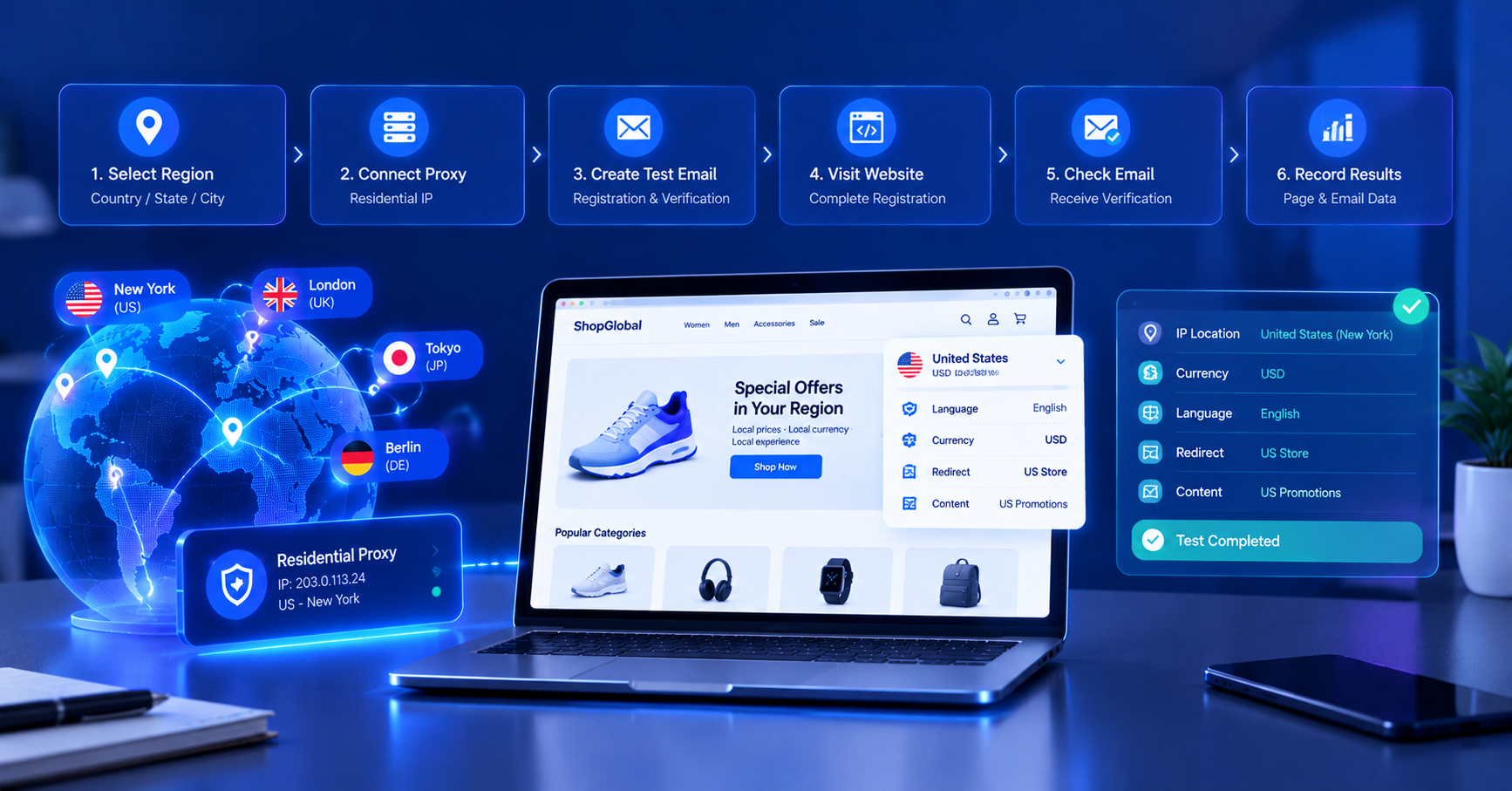
In this type of workflow, IPFLY provides the regional network environment, while Boomlify can handle the test email and email verification layer.
For development teams, this separation also makes the workflow easier to organize. The proxy layer manages network conditions, the email layer manages registration and verification messages, and the browser or automation framework performs the actual website interactions.
Common Problems That Can Affect Multi-Region Test Results
One of the most common problems is using the same IP environment for every test.
Although this approach is simple, it may not accurately represent how users in different markets experience a location-sensitive website.
Another problem is changing IPs too frequently during a single workflow. For registration or login testing, constant changes in the network environment can introduce additional variables and make the results more difficult to interpret.
Another frequently overlooked issue is testing only the registration page.
A complete registration workflow may also involve email verification, verification links, login, regional redirects, and subsequent account pages.
Confirming that registration was successful does not necessarily mean that the entire workflow is functioning correctly in the target region.
Finally, residential proxies should not be treated as the only mechanism for geographic identification. Websites may combine IP information with cookies, browser language, account details, and other signals when determining a user's location. A more reliable testing approach is therefore to control the network environment while also recording other variables that may affect the outcome.
How to Build a More Reliable Testing Process
A good multi-region testing process does not necessarily need to be complicated.
What matters most is keeping the different testing variables clearly separated.
The network environment represents the target region. The test email handles registration and verification. The browser session maintains the user's workflow. The final results can then be recorded based on page behavior, email status, and verification outcomes.
As testing expands from one region to multiple countries and cities, this approach makes it easier to determine whether an issue originates from the website itself or from the testing environment.
For teams involved in international market research, advertising verification, SEO monitoring, website QA, or regional content testing, a residential proxy should not be viewed simply as a tool for changing IP addresses. It can become a fundamental component of the overall testing environment.
Conclusion
The real challenge in multi-region website testing is not simply creating more email addresses. It is building a stable, repeatable testing environment in which key variables can be controlled.
Residential proxies provide the network layer, allowing testers to access websites from different countries and cities. Test email provides the registration and verification layer. When these two components are combined, teams can cover a much broader range of testing scenarios than they could by simply changing email addresses.
For long-term, multi-region, or large-scale testing projects, selecting the right residential proxy type, geographic location, and session strategy is often more important than simply focusing on the size of the IP pool.
Once the network and email environments are properly separated, multi-region testing can evolve from a simple manual visit into a more consistent, repeatable, and measurable testing process.
Written by
Boomlify Team
Editorial team
Reviews, teardowns and practical guides from the Boomlify editorial team.
Found this useful?